
Success in the Workplace
Building Organizational Results Through Human Development, Shared Accomplishment, and Meaningful Work
Success in the workplace means achieving organizational goals while preserving the satisfaction people feel for the work they accomplish. Sustainable success happens when organizations develop their people, align everyday behaviors with organizational goals, and create the conditions for individuals to contribute their strengths to shared results.
The TIGERS 6 Principles™ provide a behavior-based foundation for building trust, strengthening collaboration, addressing problems constructively, and developing the human capabilities that help organizations achieve results over time.
Why Organizational Results Alone Are Not Enough
Organizations must achieve their goals, manage costs, maintain quality, and remain financially sustainable. These responsibilities are essential. Yet organizational results tell only part of the story. They show what an organization has accomplished, but they do not always reveal how effectively people worked together to achieve those results—or what the process cost in lost time, frustration, and underused capability.
Behind every result are people making decisions, solving problems, coordinating work, and responding to challenges. Their ability to contribute depends partly on how work is organized, how clearly expectations are communicated, and whether people can rely on one another to follow through. When these conditions are weak, employees may spend valuable time clarifying responsibilities, correcting misunderstandings, waiting for decisions, or resolving conflicts that could have been prevented. People can work hard and remain busy without making the progress their organization needs.
These difficulties are not always visible in financial reports or performance dashboards. A department may meet its immediate targets while creating delays for another department. A manager may deliver strong individual results while discouraging employees from sharing concerns or proposing improvements. An organization may hire experienced professionals to solve problems without establishing the shared behavioral expectations needed for them to work effectively together.
Over time, these patterns can affect more than productivity. Employees may become frustrated when their skills are underused, their contributions go unrecognized, or their efforts are repeatedly disrupted by problems outside their control. They may begin to protect their own priorities rather than consider what will help the organization succeed as a whole. When capable people cannot see a meaningful connection between their efforts and organizational progress, their willingness to take initiative can diminish.
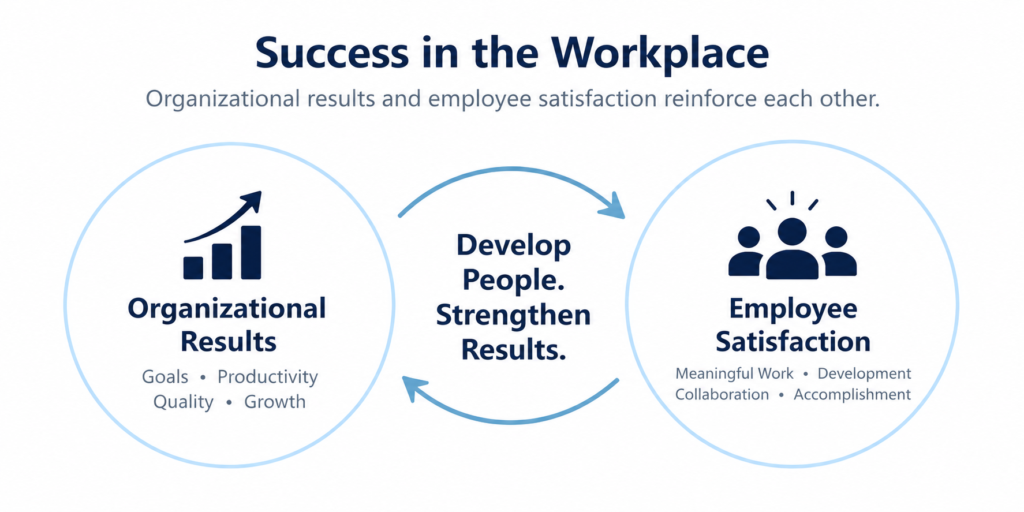
The answer is not to choose employee satisfaction over performance. Organizations need results, accountability, sound financial management, and clear standards. Employees also need work that allows them to contribute, develop their capabilities, solve problems, and understand the value of what they accomplish. These needs are not inherently in conflict. In well-designed working relationships, they can reinforce one another.
This distinction matters because success is often treated as an outcome to measure rather than a capability to develop. Organizations can track revenue, quality, customer satisfaction, and completion of goals. They can also examine the everyday behaviors that influence those outcomes. Examples include whether people communicate directly and respectfully, coordinate their complementary strengths, address problems constructively, and take responsibility for their commitments.
When leaders pay attention to both results and the behaviors that support them, they gain a fuller view of organizational performance. They can identify where people need clearer expectations, better coordination, more effective feedback, or opportunities to develop. Instead of assuming that every shortfall requires more pressure or another outside hire, they can ask whether the organization is making the best use of the people and capabilities it already has.
Sustainable success depends not only on what an organization achieves, but also on its ability to develop people who can achieve meaningful results together.
Developing Success From Within
Sustainable organizational success begins when leaders recognize that the people already working in an organization represent a significant source of untapped capability. Employees bring experience, knowledge, relationships, problem-solving skills, and perspectives that may extend well beyond their current job descriptions. Developing these capabilities allows organizations to strengthen performance, make better use of their investment in people, and help employees find greater satisfaction in their contributions.
Hiring experienced talent can bring valuable expertise, fresh perspectives, and capabilities an organization needs. But hiring is only the beginning. When onboarding consists primarily of completing paperwork, reviewing an employee handbook, and learning immediate job responsibilities, new employees may receive little guidance about the organization’s culture, behavioral expectations, or how to work effectively with the people around them.
Even highly capable professionals need to understand how decisions are made, how colleagues communicate, how disagreements are handled, and how their strengths can complement those of others. Without this understanding, people can step on personality landmines with the best of intentions. Time that could be spent solving problems, serving customers, and achieving goals is instead lost to misunderstandings, avoidable friction, and the slower process of learning how to work together.
The business opportunity is to shorten that learning curve through intentional cultural and behavioral onboarding, followed by ongoing development. Employees need more than an understanding of their immediate roles. They need opportunities to discover and develop capabilities that can contribute to the organization’s broader goals as its needs evolve.
Consider the cost of overlooking talent already in the organization. An experienced employee may understand the culture, work effectively with colleagues, and genuinely care about the company’s success, yet remain confined to a narrow job description with little opportunity to grow. Meanwhile, an external hire with impressive credentials may bring additional expertise but struggle to work constructively within the organization’s culture. If the new hire creates friction, disrupts effective working relationships, or contributes to turnover, the organization may lose productivity while incurring additional recruitment, onboarding, and replacement costs.
The wiser strategy is to develop the capabilities of proven employees while intentionally integrating new talent into the organization’s culture and behavioral expectations. This does not mean promoting people beyond their abilities or overlooking the need for outside expertise. It means recognizing the value of the talent already in hand, developing it more fully, and building the shared behavioral capabilities that allow both existing and new employees to contribute effectively.
When organizations rely heavily on individual managers to determine how work gets done, employees can encounter very different expectations across departments. One manager may encourage open discussion and shared problem-solving, while another may discourage questions or reward individual achievement above collective results. Even when everyone intends to do good work, these differences can create confusion, inconsistent practices, and unnecessary barriers to cooperation.
Developing success from within requires more than hiring capable people and hoping their strengths will translate into organizational results. It requires clear behavioral expectations, opportunities to learn, and practical ways to apply new skills to everyday work. It also requires a commitment to developing people beyond the boundaries of their current positions so that individual growth can contribute to organizational capability at scale.
Help People Understand the Bigger Picture
People are better positioned to contribute when they understand what the organization is trying to accomplish and how their work supports those goals. Appropriate transparency about organizational priorities, performance expectations, and financial realities can help employees see beyond the immediate demands of their own positions.
With that understanding, employees can make better-informed decisions, recognize the consequences of their choices, and identify opportunities to improve how work is performed. They are more likely to see cost, quality, customer experience, and coordination as connected responsibilities rather than separate concerns belonging to different departments.
This understanding must be accompanied by appropriate boundaries. Not every employee needs access to every confidential financial or strategic detail. Leaders must determine what information people need to make sound decisions and take responsibility for their work.
The objective is to develop informed contributors who understand how their efforts affect organizational success and who can recognize opportunities to improve outcomes beyond their immediate responsibilities.
Turn Individual Strengths Into Shared Capability
Developing people also means recognizing that individual strengths do not automatically produce effective teamwork. A person who excels at generating ideas may become frustrated when working with someone who wants detailed analysis before moving forward. A highly analytical employee may see a fast-moving colleague as careless, while the colleague may experience the analyst as unnecessarily critical.
Neither person necessarily lacks commitment or ability. The problem may be that their differences have not been understood or organized to support the work.
When leaders help people recognize complementary strengths, they can design responsibilities and working relationships that allow those strengths to contribute at the right time. One person may be particularly effective at developing a plan, another at engaging customers, and another at monitoring implementation and identifying needed adjustments. Success comes from coordinating these contributions toward a shared objective, not requiring everyone to think or work in the same way.
This is one reason collaboration should not be confused with consensus. People can disagree, bring different perspectives, and retain responsibility for their areas of expertise while still working toward a common goal. The essential requirement is that differences are handled constructively and that individual contributions support, rather than undermine, collective progress.
When behavioral expectations are clear, people have a better opportunity to understand one another’s working styles, address differences before they become entrenched conflicts, and coordinate their efforts. This benefits established employees as well as new hires. It also helps the organization preserve effective working relationships while expanding its capabilities.
Make Development Part of Everyday Work
Training can introduce new concepts, but lasting development depends on whether people apply what they learn. A one-time workshop cannot, by itself, establish consistent workplace behaviors. Employees and managers need opportunities to discuss real situations, practice different responses, give and receive useful feedback, and reflect on the results.
A structured approach makes this process more manageable. Short, recurring learning sessions can help teams examine one set of behaviors at a time and consider how those behaviors apply to their responsibilities. Managers and trained employee leaders can reinforce the learning through regular conversations and practical examples. Development can then become part of how people plan, communicate, resolve problems, and evaluate their contributions.
A scalable approach also recognizes that development should not stop once someone has mastered a limited set of job responsibilities. As organizational needs change, employees can continue building skills, taking on appropriate challenges, and contributing in new ways. The organization benefits by making better use of existing knowledge and experience, while employees gain opportunities for growth and more meaningful contributions.
This approach helps organizations identify specific behaviors that need attention instead of treating every performance problem as evidence that an entire person, team, or culture must be changed. Small, observable improvements can make a meaningful difference when they address the actual barriers to effective work.
Developing success from within is therefore not about asking employees to work harder or simply feel more engaged. It is about creating the conditions in which people can use their abilities more effectively, take appropriate responsibility, and contribute to results that matter.
When organizations intentionally develop existing talent, integrate new employees through cultural and behavioral understanding, and make development part of everyday work, they build internal capability, reduce avoidable friction, and create a stronger foundation for sustainable success.
Connecting Individual Growth to Organizational Goals
Developing people creates value when their growing capabilities are connected to the work the organization needs to accomplish. Individual development and organizational performance should not operate as separate initiatives. They should reinforce one another through clear goals, defined responsibilities, and behaviors that help people coordinate their efforts.
An employee may become more skilled, confident, and productive in an individual role. But if that development does not connect to the organization’s priorities, its full value may never be realized. A team may perform well within its own department while its decisions create delays or additional work elsewhere. Individual achievement matters, but sustainable organizational success depends on how individual contributions combine to produce results.
Align Individual Contributions With Shared Goals
Leaders help make this connection by explaining organizational priorities and clarifying how each role contributes to them. Employees need to understand not only what they are responsible for accomplishing, but also where their work connects with the responsibilities of others.
For example, sales growth may depend on more than the effectiveness of the sales team. It can also depend on whether operations can deliver what was promised, whether customer service can resolve problems promptly, and whether departments communicate changes before they disrupt commitments. Each group has its own responsibilities, but the customer experiences the organization as a whole.
When employees understand these connections, they can make better decisions about priorities, communicate earlier when problems arise, and consider the wider consequences of their actions. Managers can reinforce this understanding by connecting individual goals and performance expectations to the outcomes the organization needs.
Make Behavioral Expectations Part of Performance
Organizational goals describe what needs to be accomplished. Behavioral expectations help clarify how people are expected to work together to accomplish it.
A performance goal might require a team to complete a project on time and within budget. Achieving that goal may also require timely communication, dependable follow-through, constructive problem-solving, and coordination across departments. When these behaviors are left undefined, employees and managers may have different assumptions about what effective performance looks like.
Making expectations observable gives people a clearer basis for working together and receiving feedback. Instead of telling employees to collaborate better, leaders can clarify what collaboration looks like in their particular operating environment. Instead of asking people to take more ownership, they can define the behaviors that demonstrate accountability in everyday decisions and commitments.
The TIGERS 6 Principles provide a shared behavioral foundation for this work. Organizations can use the principles and their behavioral definitions to develop a common understanding of effective workplace conduct, then tailor the relevant behaviors to their own mission, operational requirements, and goals.
Reinforce Accountability Without Creating Silos
Accountability is essential to organizational success, but it can become counterproductive when people are measured only on their individual or departmental results. Employees may focus on protecting their own targets even when doing so creates problems for colleagues or compromises a larger organizational objective.
Effective accountability connects individual responsibility with shared outcomes. People remain responsible for their commitments, decisions, and performance, while also recognizing how their work affects others. Managers can reinforce this balance through performance conversations, feedback, team agreements, relevant key performance indicators, and leadership goals that recognize both results and the behaviors that support them.
This does not require every employee to be responsible for every outcome. It requires leaders to make dependencies visible, clarify who owns which decisions, and ensure that measures of success do not inadvertently reward behavior that undermines cooperation.
Turn Development Into Measurable Progress
When individual growth is connected to organizational goals, development becomes more than a training activity. Leaders can identify the capabilities and behaviors needed to improve performance, provide opportunities to practice them, and assess whether the changes are helping people work more effectively.
The process should be practical and proportionate. Not every challenge requires a major organizational change initiative. Sometimes the most useful intervention is clarifying a handoff, improving a feedback conversation, resolving a recurring misunderstanding, or helping colleagues coordinate their complementary strengths.
Over time, these improvements can be incorporated into the organization’s normal management practices. Performance evaluations, team discussions, operational measures, and leadership priorities can reinforce the behaviors that matter most to achieving the mission.
When individual development, observable behaviors, and organizational goals are aligned, people can take greater responsibility for their own contributions while helping the organization achieve results that no individual or department could accomplish alone.
The Role of Leadership in Creating Conditions for Success
Leaders influence organizational success not only through the goals they set and the decisions they make, but also through the behaviors they model, encourage, and tolerate. Their everyday actions help employees understand what the organization truly values and what it expects of people working together.
An organization may promote collaboration, accountability, and respect in its stated values, yet employees can experience something quite different in practice. If leaders reward individual achievement at the expense of shared results, discourage employees from raising concerns, or allow departments to operate by conflicting behavioral expectations, the culture people experience may not reflect the culture the organization intends to create.
This gap is not necessarily the result of bad intentions. Leaders bring different professional experiences, assumptions, communication styles, and ideas about what effective management looks like. Without a clearly defined behavioral foundation, each may develop their own approach to leading people. Across an organization, those differences can create inconsistent expectations, fragmented working relationships, and barriers to cooperation.
Define the Culture You Intend to Build
Culture is shaped by what people repeatedly do, how they respond to one another, and what their leaders reinforce. Statements about values can establish aspirations, but employees need to understand what those values look like in everyday decisions, conversations, and working relationships.
Leaders can begin by defining the behaviors that support the organization’s mission. How should people communicate when they disagree? What does accountability look like when a commitment cannot be met? How should employees raise risks, resolve problems, and coordinate work across departmental boundaries?
These questions help translate broad intentions into observable expectations. They also create a common foundation for existing employees, new hires, and managers who might otherwise interpret organizational values differently.
The goal is not to make everyone think alike or eliminate individual management styles. It is to establish shared behavioral expectations that allow people with different strengths and perspectives to work effectively together.
Model the Behaviors You Expect
Employees pay attention to what leaders do, particularly when pressure increases. A manager who asks for candid feedback but reacts defensively to criticism sends a different message from one who listens, considers the information, and responds constructively. A leader who speaks about accountability but excuses missed commitments without addressing their impact creates uncertainty about what accountability actually means.
Consistency matters because employees learn from repeated experience. When leaders demonstrate the behaviors they expect, acknowledge their own mistakes, and address problems directly and respectfully, they help make those behaviors credible.
This does not mean leaders must be perfect. It means they must be willing to recognize the impact of their actions, learn from experience, and take responsibility for reinforcing the standards they ask others to meet.
Address Problems Before They Become Patterns
Workplace friction is inevitable. People have different priorities, interpretations, communication styles, and approaches to solving problems. The important distinction is whether the organization has the behavioral understanding and practical skills needed to address differences before they become entrenched conflict.
When concerns are ignored, misunderstandings can become assumptions about another person’s motives. Departments may begin protecting their own interests, and employees may hesitate to raise problems because they do not expect a constructive response. Over time, these patterns can interfere with trust, communication, and execution.
Leaders can interrupt this progression by encouraging respectful, forthright conversations, clarifying responsibilities, and helping people focus on the issue that needs to be resolved rather than assigning blame. They can also use feedback and development conversations to address specific behaviors instead of treating every disagreement as a personality problem.
The earlier these patterns are recognized, the more opportunity there is to resolve them without allowing avoidable friction to become part of the organization’s normal way of operating.
Build Leadership Consistency Without Depending on One Leader
An organization’s culture cannot depend entirely on the personality, preferences, or presence of a single leader. Leadership transitions, growth, restructuring, and new hires all introduce changes. If the intended culture exists only in the minds of a few individuals, it can weaken as people move into new roles or departments develop their own practices.
A shared behavioral foundation helps make the culture more consistent and transferable. Leaders can use common definitions and expectations in onboarding, team discussions, feedback, performance evaluations, and development planning. Employees then have a clearer understanding of what effective working relationships look like, even when their managers have different personal styles.
The TIGERS 6 Principles provide a framework for establishing that foundation. The principles help organizations focus on the behaviors that support effective collaboration and goal achievement, while allowing each organization to determine how those behaviors apply to its own mission and operations.
Leadership creates the conditions for success when it makes expectations clear, models the behaviors, and integrates them into how work is managed. This turns culture from something left largely to chance into something leaders can intentionally develop and reinforce.
Sustainable success becomes more achievable when leaders share responsibility for developing the culture and behavioral capabilities that allow people to perform well together.
Recognizing the Behaviors That Build Success
Organizational success is influenced by more than individual talent, strategic plans, or financial resources. It also depends on the behaviors people use to communicate, coordinate work, address problems, and fulfill their responsibilities. These behaviors shape the quality of working relationships and influence how effectively people turn organizational goals into results.
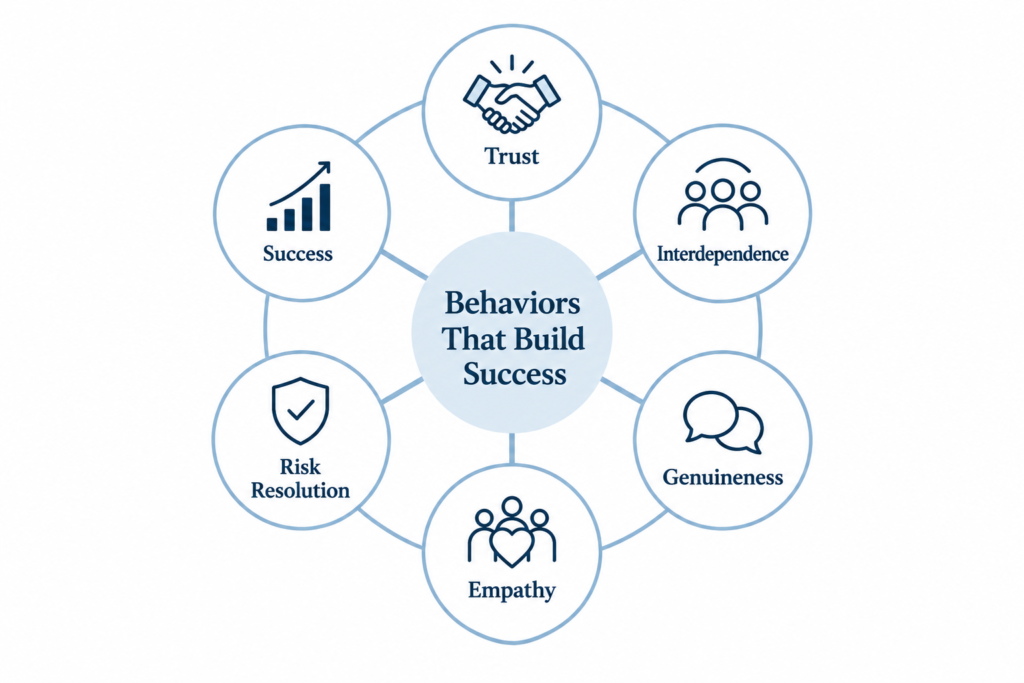
The TIGERS 6 Principles™ provide a shared foundation for understanding and developing these behaviors: Trust, Interdependence, Genuineness, Empathy, Risk Resolution, and Success. Each principle addresses a different dimension of effective working relationships, yet their greatest value comes from how they work together.
Trust: Building Dependable Working Relationships
Trust helps people rely on one another’s commitments, judgment, and follow-through. When employees and leaders behave consistently and competently, colleagues can spend less time second-guessing intentions or checking whether responsibilities will be met. This creates a stronger foundation for communication, delegation, and coordinated execution.
Trust does not mean avoiding difficult conversations or assuming that every decision is correct. It means building working relationships in which people can raise concerns, address mistakes, and resolve problems without unnecessarily undermining one another.
Interdependence: Coordinating Complementary Strengths
Interdependence recognizes that organizational goals often require people to contribute different skills, knowledge, and perspectives. Effective collaboration depends on understanding how those contributions connect and coordinating them toward shared outcomes.
When people recognize their interdependence, they can move beyond protecting individual or departmental priorities and consider how their decisions affect the wider organization. They remain accountable for their own responsibilities while recognizing that their success is often connected to the success of others.
Genuineness: Communicating Respectfully and Directly
Genuineness means being respectfully sincere, frank, and forthright in communication. It allows people to raise concerns, share information, clarify expectations, and discuss difficult issues before misunderstandings become larger problems.
Organizations benefit when employees can speak honestly without resorting to personal attacks or withholding information to avoid discomfort. Respectful candor helps people address the actual issue, make better-informed decisions, and move forward with greater clarity.
Empathy: Understanding Other Perspectives
Empathy helps people recognize how others may experience a situation, interpret information, or respond to a challenge. It does not require agreement with every viewpoint. Rather, it creates an opportunity to understand differences before deciding how to respond.
In the workplace, empathy can help colleagues interpret one another more accurately, consider the impact of decisions, and work through differences without assuming that another person’s approach reflects bad intentions. This understanding can make complementary strengths easier to coordinate and disagreements more productive.
Risk Resolution: Addressing Problems Constructively
Risk Resolution supports the ability to identify concerns, discuss potential consequences, and work toward solutions. Organizational success depends on people being willing to surface problems early rather than allowing uncertainty, mistakes, or unresolved disagreements to interfere with execution.
When employees can raise concerns and participate in constructive problem-solving, leaders have a better opportunity to address issues before they grow more costly or disruptive. Risk Resolution is not about eliminating all uncertainty. It is about developing the behaviors needed to recognize and work through risks responsibly.
Success: Balancing Goal Achievement With Satisfaction
Success means achieving goals in balance with the satisfaction people feel for the work they accomplish. It connects organizational performance with the human experience of contributing meaningfully, developing capabilities, and seeing the results of one’s efforts.
This principle reinforces the purpose of the other five. Trust, Interdependence, Genuineness, Empathy, and Risk Resolution help establish the conditions in which people can work together effectively. Success brings attention to what those behaviors help people accomplish—and whether the work provides a meaningful sense of contribution alongside organizational results.
Develop the Principles as an Interconnected System
The six principles are not separate boxes to check or personality traits to assign to employees. They provide a common behavioral foundation that organizations can use to understand working relationships, identify opportunities for development, and strengthen how people work together.
A team may trust one another but still struggle if members do not coordinate their complementary strengths. Employees may communicate frankly but fail to resolve problems if they cannot consider other perspectives. A group may be capable of meeting its targets yet create unnecessary frustration if the way it works together leaves people unable to contribute effectively.
The principles become more useful when organizations consider how they reinforce one another in real workplace situations. Leaders can then identify the specific behaviors that need attention, help employees practice more effective responses, and connect development to the work the organization needs to accomplish.
The TIGERS 6 Principles offer a shared language for this process. They help organizations move beyond general calls to improve teamwork and toward a clearer understanding of the behaviors that support dependable relationships, effective collaboration, constructive problem-solving, and meaningful results.
When the six principles are understood and practiced together, they help organizations develop the behavioral capabilities people need to achieve goals and find greater satisfaction in their contributions.
Measuring Success Through Results and Human Satisfaction
Organizational success is often measured through financial performance, productivity, quality, customer satisfaction, and progress toward strategic goals. These measures are essential. They help leaders understand whether the organization is achieving what it set out to accomplish.
However, results alone do not always reveal how effectively people are working together or whether the organization is developing the capabilities needed to sustain those results.
A company may meet its quarterly targets while employees struggle with unclear expectations, delayed decisions, preventable conflict, or poor coordination between departments. These problems may not immediately appear on a financial report, but they can affect the organization’s ability to perform consistently over time.
A more complete understanding of success considers both organizational results and the satisfaction people experience through meaningful accomplishment.
Measure What the Organization Achieves
Leaders need clear measures of organizational performance. Depending on the organization’s mission, these may include revenue, profitability, operating costs, product or service quality, customer retention, productivity, safety, and progress toward strategic objectives.
These measures establish whether the organization is achieving its goals. They also help leaders identify where performance needs to improve.
The next question is what behaviors and working conditions are helping or hindering those results.
Recognize the Human Conditions Behind Performance
The way people communicate, coordinate responsibilities, resolve problems, and hold themselves accountable influences how work gets done.
When employees understand expectations, can raise concerns constructively, and know how their contributions affect shared goals, they are better positioned to take responsibility and solve problems before they become larger disruptions.
Leaders can examine these conditions through employee feedback, behavioral assessments, performance conversations, and observations of how work moves between individuals and departments.
The purpose is not to measure people’s personalities or label employees as problems. It is to identify specific behaviors that can be strengthened to improve working relationships and organizational performance.
Connect Employee Development to Business Results
Measurement becomes more useful when it leads to action.
If projects repeatedly stall at departmental handoffs, the organization may need clearer responsibilities and stronger coordination. If employees hesitate to raise concerns, leaders may need to strengthen trust and create more constructive ways to address problems. If capable employees are underused, development opportunities may help the organization draw on skills it already has.
These responses connect employee development to identifiable organizational needs. They also allow leaders to evaluate whether changes in behavior are improving execution, reducing avoidable delays, or helping teams meet their goals more consistently.
The TIGERS Workforce Behavioral Profile™ can help identify behavioral strengths and opportunities for development across the six TIGERS principles. Those findings can inform focused development rather than assuming that an entire team, department, or culture must be changed at once.
Keep Organizational Results and Human Satisfaction in View
Employee satisfaction is not a substitute for accountability, financial performance, or meeting customer needs. Nor does achieving a business target automatically mean that people have experienced their work as meaningful or satisfying.
The two dimensions need to be considered together.
When people can use their strengths, understand the importance of their contributions, work constructively with others, and see progress toward shared goals, the experience of accomplishing work can become more satisfying. When organizations also achieve their objectives, they strengthen the conditions for continued investment in people and future performance.
Measuring both dimensions helps leaders look beyond short-term outcomes to consider whether they are building the human and organizational capabilities needed for sustainable success.
Developing Success as an Organizational Capability
Sustainable success does not happen through a single training session, a new performance initiative, or a change in leadership. It develops when organizations make people development and effective workplace behaviors part of how work gets done.
Organizations already have systems for managing finances, measuring performance, setting goals, and evaluating results. Developing success as an organizational capability means connecting those systems to the behaviors people need to work together effectively.
The objective is not to add unnecessary complexity. It is to establish clear behavioral expectations, help people practice them, and reinforce them through everyday management and organizational processes.
Establish a Shared Behavioral Foundation
People cannot consistently meet expectations they do not understand. Organizations need to translate their mission, values, and performance goals into observable workplace behaviors.
The TIGERS 6 Principles provide a shared foundation: Trust, Interdependence, Genuineness, Empathy, Risk Resolution, and Success. They give leaders and employees a common language for discussing how people communicate, coordinate work, address problems, and contribute to shared outcomes.
The principles are a starting point, not a substitute for understanding the organization’s specific needs. Through the Team Synergy Accelerator, organizations can identify and customize behaviors that support their mission, operating requirements, and strategic goals.
This creates a clearer connection between what the organization intends to accomplish and how people are expected to work together to accomplish it.
Make Development Part of Everyday Operations
Training is more likely to influence workplace behavior when learning continues beyond the initial session.
The TIGERS learning approach uses short, recurring micro-trainings that encourage employees and managers to discuss the principles, consider how they apply to real work situations, and identify behaviors they can strengthen. Managers and trained employee leaders can help reinforce this learning through ongoing conversations and practice.
Transformational Feedback supports the process by helping people address performance concerns while identifying opportunities for development. Rather than treating every difficulty as a major personnel or cultural problem, leaders can focus on the specific behavior that needs attention.
Over time, development becomes part of the work itself. People learn to communicate more effectively, coordinate responsibilities, resolve problems constructively, and take greater responsibility for their contributions.
Integrate Behavioral Expectations Into Organizational Systems
For development to become sustainable, it must extend beyond individual commitment.
Organizations can incorporate agreed-upon behaviors into onboarding, performance evaluations, team agreements, leadership development, key performance indicators, and annual leadership goals. This helps make behavioral expectations consistent across departments rather than dependent on the preferences of individual managers.
The TIGERS Workforce Behavioral Profile™ can help identify strengths and development opportunities across the six principles. Organizations can use those findings to guide targeted learning and determine where further attention may be useful.
The aim is to connect behavioral development to the systems already used to manage the organization. People understand what is expected, leaders reinforce those expectations, and progress can be examined alongside operational results.
Build Capability That Grows With the Organization
As organizations grow, their people, responsibilities, and operating demands change. New employees arrive, experienced employees take on broader responsibilities, and teams must adapt to new priorities and technologies.
A shared behavioral foundation helps organizations maintain consistency while adapting to these changes. It gives people a way to work through differences, address emerging problems, and coordinate their efforts without requiring every decision or relationship to depend on a single leader.
Success then becomes more than an outcome achieved in a particular quarter or year. It becomes an organizational capability: the ability to develop people, align behavior with goals, learn from experience, and improve how work gets done.
Success Is Built Through People
Organizations do not have to choose between achieving business goals and developing people. The two can reinforce one another when leaders intentionally connect human development, workplace behaviors, and organizational priorities.
The TIGERS 6 Principles offer a behavior-based foundation for building that connection. Through shared behavioral expectations, ongoing learning, constructive feedback, and integration into everyday management systems, organizations can strengthen the conditions that support both meaningful work and measurable results.
The opportunity is to move beyond treating success as something to pursue only through targets and performance pressure. Organizations can develop the people and working relationships that make those targets more achievable and sustainable.
Explore the TIGERS 6 Principles and learn how a behavior-based approach can help your organization strengthen collaboration, develop people, and achieve meaningful results.