
The Manager Alignment Gap
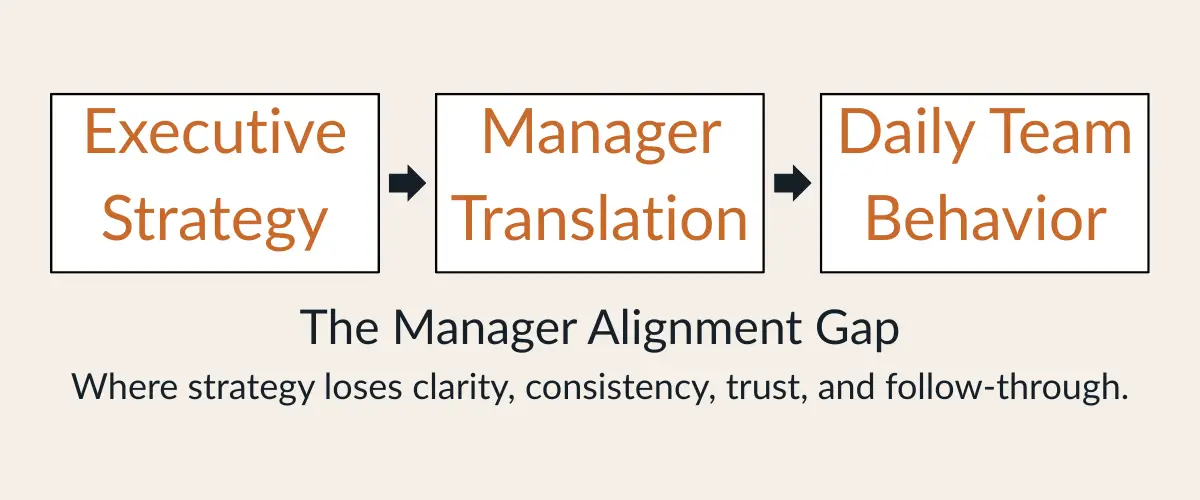
The manager alignment gap is the hidden breakdown between executive intent and daily team behavior. It happens when leadership priorities are not translated consistently by managers into clear expectations, trusted communication, team agreements, accountability, and follow-through.
What Is the Manager Alignment Gap?
The manager alignment gap occurs when executive strategy does not become consistent manager behavior.
It is not simply a communication problem. It is a translation problem. Senior leaders may know the direction, the priorities, and the reasons behind the decision. But employees experience that strategy through their direct managers, not through the executive meeting where the strategy was created.
When managers are not given enough context, coaching, behavioral expectations, or practical tools, each manager is left to interpret the message alone. One manager may over-communicate. Another may avoid the hard conversation. One manager may define accountability clearly. Another may let expectations drift. One team receives clarity while another receives confusion.
Employees notice these differences quickly.
The manager alignment gap becomes costly because it weakens trust, slows execution, and causes people to spend more energy interpreting the work than doing the work.
Why Strategy Breaks Before It Reaches the Team
Strategy often breaks before it reaches the team because executives and managers are not always working from the same level of context.
Senior leaders may spend weeks or months discussing a new direction. They understand the tradeoffs, risks, pressures, and reasons behind the decision. By the time the strategy is announced, it may feel clear to them because they have already worked through the complexity.
Managers often receive the same strategy much later, with less context and more pressure to act quickly.
That is where middle manager alignment becomes essential. Managers are the people expected to translate executive intent into priorities, team conversations, decisions, coaching, accountability, and follow-through. When they are not aligned, the strategy becomes inconsistent before employees ever have a chance to execute it.
One manager may emphasize speed. Another may emphasize caution. One team may hear that collaboration is the priority. Another may hear that hitting the deadline matters most. One manager may encourage questions. Another may shut them down because they feel uncertain themselves.
The result is not always obvious at first. Work continues. People stay busy. Meetings happen. Projects move. But underneath the activity, teams begin making different assumptions about what matters most.
That is how strategy becomes expensive.
The issue is not that employees are unwilling to support the direction. The issue is that the direction has not been translated into consistent daily behavior managers can reinforce and employees can trust.
The Three Places Manager Alignment Breaks Down
The manager alignment gap usually shows up in three places: priorities, ownership, and behavior.
The first is the priorities gap. This happens when leadership goals are not translated into clear, sequenced team priorities. Everything sounds important. Multiple initiatives quietly become the “top priority.” Managers make local tradeoffs to keep their teams moving, but those tradeoffs may not match what other managers are doing across the organization.
The result is friction, rework, and exhaustion. Employees are busy, but they are not always coordinated.
The second is the role and ownership gap. This happens when people are unclear about who owns what. Responsibility overlaps. Decisions stall. Work gets duplicated. Problems fall between functions because everyone assumes someone else is handling them.
Managers may try to solve these issues inside their own teams, but if the ownership gap crosses departments, local fixes are not enough. The organization needs clearer agreements.
The third is the behavioral gap. This is often the most damaging gap because it directly affects trust and culture.
Managers may agree with the strategy in principle but lead it differently in practice. One manager gives direct feedback. Another avoids feedback. One manager invites questions. Another shuts them down. One manager defines accountability as learning and follow-through. Another uses accountability as blame.
Employees experience these differences as inconsistency and unfairness. Over time, that weakens trust and makes execution harder.
The Trust Cost of Manager Misalignment
When managers are not aligned, employees do not simply experience a strategy problem. They experience a trust problem.
Employees judge leadership by what they see and hear every day. They notice whether expectations are clear, whether managers follow through, whether difficult questions are answered honestly, and whether accountability is handled consistently from one team to another.
When one manager communicates clearly and another stays vague, trust weakens. When one team is invited into honest discussion and another is told only what to do, trust weakens. When one manager treats feedback as learning and another treats feedback as blame, trust weakens.
Over time, employees begin to protect themselves. They ask fewer questions. They share fewer ideas. They avoid risk. They stop raising concerns early because they are not sure how those concerns will be received.
This is where the manager alignment gap becomes expensive. The organization may still see activity, but it loses candor, commitment, and coordinated follow-through.
During change, this cost grows even larger. Whether the organization is adopting AI, restructuring roles, reducing layers, improving accountability, or shifting strategy, employees look to managers for meaning. If managers are not prepared to communicate consistently and lead with trust, uncertainty spreads faster than execution.
Why Middle Managers Need More Than Talking Points
Talking points help managers repeat the message. They do not help managers lead what happens after the message lands.
That is where many organizations underestimate the manager alignment gap. Employees do not stop at the announcement. They ask what the change means for their work, their priorities, their team, their workload, and their future. They watch whether managers answer honestly, listen well, and follow through consistently.
Managers need more than a script. They need context, coaching, authority, and a behavior-based way to guide the team through uncertainty.
Without that support, managers are left to improvise. Some will communicate clearly. Others will avoid difficult conversations. Some will invite questions. Others will shut them down. Some will reinforce team agreements. Others will let old patterns continue.
That inconsistency is what employees experience as weak leadership.
To close the manager alignment gap, managers need a shared framework for trust, accountability, feedback, conflict resolution, and follow-through. They need to know what behaviors to strengthen, what behaviors to reduce, and what behaviors must stop because they damage trust and performance.
This is where leadership alignment training becomes practical. It gives managers more than language. It gives them a structure for turning strategy into daily behavior employees can understand and trust.
How TIGERS 6 Principles Closes the Manager Alignment Gap
TIGERS 6 Principles closes the manager alignment gap by giving leaders, managers, and teams a shared language for daily behavior.
The six principles are Trust, Interdependence, Genuineness, Empathy, Risk Resolution, and Success. Together, they help managers translate strategy into the behaviors people can actually see, practice, discuss, and improve.
This matters because most organizations already use words like trust, accountability, collaboration, communication, and culture. The problem is that these words often mean different things to different managers.
One manager may think trust means giving people freedom. Another may think trust means checking work closely. One manager may think accountability means consequences. Another may think accountability means clear agreements and follow-through. One manager may think empathy means being supportive. Another may avoid empathy because they fear it will weaken performance.
Without a behavior-based structure, these differences create inconsistent leadership experiences across teams.
TIGERS 6 Principles gives managers a practical way to define what trust, interdependence, genuineness, empathy, risk resolution, and success look like in real work. It helps teams identify which behaviors strengthen performance, which behaviors damage trust, and which agreements are needed so strategy becomes daily practice.
This is why TIGERS is more than a training topic. It is a behavior-based leadership architecture for improving trust, feedback, accountability, collaboration, and follow-through.
What Leaders Can Do Next
Closing the manager alignment gap begins by recognizing that communication and alignment are not the same thing.
A message can be clear at the executive level and still become confusing by the time it reaches employees. Leaders need to know whether managers are prepared to translate strategy into daily behavior, not merely repeat the announcement.
Start by asking practical questions.
Do managers understand the strategy well enough to explain it simply?
Do they know which priorities matter most?
Do they know what teams should stop, start, or continue?
Do they have a shared language for trust, accountability, feedback, and follow-through?
Do they know how to surface employee concerns before those concerns become resistance?
Do teams have behavioral agreements that support the strategy?
When the answer is no, the organization does not only have a communication problem. It has an alignment architecture problem.
TIGERS 6 Principles helps leaders address this by giving managers and teams a practical way to turn trust, accountability, feedback, collaboration, and follow-through into daily workplace behavior. This is how strategy becomes visible, consistent, and easier for employees to trust.
Close the Manager Alignment Gap
When executive strategy does not become consistent manager behavior, teams lose clarity, trust, and momentum.
The Manager Alignment Gap is quiet, but it is not invisible. You can see it in rework, competing priorities, uneven accountability, manager burnout, low trust, and employee disengagement.
The good news is that once leaders can see the gap, they can begin to close it.
TIGERS 6 Principles helps leaders and managers turn trust, accountability, feedback, collaboration, and follow-through into daily workplace behavior. This gives teams a clearer way to understand expectations, resolve risk, strengthen agreements, and move strategy from intention to execution.
Download the Manager Alignment Gap Resource
Explore TIGERS 6 Principles Leadership Architecture.
Related TIGERS Resources
The Manager Alignment Gap connects to several related TIGERS 6 Principles topics, including middle manager alignment, AI-driven workplace disruption, leadership architecture, and behavior-based team change.
Middle Manager Alignment and Why Strategy Breaks
Use this when you want a deeper look at how strategy fails when managers are not equipped to translate executive priorities into daily team behavior.
What AI Layoffs Reveal About Trust, Morale, and Manager Alignment
Use this when AI, restructuring, or workforce uncertainty is exposing trust, morale, and communication gaps.
Leadership Alignment Training for Better Culture and Execution
Use this when leaders and managers need a practical way to create more consistent expectations, communication, and follow-through.
Behavior-Based Team Change for Consultants and Trainers
Use this when consultants, facilitators, HR leaders, and trainers need a system for moving teams from insight to measurable workplace behavior.
Leadership Architecture and How AI Exposes the Manager Alignment Gap
Use this when you want to understand how leadership architecture helps close the gap between executive intent and manager behavior.