
Empathy in the Workplace
Understanding differences and another perspective without requiring agreement
Empathy in the workplace begins with a deceptively simple practice. The practice is seeking to understand another person’s perspective, whether we agree or not. That definition matters because people do not enter a workplace as identical minds. Each person brings a history, assumptions, values, experiences, and ways of interpreting events. Those differences affect how people communicate, make decisions, solve problems, and respond when something goes wrong.
Empathy does not require us to adopt another person’s view, approve of harmful behavior, or set aside our own judgment permanently. It asks us to pause premature judgment long enough to understand what another person sees, believes, or is responding to. Understanding gives us better information. What we do with that information determines whether it becomes useful in relationships and in work.
Within the TIGERS 6 Principles™, empathy is not an isolated interpersonal skill. It works alongside Trust, Interdependence, Genuineness, Risk Resolution, and Success to help people work with differences instead of pretending those differences do not exist. The aim is not to make people think alike. It is to help them contribute distinct perspectives to shared work—and to learn when those perspectives challenge what they themselves believe.
Empathy Is Not Sympathy or Emotional Overinvolvement
Empathy and sympathy are related, but they are not the same. Sympathy often communicates care or sorrow about another person’s experience. An example is, “I’m sorry that happened.” Empathy goes further by seeking to understand the experience from that person’s perspective. We can care about someone without assuming we know exactly how they feel.
Nor does empathy require us to absorb another person’s emotions. A colleague may be angry, anxious, grieving, or overwhelmed. We can acknowledge the emotion, ask what is happening, and seek to understand the concern without becoming overwhelmed ourselves or taking responsibility for feeling exactly what the other person feels. Emotional resonance is a normal human response. Difficulty arises when emotional overinvolvement interferes with clear thinking, appropriate boundaries, or the ability to help constructively.
This distinction matters in workplaces where people regularly encounter distress, disagreement, and high-stakes decisions. Caring does not mean losing perspective. Understanding does not mean agreeing. Maintaining professional boundaries does not mean being indifferent. Empathy allows people to remain present, curious, and respectful while still using judgment and taking appropriate action.
Empathy also has limits. Understanding why someone holds a belief does not make the belief accurate or acceptable. A person can listen carefully and still challenge discrimination, misinformation, disrespect, or unsafe conduct. The purpose of understanding is not to excuse every behavior. It is to respond with a clearer view of what is happening and what needs to change.
Why Empathy Matters to Workplace Performance
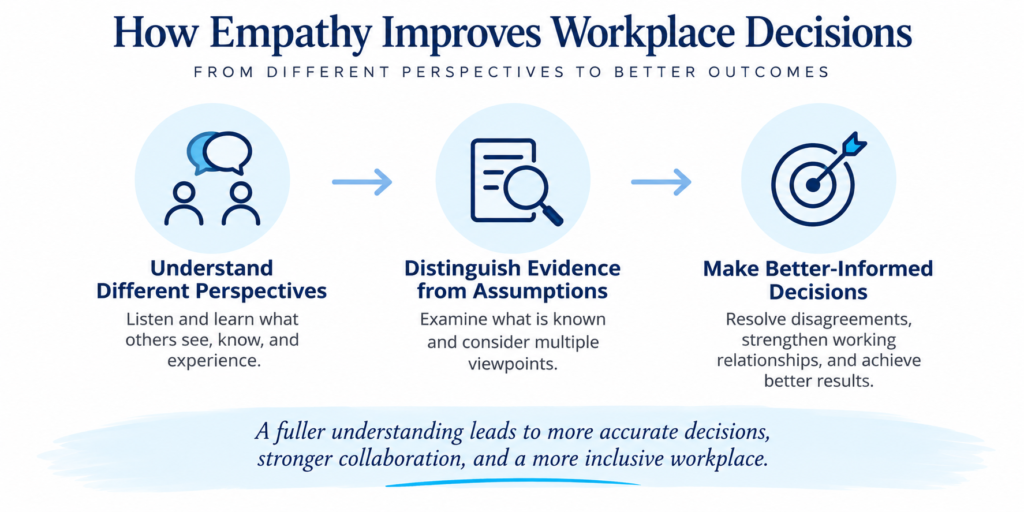
Work depends on people interpreting information together. Teams must surface concerns, compare evidence, resolve competing priorities, and make decisions with incomplete information. When people assume they already know what another person means, they can mistake a question for resistance, a different communication style for disrespect, or a warning for negativity. Those assumptions can distort the problem the group is trying to solve.
Empathy improves the quality of information available to a team. Asking what someone has observed, what they are concerned about, or what assumptions they are using can reveal missing context. A disagreement about a proposed solution may turn out to be a disagreement about the problem itself. What looks like unwillingness may reflect a risk the rest of the group has not considered.
Empathy is especially important when people have different roles, levels of authority, professional training, cultural experiences, or access to information. Leaders rarely see the whole system from one position. People closer to a process may notice consequences that decisionmakers cannot see from a distance. Seeking those perspectives is not simply considerate. It can make decisions more informed.
Empathy does not guarantee agreement or eliminate tension. Its contribution is practical. It helps people understand what they are disagreeing about, distinguish evidence from assumption, and respond to one another with greater accuracy. Those behaviors can support better problem-solving, stronger working relationships, and more responsible decisions.
The Behaviors That Build Empathy
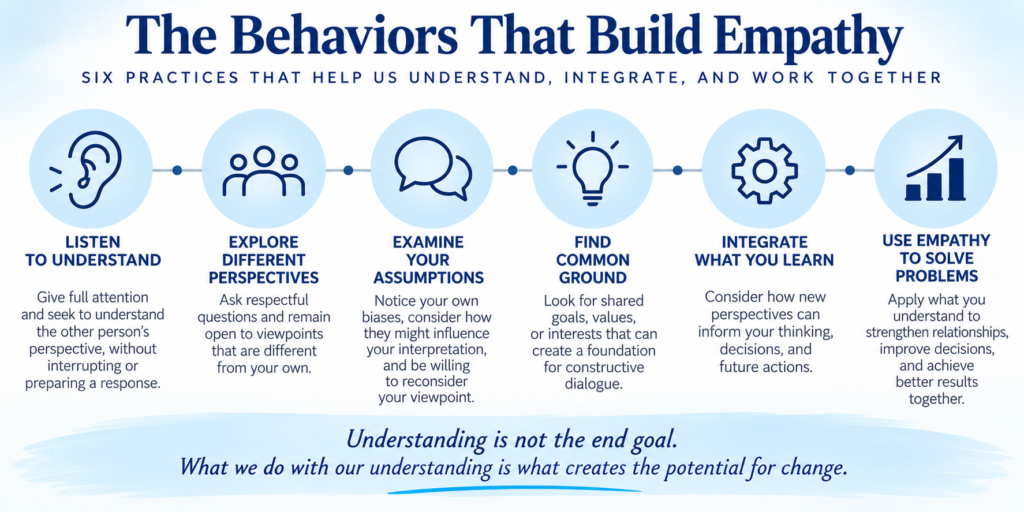
Empathy becomes useful in organizations when people can observe it in action. Good intentions alone are difficult for colleagues to rely on. Behaviors provide something people can practice, discuss, and improve.
Six behaviors can help make empathy visible:
Listen to understand.Give the other person room to explain their perspective before preparing your response.
Ask before assuming. Use open questions to learn what the person means, knows, or is concerned about.
Pause premature judgment. Notice the conclusion forming in your mind and test it before treating it as fact.
Explore the other perspective. Consider what the situation looks like from the other person’s role, experience, or responsibilities.
Acknowledge without absorbing. Recognize a concern or emotion without claiming to feel exactly the same or taking ownership of it.
Separate understanding from agreement. Explain another person’s position accurately while retaining your own judgment.
These observable behaviors are not a substitute for official TIGERS definitions or validated assessment language. Their value is that they make empathy discussable. A team can ask whether people practice them, what gets in the way, and what would make them easier to use.
How Leaders Practice Empathy Without Losing Perspective
Leaders influence whether people believe it is safe and worthwhile to share a unique perspective. A leader who interrupts, labels disagreement as disloyalty, or reacts defensively teaches people to withhold information. They also impact the Genuineness of others by modeling non-genuine behavior. A leader who asks questions, reflects what they heard, and responds thoughtfully makes it easier for the group to examine the issue.
Practicing empathy does not mean a leader must accept every request or delay every decision until everyone agrees. Leaders still have responsibilities, constraints, and decisions to make. They can listen seriously, explain the reasoning behind a decision, and be clear about which concerns changed the decision and which did not.
A useful practice is to distinguish three questions: What is this person experiencing or observing? What does that tell us about the situation? What response is appropriate? The first question seeks understanding. The second evaluates information. The third requires judgment and action. Keeping these questions distinct helps prevent both dismissiveness and emotional overinvolvement.
Leaders also need to examine their own assumptions. Empathy is not only a technique for understanding other people. It can reveal the limits of our own perspective. A leader may discover that a policy that appears fair from one position creates a barrier from another, or that a colleague’s objection identifies a risk the team has overlooked. Being willing to learn is a form of leadership strength, not a loss of authority.
Empathy in Difficult Conversations and Decision-Making
Difficult conversations often become unproductive when people move too quickly from difference to judgment. One person describes an action. Another hears an accusation. Someone raises a risk. A colleague interprets it as obstruction. The conversation shifts from understanding the issue to defending identity, competence, or intent.
Empathy can interrupt that pattern. A person might ask, “What are you seeing that leads you to that conclusion?” or “What is the concern you most want us to understand?” They can then summarize the answer and invite correction, such as, “Have I understood you accurately?” This does not settle the disagreement. It establishes a more reliable starting point for working through it.
The same discipline improves decision-making. Before choosing a solution, a group can identify whose perspective is represented, what information is missing, which assumptions are viewed as facts, and who may experience consequences the decision-makers have not considered. The group can then debate the merits of the options without reducing people to the positions they initially take.
Conflict is not inherently good or bad. Differences are part of human relationships and collective work. Conflict can expose assumptions, reveal risk, and create an opening for learning. It can also lead to defensiveness or harm. The outcome depends in part on how people engage with the difference, whether they seek understanding, and what they do with what they learn.
A productive conversation does not require everyone to leave with the same opinion. It requires enough understanding to make a considered decision, explain the reasoning, and continue working together where possible. Sometimes empathy changes the decision. Sometimes it changes how people disagree. Sometimes it reveals that a boundary or a firm intervention is necessary.
The Cost of Misunderstanding Empathy
When empathy is confused with agreement, people may avoid it because they fear it will weaken their position. When it is confused with sympathy, they may offer reassurance without understanding the actual concern. When it is confused with emotional absorption, they may believe they must carry another person’s distress to prove that they care.
Each misunderstanding can limit effectiveness. Premature judgment can close off information. Unexamined agreement can leave important risks unchallenged. Emotional overinvolvement can make it harder to maintain boundaries and think clearly. In demanding workplaces, sustained emotional strain can contribute to exhaustion, although burnout has multiple causes and should not be attributed to empathy alone.
A further cost appears when a group treats disagreement as a threat to harmony. People may remain polite while important concerns go unspoken. The absence of open conflict is not proof that people understand one another or that a decision has been adequately examined. Sometimes the group needs more honest difference, not less.
The aim is not endless discussion or conflict for its own sake. It is to make enough room for meaningful differences to be understood and integrated into the work. Empathy helps a group avoid confusing comfort with understanding and agreement with effective collaboration.
How Empathy Connects to the Other Five TIGERS Principles
Empathy works in relationship with the other TIGERS principles. Trust supports the willingness to share a concern or admit uncertainty. Genuineness makes communication respectfully sincere, frank, and forthright, so the group can consider what people actually think and observe. Interdependence recognizes that no one person holds every perspective or has every capability needed for shared success.
Risk Resolution helps people address uncertainty, competing interpretations, and potential consequences instead of avoiding difficult issues. Success directs the group toward the outcomes it is trying to achieve together. Empathy contributes by helping people understand how others see the situation and what their perspectives may reveal about the path forward.
These principles are mutually reinforced. Genuineness without empathy can become bluntness that dismisses the impact on others. Empathy without genuineness can become an effort to preserve comfort by withholding the truth. Interdependence without either can become coordination without real contribution. When the principles are practiced together within the framework of their unique mission, people can bring distinct perspectives into a shared process and work through the differences those perspectives create.
This is particularly important in group processes such as conflict resolution, decision-making, and problem-solving. The group needs people to be genuine enough to surface what matters, empathetic enough to understand different views, and interdependent enough to integrate those views into work that no individual could accomplish as effectively alone.
Turning Empathy into an Organizational Capability
An organization cannot rely on a general instruction to “be more empathetic” and expect consistent results. It needs to translate the principle into observable behaviors that are unique to the group’s mission, create opportunities to practice them, and examine how those behaviors affect the way people work together.
Teams can build short reflection practices into regular work. After a difficult discussion, they might ask: Did we accurately understand the perspectives represented? Which assumptions did we test? What information changed our thinking? What did we decide, and how will we carry that decision forward? These questions turn empathy from an abstract virtue into part of an ongoing learning process.
Leaders can also examine the conditions that shape behavior. Are people interrupted or dismissed when they raise concerns? Are dissenting views invited before a decision is made, rather than requested after the direction is already set? Do teams distinguish between challenging an idea and diminishing the person who offers it? Are people expected to explain how they reached a conclusion, not merely announce the conclusion?
The progression is from individual behavior to team conversations, from conversations to better-informed decisions, and from repeated practice to an organizational capability. Measurement can help when grounded in clear definitions and suitable evidence. It should examine behavior and outcomes rather than assume that a person’s intention tells the whole story.
Over time, a team may become better at recognizing its blind spots, managing disagreement, and incorporating relevant information. This is not because conflict disappears. It is because people develop better ways to work with differences.
Developing Empathy That Improves How People Work Together
Empathy begins with a willingness to understand another person’s perspective. Its value grows when that understanding changes how we respond. Sometimes the change is small: asking one more question before assuming. Sometimes it is substantial: reconsidering a belief that has shaped how we see an entire group of people.
Human development is not automatic, and understanding does not always lead to change. People can resist information that challenges their worldview. But when they are willing to examine what they believe, integrate what they learn, and act on that learning, a relationship can become a place where people develop—not by becoming alike, but by learning how to work meaningfully with their differences.
That is the opportunity empathy offers the workplace. It helps people understand without requiring agreement, stay grounded without becoming indifferent, and engage in conflict without assuming it must be destructive. Practiced alongside the other TIGERS 6 Principles, empathy can strengthen the group processes through which people resolve conflict, make decisions, solve problems, and pursue shared success.
The goal is not to remove difference from human relationships. It is to understand difference well enough to collaborate with it—and to remain open to the possibility that what we learn from one another may change us.