
Genuineness in the Workplace
Discover how respectfully sincere, frank, and forthright communication helps people address problems, build understanding, and make better decisions together.
Genuineness in the workplace is essential to clear communication, sound decision-making, and effective working relationships. Yet in many organizations, people hesitate to speak openly about problems, disagree with decisions, or share information that others need to hear. They may remain silent to avoid conflict, soften a message until its meaning becomes unclear, or assume someone else will raise a difficult issue.
These communication patterns can create costly gaps between what people know and what the organization understands. Problems remain unresolved, misunderstandings persist, and leaders make decisions without having the full picture. As organizations grow and work becomes more interdependent, the consequences of indirect or incomplete communication can spread across teams and departments.
The TIGERS® Genuineness Principle addresses this challenge through respectfully sincere, frank, and forthright communication with team members and colleagues. It is not about being blunt, saying whatever comes to mind, or disregarding other people’s feelings. It is about communicating honestly and directly while treating others with respect.
When people practice Genuineness, they raise concerns instead of allowing them to grow, give clear feedback instead of relying on hints, and share relevant information rather than leaving colleagues to make assumptions. They can disagree without making disagreement personal, acknowledge mistakes without unnecessary defensiveness, and address difficult issues with the intention of improving understanding and results.
For leaders, Genuineness helps create the conditions for people to discuss what is actually happening at work—not simply what feels safe or convenient to say. For teams, it makes it easier to resolve problems, clarify expectations, and make decisions based on more complete information.
Genuineness turns honest communication into a practical workplace behavior that helps people address reality, solve problems, and move forward together.
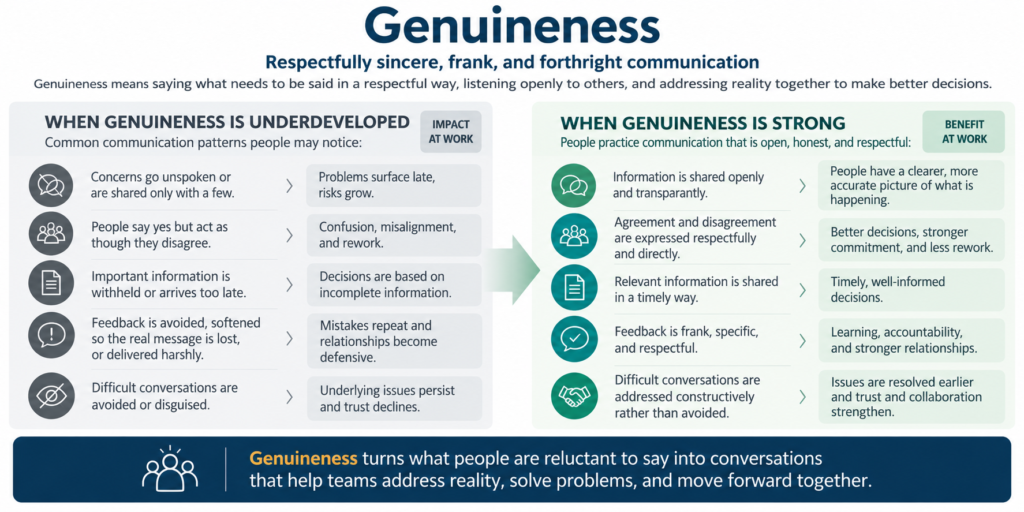
Why Genuineness Matters in the Workplace
Genuineness in the workplace means being respectfully sincere, frank, and forthright in communication with colleagues and team members. It allows people to address what is actually happening, share information others need, express concerns, and work through differences without undermining the relationships that make collaboration possible.
When Genuineness is missing, workplace problems can remain hidden in plain sight. Team members may notice a mistake but hesitate to point it out. Employees may disagree with a decision but remain silent during a meeting, only to express their objections privately afterward. Managers may avoid giving direct feedback because they fear upsetting someone, while employees may interpret that silence as approval. In each case, the information needed to make a sound decision or resolve a problem is withheld, delayed, or distorted.
These patterns carry organizational costs. Problems that could have been addressed early may grow more complicated. Decisions may be made without important information. Accountability becomes harder when expectations and concerns have not been discussed openly. Over time, people can become less willing to contribute ideas, question assumptions, or raise issues that could affect team performance.
Genuineness helps teams address these challenges by making respectful candor a normal part of working together. People can question an assumption without attacking the person who expressed it. They can acknowledge a mistake without treating it as a personal failure. They can explain why they disagree, ask for clarification, and identify concerns before those concerns become larger obstacles. The purpose is not to win an argument or prove someone wrong. It is to understand the situation accurately enough to make better decisions and resolve problems together.
Genuineness is not permission to be harsh, impulsive, or insensitive. Saying whatever comes to mind without considering its impact is not the same as being respectfully forthright. Effective candor combines honesty with consideration for the people involved and a commitment to addressing the issue constructively.
This distinction matters because collaboration depends on more than good intentions. Teams need the ability to discuss difficult subjects, challenge ideas, acknowledge mistakes, and address disagreements while maintaining productive working relationships. Genuineness helps make those conversations possible.
Within the TIGERS 6 Principles™ framework, Genuineness works alongside Trust, Interdependence, Empathy, Risk Resolution, and Success. It helps people communicate the information and concerns necessary for the other principles to function in practice. When colleagues can speak respectfully and directly about what matters, teams have a stronger foundation for solving problems, making informed decisions, and translating shared intentions into observable workplace behaviors.
The Behaviors That Build Genuineness
Genuineness becomes meaningful in the workplace when people put it into practice. It is not enough to value honesty or encourage open communication. Team members need observable behaviors that help them share information, raise concerns, discuss differences, and resolve problems respectfully. These behaviors make it possible to address reality as it is rather than allowing assumptions, unspoken disagreements, or incomplete information to shape decisions.
Speaking respectfully and directly. People demonstrate Genuineness when they say what needs to be said without disguising the message or attacking the person receiving it. Instead of hinting that something is wrong, they identify the concern and explain why it matters. They distinguish between criticizing a person and addressing a behavior, decision, or outcome. Direct communication reduces the guesswork that can lead to misunderstandings and allows colleagues to respond to the actual issue.
Sharing concerns before they become larger problems. Genuineness means raising questions when something appears inconsistent, unclear, or likely to interfere with a team’s goals. People do not have to wait until a problem becomes a crisis to speak up. They explain what they observe, identify the potential impact, and invite others to examine the situation. Early conversations give teams more opportunities to correct course before a manageable issue becomes a costly one.
Expressing disagreement constructively. Effective teams do not need everyone to think alike. They need people who can explain different perspectives and examine competing ideas without turning disagreement into a personal conflict. Genuineness allows team members to say, “I see this differently,” explain their reasoning, and ask questions that help the group reach a better-informed decision. Respectful disagreement can reveal assumptions, expose risks, and improve the quality of decisions.
Acknowledging mistakes and limitations. People build Genuineness when they admit what they do not know, acknowledge an error, or recognize when their actions have contributed to a problem. Rather than spending energy defending themselves or shifting blame, they help establish what happened and what needs to change. This behavior supports accountability because colleagues can address the facts and focus on corrective action.
Giving clear, constructive feedback. Genuineness requires people to communicate what they observe and how it affects the work. Vague comments such as “You need to do better” give little direction. Specific feedback identifies the behavior, explains its impact, and opens a conversation about what would improve the outcome. When delivered respectfully, feedback gives people useful information they can act on rather than leaving them to guess what others expect.
Asking questions instead of making assumptions. Not every misunderstanding reflects dishonesty or a lack of commitment. People may have different information, competing priorities, or interpretations of an agreement. Genuineness includes checking understanding before drawing conclusions. Questions such as “Can you help me understand how you reached that decision?” or “What did you understand we had agreed to?” allow colleagues to clarify differences without immediately assigning blame.
Following through on what has been communicated. Words and actions need to align. People demonstrate Genuineness when they make realistic commitments, communicate when circumstances change, and tell others promptly when they cannot deliver as expected. If a commitment is at risk, they explain the situation rather than allowing colleagues to discover the problem later. This consistency makes communication more dependable and supports the development of Trust.
These behaviors are most effective when they become shared expectations rather than standards applied only to certain people. Leaders demonstrate Genuineness by inviting questions, listening without retaliation, acknowledging their own mistakes, and responding constructively when someone raises an uncomfortable concern. Team members reinforce it when they speak directly, listen to understand, and remain willing to reconsider their own assumptions.
Genuineness does not require people to share every thought or disclose information that is private or confidential. It requires them to communicate relevant information honestly, respectfully, and at the appropriate time. The objective is not unfiltered expression. It is communication that helps people understand what is happening, make better decisions, and work through challenges together.
When these behaviors become part of everyday work, candor becomes less dependent on individual courage. People have a clearer understanding of how to raise concerns, disagree productively, and address mistakes. That shared capability helps teams surface problems earlier, improve decisions, and turn difficult conversations into opportunities for learning and better performance.
How Leaders Strengthen Genuineness
Leaders strengthen Genuineness by demonstrating that honest, respectful communication is expected, welcomed, and useful. People pay attention not only to what leaders say about openness but also to how they respond when someone questions a decision, raises a concern, disagrees, or admits a mistake.
When leaders react defensively, embarrass people, or punish those who deliver unwelcome information, employees may learn to remain silent, agree outwardly, or avoid difficult conversations. These responses can develop over time as people adapt to their experiences. A leader may interpret silence as agreement when employees are actually withholding concerns because speaking up feels risky.
Strengthening Genuineness requires leaders to create conditions in which people can communicate directly without being demeaned or intimidated. This begins with the leader’s own behavior.
Model respectful candor. Say what needs to be said clearly and respectfully. Explain the reasoning behind decisions, acknowledge uncertainty, and address difficult issues rather than relying on hints, assumptions, or indirect messages. Leaders who admit their own mistakes demonstrate that honesty and accountability can coexist.
Invite disagreement and questions. Ask people what might be missing, what concerns them, and what they see differently. Make it clear that questioning an idea is not the same as challenging someone’s worth or authority. When disagreement surfaces, examine the substance of the concern before defending the original position.
Respond constructively to unwelcome information. Thank people for raising concerns, ask clarifying questions, and focus on understanding the situation. A constructive response does not require agreeing with every suggestion. It requires taking the information seriously and explaining what happens next.
Address problems directly and fairly. When performance, behavior, or working relationships need attention, discuss the issue with the people involved. Avoid public humiliation, gossip, and indirect criticism. Be specific about what happened, why it matters, and what needs to change.
Make feedback useful and reciprocal. Provide clear, behavior-specific feedback that helps people understand the impact of their actions. Invite feedback about your own leadership, listen without immediately defending yourself, and demonstrate when another person’s perspective changes your thinking or your decision.
Distinguish candor from aggression. Frank communication is not permission to intimidate, insult, or disregard another person’s perspective. Leaders establish that people can be direct while remaining respectful—and that avoiding an uncomfortable truth is no more constructive than delivering it harshly.
These practices help teams develop more effective communication habits over time. People become better able to raise concerns early, discuss differences, acknowledge mistakes, and work through problems together. The result is not agreement on everything. It is a workplace where people can address reality openly enough to make better decisions, strengthen accountability, and improve results.
Measuring and Developing Genuineness
Genuineness becomes a practical workplace capability when organizations move beyond valuing honesty and define what respectfully sincere, frank, and forthright communication looks like in everyday work. People need to be able to express concerns, disagree with decisions, acknowledge mistakes, and discuss difficult realities without resorting to intimidation or withdrawing from the conversation.
Measuring Genuineness begins with observable behaviors. Do team members share relevant information in time for others to act? Can they raise concerns, offer frank feedback, and challenge assumptions respectfully? Do they acknowledge mistakes and address disagreements directly? Do leaders respond constructively when someone expresses an unwelcome perspective?
These questions help organizations identify communication patterns without judging people’s character or assuming why they behave as they do.
Developing More Effective Conflict-Resolution Behaviors
People develop communication habits through experience. Some learn to accommodate others to preserve relationships or avoid negative consequences. Others avoid difficult conversations because disagreement feels unsafe. Still others rely on forceful competition, control, or domination because those behaviors have been rewarded in their experience.
These patterns can persist into adulthood and influence workplace relationships. In a highly competitive, individualistic culture, people may feel pressure to protect their positions, avoid appearing weak, or win disagreements rather than understand them. Simply telling people to speak up, listen better, or be more respectful is unlikely to change deeply established habits.
The Thomas-Kilmann Conflict Mode Instrument (TKI) offers a useful framework for understanding five approaches to conflict: competing, collaborating, compromising, avoiding, and accommodating. The modes reflect different levels of assertiveness in addressing one’s own concerns and cooperation in addressing another person’s concerns. Each can be useful in particular circumstances; difficulties arise when people rely rigidly on one approach when a situation calls for another.
People who habitually accommodate may need practice expressing their own needs, raising concerns, and disagreeing respectfully without abandoning their positions. People who habitually dominate may need to strengthen their listening skills, consider perspectives that differ from their own, and make room for others to contribute. People who avoid conflict may need to learn how to initiate difficult conversations and address concerns before they grow. Those who rely on competition or compromise may benefit from learning when collaboration can produce a more effective solution by addressing the underlying concerns of everyone involved.
The objective is not to eliminate competition or disagreement. It is to develop the capacity to express one’s own position while making a genuine effort to understand others and work toward solutions.
Learning Circles: Practice, Modeling, and Compassionate Feedback
Leaders can support this development through facilitated learning circles in which team members examine communication patterns, practice alternative responses, and receive constructive feedback. Participants can work through realistic workplace situations, practice difficult conversations, and reflect on how different responses affect understanding, relationships, and results.
This work requires care. Communication habits may have deep roots in experiences of humiliation, punishment, exclusion, or domination. A person who learned that speaking up was dangerous may experience considerable anxiety when asked to disagree openly. Someone accustomed to controlling conversations may find it difficult to listen without immediately defending a position. These reactions should not be mistaken automatically for bad intentions or unwillingness to learn.
Facilitators must model the very behaviors they are helping people develop. They need to establish clear agreements about respect, confidentiality, participation, and feedback; focus on observable behavior rather than personal judgments; and allow people to learn at a manageable pace. Participants should never be pressured to disclose painful personal experiences or made to feel humiliated in the name of development. Because these conversations can evoke strong emotions, facilitators must be prepared to pause, respond compassionately, and respect individual boundaries.
Learning circles are not simply opportunities to discuss communication. They are places to practice it. Participants learn to state concerns clearly, listen without interrupting, acknowledge another perspective without automatically agreeing, and address differences without attacking or withdrawing. Repeated practice, supportive feedback, and opportunities to apply these skills at work help new behaviors become more dependable.
Leadership and Organizational Responsibility
Individual skill development is only part of the solution. Leaders also shape whether respectful candor is possible in the first place. When people are ridiculed for raising concerns, penalized for disagreeing, or rewarded for intimidating others, the workplace teaches them that honesty carries risks and domination brings advantages.
Organizations must therefore examine not only how people communicate but also what their cultures reward and tolerate. Leaders need to demonstrate that disagreement is welcome, feedback is taken seriously, and bullying or intimidation will be addressed. Inviting people to speak honestly is not enough if doing so exposes them to retaliation or humiliation.
Experience working with teams can also reveal meaningful differences in how people approach disagreement. For example, in work with Costco teams, I observed that Canadian teams could engage in substantially more collaborative disagreement than the U.S. teams I worked with. This is a practitioner observation, not a conclusion about all Canadian or American teams. It illustrates why organizations need to examine their own norms, leadership practices, and expectations rather than assume that people automatically know how to collaborate through conflict.
In competitive and individualistic environments especially, the ability to disagree constructively may need to be taught, modeled, practiced, and reinforced. It should not be left to chance.
Within the TIGERS 6 Principles™ framework, Genuineness works alongside Trust, Interdependence, Empathy, Risk Resolution, and Success. It helps people surface information, challenge assumptions, resolve differences, and make decisions based on a clearer understanding of reality.
When organizations measure observable behaviors, provide compassionate opportunities to practice, and hold leaders accountable for the conditions they create, Genuineness becomes more than a stated value. It becomes a capability that people and teams can deliberately develop to strengthen relationships, improve decisions, and achieve better results.
Genuineness as an Organizational Capability
Genuineness becomes an organizational capability when respectful, sincere, frank, and forthright communication is embedded in the way people work together—not left to individual personality or goodwill. It influences how information moves, how decisions are made, how mistakes are addressed, and how teams respond when reality challenges their assumptions.
In organizations where Genuineness is practiced consistently, people can raise concerns before problems escalate, question assumptions without making disagreements personal, and share information others need to make informed decisions. Difficult conversations become a normal part of solving problems rather than events to avoid. People can acknowledge mistakes, examine what went wrong, and use what they learn to improve future performance.
These outcomes depend on more than encouraging employees to speak openly. Organizational practices must support the behaviors leaders say they value. If employees are invited to challenge ideas but experience ridicule or retaliation when they do, the message is clear: silence is safer than candor. If leaders expect accountability from others but avoid acknowledging their own mistakes, people learn that Genuineness is an expectation for employees rather than a shared responsibility.
Building this capability requires alignment between communication expectations, leadership behavior, team agreements, feedback practices, and organizational responses to problems. People need opportunities to practice respectful disagreement, access to the information necessary to do their work, and confidence that concerns will be addressed fairly. Leaders must demonstrate that frank communication is welcome even when the information is inconvenient.
Within the TIGERS 6 Principles™ framework, Genuineness reinforces the other five principles. It helps build Trust through honest communication, strengthens Interdependence through information sharing, and expresses Empathy by addressing difficult issues with consideration for others. It supports Risk Resolution by bringing emerging problems into the open and contributes to Success by helping teams make better decisions, learn from experience, and follow through on commitments.
When Genuineness becomes part of how an organization works, respectful candor is no longer dependent on having the right people in the room. It becomes a shared capability that helps teams address reality, resolve problems, and improve results together.
Put Genuineness to Work
Genuineness is not developed simply by telling people to be honest, speak up, or communicate more openly. It becomes a workplace capability when people learn how to express concerns, challenge assumptions, give feedback, and address difficult realities in ways that are both frank and respectful. These behaviors require practice, reinforcement, and a workplace culture that supports their use.
Start with the conversations your team needs but may be avoiding.
Consider the issues that remain unspoken in your organization. Are employees reluctant to question a decision because they fear being labeled difficult? Do team members agree in meetings but express their reservations privately afterward? Are mistakes discussed openly so that others can learn, or do people conceal them to protect themselves? Do leaders receive the information they need to make sound decisions, or do important details get filtered as information moves up the organizational hierarchy?
These questions help teams identify where communication patterns may be interfering with effective work. They also shift attention away from blaming individuals and toward understanding what people experience when they communicate, disagree, or raise concerns.
Make respectful candor part of everyday work.
Teams can begin by establishing clear agreements about how they will communicate when differences arise. Members can practice stating concerns directly, explaining the reasoning behind their perspectives, asking questions before making assumptions, and listening to information that challenges their views. Feedback can focus on observable behaviors and their effects rather than judgments about another person’s character or intentions.
Leaders have a particularly important responsibility. Their responses to questions, mistakes, and unwelcome information teach people whether frank communication is genuinely valued. When leaders listen without immediately becoming defensive, acknowledge their own mistakes, and address concerns fairly, they demonstrate that Genuineness is a shared expectation rather than a standard imposed only on others.
Connect Genuineness to better organizational results.
The purpose of developing Genuineness is not to encourage more conversation for its own sake. It is to help people exchange the information they need, recognize problems earlier, resolve differences constructively, and make decisions based on a more complete understanding of reality.
Organizations can look for evidence of progress in everyday work. Are concerns raised earlier? Are expectations clarified before misunderstandings become costly? Can employees challenge an idea without attacking the person who proposed it? Do teams learn from mistakes and change their practices accordingly? Are disagreements more likely to produce solutions than lingering resentment or silent resistance?
These observable outcomes provide a practical way to evaluate whether communication behaviors are improving and contributing to team effectiveness.
Build Genuineness into the way your organization develops people.
Within the TIGERS 6 Principles™ framework, Genuineness is connected to the other five principles. Trust helps people believe that frank communication will be treated fairly. Interdependence makes open information sharing essential to coordinated work. Empathy helps people communicate difficult truths with consideration for others. Risk Resolution enables teams to surface concerns and work through problems. Success connects these behaviors to shared goals, accountability, and results.
Together, the six principles provide a framework for developing the behavioral capabilities that effective collaboration requires. Genuineness helps make the framework actionable by translating the value of honesty into observable communication practices that people can learn, practice, measure, and strengthen over time.
The question is not whether your organization values honesty. It is whether people can communicate respectfully, sincerely, frankly, and forthrightly when the conversation matters most.
When Genuineness becomes part of how people work together, difficult conversations become opportunities to understand problems, improve decisions, and strengthen working relationships. That is how a principle becomes an organizational capability—and how better communication contributes to more effective, collaborative teams.