
Risk in the Workplace
Turning Uncertainty Into Opportunity Through Planning, Learning, and Constructive Decision-Making
Risk in the workplace is an unavoidable part of organizational life. Every decision to change a process, introduce an idea, solve a problem, or pursue an opportunity involves taking a chance. That chance may lead to progress and innovation, or it may result in a mistake with the potential for loss or injury.
The difference isn’t whether an organization takes risks. It is how people approach risk, plan for its consequences, make decisions, and respond when things don’t go as expected.
When fear of risk dominates, people may avoid difficult decisions, hesitate to express concerns, or remain with familiar practices even when change is needed. Organizations can become stagnant, opportunities are missed, and problems remain unresolved.
When risk is approached thoughtfully, it becomes a catalyst for change, innovation, and learning. Effective planning helps organizations anticipate how change will affect their people, strategies, systems, and values. When mistakes occur, examining their root causes creates opportunities to learn rather than simply assign blame.
The TIGERS 6 Principles™ provide a framework for strengthening the human behaviors that make these practices possible. Risk Resolution helps people address uncertainty constructively, work through problems, make informed decisions, and turn experience into organizational learning.
The goal isn’t to eliminate risk. It is to develop the capacity to approach it wisely, respond to it effectively, and use what is learned to improve how people work together.
Understanding Risk in the Workplace
Risk in the workplace means taking a chance when the outcome is uncertain. Every time an organization introduces a new strategy, changes a process, addresses a difficult problem, or makes a significant decision, it accepts some degree of risk.
In the TIGERS 6 Principles™ framework, risk is not inherently negative. Taking a chance creates the possibility of progress, but it also creates the possibility of making a mistake that could result in loss or injury. The challenge is learning how to approach risk thoughtfully rather than allowing fear to determine what people will or will not do.
When people fear the consequences of being wrong, they may avoid decisions, remain on the fence, or continue using practices that no longer serve the organization. This avoidance can be just as costly as a poorly considered risk. Opportunities for improvement are lost, problems persist, and innovation stalls.
Conversely, organizations that approach risk constructively recognize that meaningful change requires people to consider alternatives, question existing practices, and sometimes try something that has never been done before. They don’t assume every risk will succeed. Instead, they develop practices for planning, making informed decisions, responding to mistakes, and applying what they learn.
Risk Resolution is about developing the organizational capability to address risk rather than avoid it. Through thoughtful planning, sound decision-making, and learning from mistakes, organizations can move forward with greater awareness of potential consequences while remaining open to the change and innovation necessary for continued success.
The Cost of Avoiding Risk
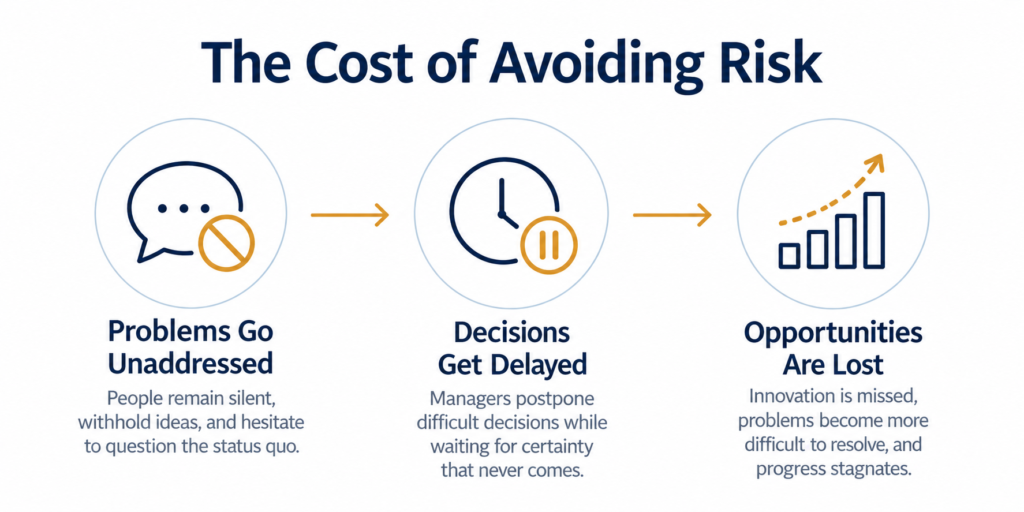
Avoiding risk may feel safer in the moment, but it can carry significant costs for an organization. When people become more concerned about the consequences of making a mistake than the consequences of leaving a problem unresolved, they may choose inaction over progress.
This can take many forms. Employees may remain silent when they see a problem, hesitate to question an established practice, or withhold ideas because they fear criticism or rejection. Managers may postpone difficult decisions while waiting for certainty that will never come. Teams may continue using familiar processes even when evidence suggests those processes are no longer effective.
Over time, these choices can create a culture of stagnation. Problems that could have been addressed early become more difficult to resolve. Opportunities for innovation are missed. Employees learn that staying quiet or maintaining the status quo is safer than contributing ideas that might challenge existing assumptions.
Avoiding risk can also undermine accountability. When people fear being blamed for mistakes, they may conceal errors, shift responsibility, or focus on protecting themselves rather than understanding what happened. This prevents organizations from learning from experience and increases the likelihood that the same problems will occur again.
The consequences extend beyond individual decisions. When people consistently avoid raising concerns or challenging assumptions, leaders receive an incomplete picture of what is happening within the organization. Decisions may appear to have broad support when important reservations have never been voiced. Agreement can be mistaken for commitment, and silence can be mistaken for understanding.
However, constructive Risk Resolution does not mean taking chances indiscriminately. Some risks should be avoided, and others require additional information, careful planning, or safeguards before proceeding. The distinction is between responsible caution that improves a decision and fear-driven avoidance that prevents a necessary decision from being made.
Organizations need ways for people to raise concerns, examine alternatives, assess potential consequences, and learn from mistakes without turning every unsuccessful attempt into a personal failure. When people can participate honestly in these processes, risk becomes something they can evaluate and manage together rather than something they must avoid individually.
The goal is not to make people comfortable with every uncertainty. It is to develop the judgment and collaborative capability to recognize when caution is warranted, when action is necessary, and how to proceed thoughtfully when outcomes cannot be guaranteed.
Planning for Risk and Organizational Change
Effective risk resolution begins before a decision is implemented. Organizations cannot eliminate uncertainty, but they can improve their ability to anticipate consequences, prepare for challenges, and respond constructively when circumstances change. Thoughtful planning helps people move forward with greater awareness rather than allowing fear or optimism alone to determine their choices.
Planning for risk involves more than identifying what could go wrong. It also requires considering what an organization hopes to accomplish, what resources and capabilities will be needed, who may be affected, and how the organization will recognize whether a change is producing the intended results. When potential problems are considered early, teams have more opportunities to prevent avoidable mistakes, establish safeguards, and develop alternatives if the original plan does not work.
Understanding the Interdependence of Organizational Functions
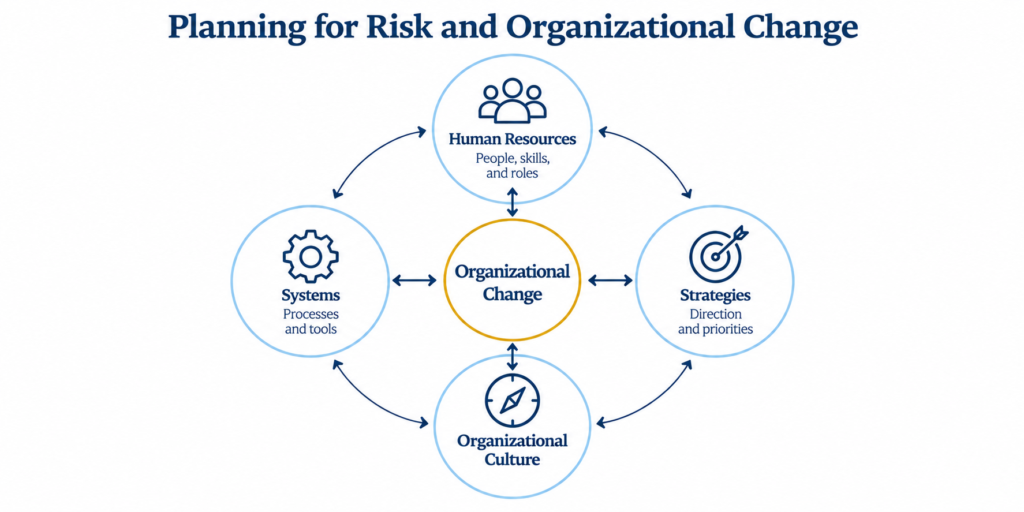
Organizational change rarely affects only one part of a business. Four interconnected functions—human resources, strategies, systems, and values—influence how an organization operates. A change in one function can affect the other three, sometimes in ways leaders do not anticipate.
For example, an organization may introduce a new strategy to improve productivity. Achieving that objective may require employees to develop new skills, systems to support different workflows, and leaders to examine whether existing values and expectations reinforce the desired change. If the strategy changes but the supporting systems, employee capabilities, and workplace expectations remain the same, implementation may falter.
The same interdependence applies when organizations introduce new technology, restructure teams, revise policies, or change how decisions are made. A change that appears sensible in isolation can create unintended consequences when its effects on the broader organization are overlooked.
Effective planning considers these relationships before implementation. Leaders and teams examine how a proposed change will affect people, strategies, systems, and values, then identify what must be adjusted to keep them aligned. This broader perspective helps organizations anticipate resistance, recognize potential problems, and prepare the support necessary for change to succeed.
Preparing People to Navigate Change
Even a well-designed plan depends on how people understand, communicate about, and respond to the change. Employees may have legitimate concerns about new responsibilities, unfamiliar processes, the loss of established routines, or the consequences of getting something wrong. If those concerns remain unspoken, leaders may mistake silence for agreement and discover important problems only after implementation begins.
The TIGERS 6 Principles™ help create the conditions for more constructive conversations about risk and change. Trust supports confidence that concerns will be taken seriously. Interdependence encourages people to consider how their decisions affect others. Genuineness makes it possible to communicate reservations and challenges respectfully and directly. Empathy helps people understand perspectives that differ from their own. Risk Resolution supports the examination of alternatives and consequences. Success keeps attention on the outcomes the organization is working to achieve.
These principles do not guarantee that every change will succeed. They help people work through uncertainty together, surface information that might otherwise be missed, and make better-informed decisions.
Planning Must Include Learning
No plan can anticipate every circumstance. Conditions change, assumptions prove incorrect, and even carefully considered decisions sometimes produce unexpected results. For that reason, risk planning should include a process for evaluating outcomes and responding when things do not go as intended.
Before implementing a change, teams can establish how they will assess progress, identify emerging problems, and determine whether adjustments are needed. When a mistake occurs, the response should examine what happened, why it happened, and what can be learned—not simply who should be blamed.
This approach turns planning into an ongoing process rather than a one-time exercise. Organizations can use experience to improve their decisions, refine their systems, and strengthen their ability to manage future risks.
Risk Resolution is not about predicting every possible outcome. It is about preparing thoughtfully, recognizing how organizational functions and people affect one another, and building the capacity to learn and adapt when reality differs from the plan.
Learning From Mistakes Through Root-Cause Analysis
Every organization makes mistakes. A process fails, a decision produces an unexpected result, a communication breaks down, or an assumption proves incorrect. What distinguishes a learning organization is not the absence of mistakes, but how people respond when they occur.
When mistakes are met with blame, embarrassment, or punishment, people have reasons to conceal what happened or protect themselves from criticism. The organization may correct the immediate problem without understanding why it occurred. As a result, the same mistake can happen again, sometimes with more serious consequences.
Root-cause analysis offers a different approach. Rather than stopping at the visible error or identifying the person involved, it examines the conditions, decisions, processes, and assumptions that contributed to the outcome. The purpose is to understand what happened well enough to prevent recurrence and improve future performance.
This does not mean removing personal accountability. People remain responsible for their decisions and actions. However, accountability becomes more productive when it includes examining contributing factors, identifying what could have been done differently, and applying what has been learned. The goal is to correct the problem and strengthen the organization’s ability to respond effectively in the future.
Making Learning Safer Than Hiding Mistakes
For people to learn openly from mistakes, leaders must demonstrate that acknowledging an error can lead to constructive learning rather than automatic humiliation. This begins with their own behavior. When leaders acknowledge their mistakes, explain what they learned, and take responsibility for their part, they show others that honesty and accountability can coexist.
Early in my career, I developed a way to encourage this kind of learning. I created an award using a wooden egg painted gold, displayed on a small stand inside a glass box. The question behind it was: “When did egg on your face turn into a golden opportunity?”
The idea was to recognize the mistake that taught us the most—not to celebrate making mistakes, but to make the learning visible and valuable.
I was preparing to introduce this process to a client as part of an effort to transform the organization into a learning organization. I had packed the golden egg in my briefcase along with my leadership materials. When people asked what it was, I invited them to guess. They didn’t know, and I told them we would talk about it later.
Then I became the first person to earn the award.
At an airport, I was reading and became so engrossed in the book that I didn’t hear the announcement for my flight. I missed the plane. I had to drive 180 miles in two hours to reach my destination. Fortunately, I arrived without getting a ticket, although my client had to wait 40 minutes. I called ahead to let them know what had happened.
I learned something simple and useful about myself. When I become absorbed in reading, I need to pay closer attention to the clock.
Rather than beating myself up over the mistake, I acknowledged it and gave myself the golden egg.
At the management meeting, I shared what had happened and what I had learned. The award then became part of a process in which people shared their mistakes and the lessons they took from them. The group voted on which story had taught them the most. The award could move from one person to another when someone offered a more valuable learning experience.
The exercise worked because the learning was genuine. I had designed the process, but I had not planned to be its first recipient. By acknowledging my own mistake, I demonstrated the kind of openness I was asking others to practice.
The golden egg did not excuse carelessness or remove accountability. It gave people a way to acknowledge mistakes, share what they learned, and help others avoid similar problems. It shifted attention from the embarrassment of being wrong to the value of learning what went wrong.
Turning Experience Into Organizational Learning
A mistake becomes a source of organizational improvement only when the learning leads to action. Teams need to identify what contributed to the outcome, determine what should change, and follow through to see whether the change makes a difference.
Useful questions include:
What happened, and what did we expect to happen?
Which assumptions, decisions, or conditions contributed to the outcome?
What information did we overlook or misunderstand?
What could we change to reduce the likelihood of a similar problem?
What have we learned that could help others in the organization?
These questions encourage people to look beyond the immediate error and examine the process that produced it. They also help distinguish an isolated mistake from a recurring problem involving unclear expectations, inadequate information, ineffective systems, or communication breakdowns.
The TIGERS 6 Principles™ support this process by helping people discuss difficult experiences honestly, consider different perspectives, take responsibility, and work together on solutions. When people can examine mistakes without making the conversation a contest over blame, they are better positioned to identify root causes and make meaningful improvements.
The ultimate measure of learning is not how openly an organization talks about mistakes. It is whether that learning changes decisions, strengthens processes, and improves future outcomes. When organizations make that connection, mistakes can become opportunities to develop greater capability rather than recurring sources of loss.
Group Decision-Making and Recognizing the Risks of Consensus
Organizations rely on groups to solve problems, evaluate alternatives, and make decisions that affect people, resources, and results. Bringing different perspectives together can improve the quality of a decision. However, a group does not automatically make better decisions simply because more people participate.
The way people interact during discussion can influence what information is considered, which concerns are expressed, and whether the final decision reflects careful examination or pressure to agree. When people prioritize harmony, defer to authority, or assume that everyone else supports a proposal, a group can overlook risks that individual members might have recognized on their own.
Several well-documented group processes help explain why this happens.
Groupthink: When Agreement Becomes More Important Than Good Judgment
Groupthink occurs when the desire for consensus interferes with a group’s critical evaluation of alternatives. Members may suppress doubts, avoid challenging influential people, or dismiss information that threatens the group’s preferred conclusion.
The danger is not agreement itself. Agreement reached after thoughtful examination can be valuable. The problem arises when maintaining unity becomes more important than testing assumptions, considering opposing evidence, or acknowledging legitimate concerns.
Leaders can reduce this risk by inviting disagreement before a decision is finalized, asking what evidence might challenge the preferred option, and making it clear that raising concerns is a contribution to the group’s success—not an act of disloyalty.
The Risky Shift: When group decisions increase risk-taking
The risky shift occurs when a group makes a decision that involves greater risk than its members would have been willing to accept individually. During group discussion, people may reinforce one another’s willingness to take a chance, making a riskier course of action seem more acceptable than it did before the discussion began.
However, the risk itself is only part of the problem. Group decision-making can also affect how personally accountable people feel for the outcome.
When a decision is made collectively, individuals may begin to think of it as the group’s decision rather than a decision for which they retain personal responsibility. A person who might have questioned the risks independently may go along with the group and later reason, “We made the decision, not me.” Because others participated, the individual may feel less responsible for questioning the assumptions, raising concerns, or anticipating consequences.
This creates a dangerous combination. The group may become more willing to accept risk while individual members feel less personally accountable for that choice.
Shared decision-making should not become a way to diffuse responsibility. Each person remains responsible for contributing relevant information, expressing legitimate concerns, exercising sound judgment, and taking ownership of their part in the decision and its implementation. A group can share responsibility for an outcome without relieving its members of individual accountability.
The TIGERS 6 Principles™ help address this challenge. Interdependence reminds people that their decisions affect one another and that effective collaboration requires active contributions from every member. Genuineness supports communicating in ways that are respectfully sincere, frank, and forthright when a proposed course of action seems unwise. Trust helps people raise concerns without fearing that disagreement will damage their relationships.
Before accepting a significant risk, groups should ask whether members have genuinely examined the consequences, whether anyone has reservations that have not been voiced, and who will be accountable for carrying out the decision and evaluating its results.
The goal is not to eliminate risk-taking. It is to ensure that collective decisions reflect thoughtful judgment, open communication, and personal accountability—not simply the momentum of the group.
The Abilene Paradox: Agreeing When People Privately Disagree
The Abilene paradox describes situations in which people collectively choose a course of action that individuals privately question or do not want, often because they mistakenly believe others support it or wish to avoid disagreement.
This can happen when employees remain silent to be agreeable, managers interpret silence as approval, or team members assume that expressing reservations will damage relationships. Everyone may participate in a decision while privately believing it is a poor choice.
The consequences can include wasted resources, frustration, weakened trust, and later attempts to distance oneself from the decision.
Preventing this pattern requires more than asking whether everyone agrees. Leaders can invite each person to identify concerns, ask what might make the proposed approach fail, and distinguish genuine commitment from reluctant compliance. Respectfully sincere, frank, and forthright communication—the TIGERS principle of Genuineness—helps make those conversations possible.
The Common Knowledge Effect: Overlooking What Some People Know
The common knowledge effect occurs when groups devote disproportionate attention to information shared by most members while overlooking information known to only one or a few people.
For example, a team evaluating a new system may repeatedly discuss its widely recognized advantages while failing to examine a concern raised by the employee who understands a critical operational limitation. Because the concern is not shared by everyone, it may receive less attention even when it is essential to the decision.
This effect illustrates why collecting different perspectives is not enough. Groups must actively create opportunities for people to contribute information that others may not have.
A useful practice is to ask each participant what they know that the rest of the group may be missing. Teams can also assign people to examine different alternatives, invite frontline employees to explain operational realities, and record unresolved questions before deciding.
The same principle applies to assumptions that a group treats as established facts. Widely shared beliefs are not necessarily accurate. When assumptions go unexamined, they can distort how people interpret evidence, understand others, and evaluate possible solutions.
Diffusion of Responsibility: When Nobody Owns the Decision
Group decisions can also create a sense that responsibility belongs to the group rather than to the individuals involved. When something goes wrong, members may say that everyone agreed, that the manager made the decision, or that they were simply following the group’s direction.
Diffusion of responsibility is not the same as group polarization or groupthink, but it can reinforce their consequences. People may support a questionable decision because they assume someone else has evaluated the risks or will take responsibility if the outcome is poor.
Effective group decision-making requires clarity about who has authority to decide, who is responsible for implementation, what safeguards are needed, and how results will be evaluated. Shared responsibility should strengthen collective ownership, not obscure individual accountability.
Escalation of Commitment: Continuing Because We Have Already Invested
Another decision-making risk occurs when individuals or groups continue investing time, money, or resources in a failing course of action because they have already committed so much to it. This is known as escalation of commitment.
Previous investment can make it difficult to acknowledge that an approach is not working. People may defend earlier decisions, reinterpret negative evidence, or approve additional resources in the hope of justifying what has already been spent.
A better approach is to establish review points before implementation begins. Teams should identify the evidence that would indicate progress, the conditions that would require a change in direction, and the circumstances under which a project should be modified or stopped.
Past investment is relevant to understanding what has happened, but it should not be the sole reason to continue. Future decisions should be based on current evidence, realistic alternatives, and the likely consequences of proceeding.
Using the TIGERS 6 Principles™ to Improve Group Decisions
These group processes demonstrate why sound decision-making depends on more than analytical ability. It also depends on the behaviors that allow people to contribute information, challenge assumptions, examine consequences, and remain accountable for results.
The TIGERS 6 Principles™ offer a framework for strengthening those behaviors:
Trust helps people raise concerns without assuming that disagreement will damage the relationship.
Interdependence encourages members to recognize how their contributions and decisions affect one another.
Genuineness supports respectfully forthright communication about reservations, assumptions, and conflicting views.
Empathy helps people understand perspectives and information different from their own without requiring agreement.
Risk Resolution encourages thoughtful evaluation of uncertainty, alternatives, and potential consequences.
Success keeps the group focused on its intended outcomes rather than on defending a position or preserving consensus for its own sake.
Before finalizing a consequential decision, a group can ask: What are we assuming? What information might we be missing? Who sees this differently, and what can we learn from that perspective? What could cause this decision to fail? How will we recognize when we need to change course?
These questions make disagreement useful and help prevent silence from being mistaken for agreement.
The objective is not to eliminate consensus or make every decision contentious. It is to ensure that agreement emerges from honest discussion, informed judgment, and shared understanding. When people can question a proposal without being treated as opponents, groups are better equipped to recognize risk, make thoughtful decisions, and learn from the outcomes.
Putting Risk Resolution Into Practice
Risk Resolution becomes an organizational capability when people have practical ways to evaluate uncertainty, make informed decisions, address problems, and learn from experience. It cannot depend solely on a leader’s judgment or an occasional risk assessment. It must be reflected in how people communicate, plan, make decisions, and respond when outcomes differ from expectations.
Organizations can strengthen this capability by incorporating several practices into their everyday work.
Evaluate Risk Before Taking Action
Before committing to a significant decision or change, teams should clarify the outcome they want to achieve, examine the available evidence, and identify potential consequences. They should consider what could go wrong, what could be gained, what safeguards may be needed, and what alternatives are available.
This process does not require predicting every possible outcome. It helps people distinguish risks worth taking from risks that need to be reduced, delayed, or avoided. It also makes assumptions visible so they can be examined before they become costly mistakes.
Encourage Honest Discussion and Constructive Disagreement
People closest to a problem often possess information that decision-makers need. Yet that information may never surface if employees fear criticism, believe disagreement is unwelcome, or assume their concerns will not matter.
Leaders can improve decision-making by inviting different perspectives before a decision is finalized, asking what evidence might challenge the preferred approach, and making space for concerns that have not yet been expressed. Constructive disagreement is not an obstacle to collaboration. It is one way teams identify blind spots and make better-informed choices.
The objective is not to achieve agreement at any cost. It is to reach decisions through honest examination, with people understanding the reasoning behind the choice and their responsibilities for carrying it out.
Clarify Ownership and Accountability
Collaborative decisions require both shared responsibility and individual accountability. Teams need to understand who has the authority to make a decision, who will implement it, who will monitor the results, and who must act if problems emerge.
Clear ownership prevents responsibility from disappearing into the group. Each person remains accountable for contributing relevant information, raising legitimate concerns, fulfilling assigned responsibilities, and communicating when circumstances change.
Accountability should also include reviewing the quality of the decision-making process, not just judging the final outcome. A thoughtful decision can produce an unfavorable result because circumstances are uncertain. Conversely, a poorly considered decision can succeed by chance. Examining the reasoning, assumptions, and safeguards helps organizations learn from both outcomes.
Respond to Mistakes With Learning and Corrective Action
When something goes wrong, the immediate priority may be to contain the problem and prevent further harm. Once the situation is under control, the organization can examine what happened, identify contributing factors, and determine what needs to change.
This includes distinguishing individual errors from problems involving unclear expectations, inadequate training, ineffective systems, incomplete information, or flawed processes. Corrective action should address the conditions that contributed to the mistake rather than simply treating the visible symptom.
People must be able to acknowledge errors honestly, but openness alone is not enough. The organization must use what it learns to improve practices, strengthen safeguards, and reduce the likelihood of recurrence.
Monitor Results and Adapt
Risk Resolution does not end when a decision is made or a plan is implemented. Teams need ways to determine whether the intended results are being achieved and whether unexpected consequences are emerging.
Establishing review points, identifying meaningful indicators of progress, and agreeing in advance on when a plan should be reconsidered help organizations respond before small problems become larger ones.
When evidence shows that an approach is not working, changing direction should be treated as a responsible response to new information—not automatically as an admission of failure. Continuing with an ineffective approach simply because time or money has already been invested can compound the original problem.
Make Risk Resolution Part of How Work Gets Done
These practices are most effective when they become part of ordinary organizational life rather than activities reserved for major projects or serious failures. Teams can incorporate risk evaluation into planning meetings, invite dissenting perspectives during decision-making, review mistakes during project evaluations, and clarify accountability whenever responsibilities change.
The TIGERS 6 Principles™ provide a behavioral framework for making these practices possible. Trust and Genuineness support candid communication. Interdependence encourages people to consider the effects of their decisions on others. Empathy helps people understand perspectives they might otherwise overlook. Risk Resolution supports thoughtful action under uncertainty. Success keeps attention on the results the organization is working to achieve.
The goal is not to create an organization where nothing goes wrong. It is to build an organization that can recognize risk, respond constructively, learn from experience, and improve its decisions over time.
Developing Risk Resolution as an Organizational Capability
Organizations become more capable of managing risk when people learn to address uncertainty as a shared responsibility rather than something to avoid or leave to individual leaders. This capability develops through consistent practices that help people evaluate potential consequences, communicate concerns, make informed decisions, and learn from experience.
Risk Resolution is not a one-time activity or a procedure reserved for major decisions. It is an ongoing organizational capability that grows as people apply what they learn to new challenges. Each decision provides an opportunity to examine assumptions, consider different perspectives, evaluate results, and improve how work gets done.
The TIGERS 6 Principles™ provide the behavioral foundation for this development. People need Trust to raise concerns, Interdependence to recognize how their decisions affect others, Genuineness to communicate honestly, and Empathy to understand perspectives beyond their own. Risk Resolution helps them address uncertainty constructively, while Success keeps their efforts directed toward meaningful outcomes.
When these principles are practiced together, organizations are better positioned to recognize emerging problems, respond to change, and turn experience into improved performance. People can take thoughtful risks without treating every mistake as failure, challenge assumptions without undermining relationships, and accept personal accountability while working toward shared goals.
The objective is not to eliminate uncertainty or guarantee that every decision will succeed. It is to develop the judgment, collaborative behaviors, and learning practices that enable people to navigate uncertainty more effectively.
Risk Resolution helps organizations move forward thoughtfully, learn continuously, and turn uncertainty into an opportunity for improvement, innovation, and sustained success.