
Interdependence in the Workplace
Discover how to break down silos, connect individual efforts, and help people achieve better results together.
Organizations depend on people working together. However, collaboration often breaks down when teams operate in silos, information stays within departments, or individual priorities take precedence over shared goals. People may be capable and committed, but their combined efforts can still fall short when work is disconnected.
The TIGERS® Interdependence Principle addresses this challenge by strengthening how people connect their work, coordinate their contributions, and recognize their mutual impact on results. Interdependence is not about making everyone responsible for everything. It is about understanding how each person’s contribution affects others and how coordinated effort advances shared success.
When people communicate across boundaries, follow through on commitments, share knowledge, and work through competing priorities, they create stronger connections between individual effort and organizational performance. Work becomes less fragmented. Problems are addressed earlier. Teams are better equipped to achieve outcomes that no individual or department could accomplish alone.
Interdependence turns individual contributions into collective capability.
Why Interdependence Matters in the Workplace
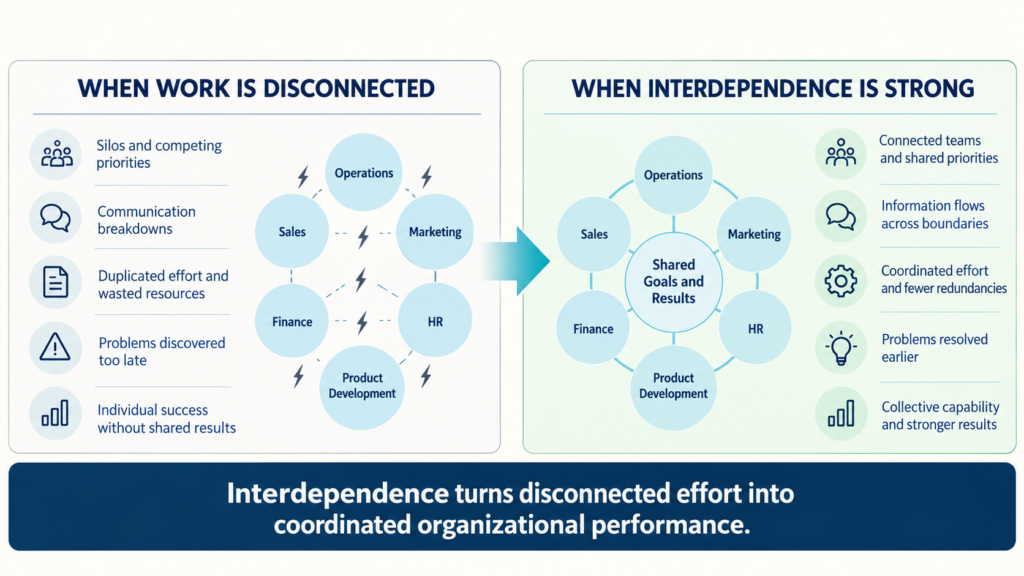
Organizations rarely struggle because people are unwilling to work hard. More often, the problem is that people are working hard in different directions. Departments protect their priorities. Information stays within functional boundaries. Decisions are often made without considering how they affect other teams. Even talented, committed employees can struggle to produce strong collective results when their efforts are disconnected.
When Individual Effort Doesn’t Add Up to Organizational Success
A department may meet its goals while creating delays for another department. A manager may make a decision that improves local efficiency but increases costs elsewhere. Two teams may unknowingly duplicate the same work because neither knows what the other is doing. These problems are not necessarily caused by poor intentions or a lack of competence. They often reflect a breakdown in how people understand and coordinate their contributions.
The consequences accumulate. Projects take longer than expected. Employees spend time resolving preventable misunderstandings. Important information arrives too late to influence decisions. People become frustrated when their work depends on colleagues who have different priorities or incomplete information. Leaders then spend valuable time intervening in problems that could have been prevented through better coordination.
The challenge is not simply getting people to work harder. It is helping their efforts work together.
Interdependence brings attention to the connections between people, their work, and the results they are trying to achieve. It helps employees recognize that their actions can enable or constrain someone else’s success. That awareness creates an opportunity to coordinate earlier, communicate more effectively, and address problems before they disrupt performance.
Why Organizational Silos Undermine Performance
Organizational silos develop when teams become so focused on their own responsibilities, measures, or priorities that they lose sight of how their work connects to the larger organization. Specialized departments are necessary, but their boundaries become obstacles when people with interdependent work fail to communicate or coordinate.
For example, sales may promise a delivery schedule that operations cannot meet. Human resources may introduce a new process without understanding the demands it places on frontline managers. A project team may complete its assigned work without preparing the next team to take over. Each group may believe it has fulfilled its responsibility, yet the overall result falls short.
These situations reveal a critical distinction. Individual performance and organizational performance are connected, but they are not the same thing. Strong individual contributions do not automatically produce strong collective results. The connections between those contributions matter.
Interdependence encourages people to look beyond their immediate assignments and consider the relationships that make successful execution possible. It supports the exchange of information, the coordination of priorities, and the recognition of how one person’s decisions affect others.
From Separate Contributions to Collective Capability
Effective organizations need people who can fulfill their own responsibilities while understanding how their work affects the people around them. Interdependence does not eliminate individual accountability, require constant agreement, or make everyone responsible for every task. Instead, it strengthens the connections that allow people to fulfill their responsibilities in ways that support others and advance shared objectives.
When people practice interdependence, they are more likely to clarify expectations, share relevant knowledge, communicate changes, and raise concerns early. They seek input from colleagues whose work may be affected by a decision. When competing priorities arise, they work to understand the broader consequences rather than assuming that one department must win at another’s expense.
These behaviors help organizations use their existing knowledge and expertise more effectively. Problems can be addressed closer to where they arise. Teams can anticipate dependencies rather than react to surprises. Leaders gain a clearer picture of where coordination is working and where it needs attention.
Interdependence therefore matters because it strengthens the connections between individual contribution and collective achievement. It helps transform separate efforts into coordinated work that is better positioned to produce the results an organization intends.
The Behaviors That Build Interdependence
Making the Connections Between People and Work Visible
Interdependence becomes meaningful when people recognize how their decisions, actions, and follow-through affect others. It is not enough for employees to understand their own responsibilities. They also need to understand where their work connects with the work of colleagues, other departments, and the organization as a whole.
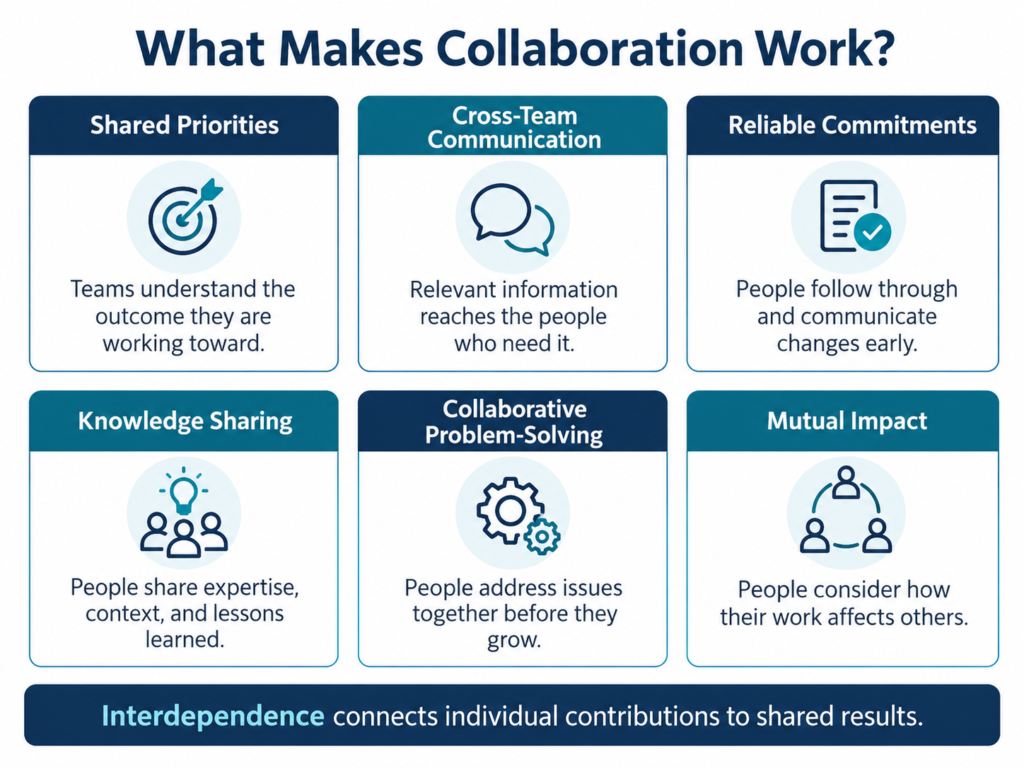
These connections become visible through everyday behaviors. People communicate information others need, clarify expectations, coordinate timing, honor commitments, and raise concerns before small problems become larger ones. They consider the consequences of their decisions for colleagues who depend on their work.
The following behaviors help turn interdependence into something people can observe, practice, and strengthen.
1. Communicating Across Boundaries
Interdependence requires communication that crosses departmental, professional, and organizational boundaries. People need to share relevant information with those whose work may be affected by a decision, change, or emerging problem.
For example, a team that discovers a delay should communicate it promptly to the people responsible for the next stage of a project. A manager introducing a new procedure should consider how it will affect the employees expected to carry it out. A colleague who discovers a better way to complete a task should share that knowledge with others who could benefit.
Effective communication is not simply sending messages. It involves checking understanding, asking questions, listening to different perspectives, and making sure important information reaches the people who need it. When communication crosses boundaries reliably, teams can coordinate their work instead of discovering too late that they have been operating with different assumptions.
2. Recognizing Mutual Impact
People strengthen interdependence when they consider how their actions influence the work and success of others. A decision that appears efficient for one person or department may create additional work, delays, or risks elsewhere.
Recognizing mutual impact means pausing to ask questions such as: Who depends on this decision? What information do others need before we proceed? Could this change create an unintended problem for another team? Whose perspective should we understand before committing to a course of action?
This awareness does not require everyone to agree on every decision. It helps people make better-informed decisions by considering the wider consequences of their choices. When employees understand how their work affects others, they are better able to anticipate dependencies, identify potential conflicts, and make adjustments before those conflicts disrupt results.
3. Following Through on Commitments
Interdependent work depends on people being able to rely on one another. When one person misses a deadline, withholds information, or changes an agreed plan without communicating, the effects can spread across an entire workflow.
Reliable follow-through means making clear commitments, communicating realistic expectations, completing agreed responsibilities, and informing others promptly when circumstances change. It also means clarifying who owns the next action and what others need in order to proceed.
When a commitment cannot be met, early communication gives colleagues an opportunity to adjust schedules, reassign work, or resolve obstacles together. Silence and last-minute surprises leave others with fewer options.
Follow-through strengthens both individual accountability and collective performance. People remain responsible for their own work while recognizing that others may depend on its timely and reliable completion.
4. Sharing Knowledge and Resources
Knowledge becomes more valuable when it can be used by the people who need it. Interdependence grows when individuals share relevant experience, lessons learned, resources, and information instead of allowing them to remain isolated within a person, team, or department.
Knowledge sharing can be as simple as documenting a process, explaining why a previous approach failed, introducing colleagues to a useful resource, or making time to help another team understand a complex issue. It also includes asking for expertise when others have knowledge that can improve a decision or prevent a mistake.
This behavior does not mean sharing every piece of information indiscriminately. People must respect confidentiality, security requirements, and appropriate boundaries. The goal is to make useful knowledge accessible to those who need it to perform their work and make informed decisions.
When knowledge moves across organizational boundaries, teams can reduce duplicated effort, learn from one another, and apply expertise more effectively.
5. Solving Problems Together
Interdependent work inevitably creates situations in which priorities compete, expectations differ, or one team’s needs conflict with another’s. These moments reveal whether people can work through differences constructively.
Collaborative problem-solving begins with understanding the situation from more than one perspective. Rather than assigning blame or defending departmental territory, people identify the issue, examine its causes, clarify the impact on those involved, and explore practical options.
For example, when operations cannot meet a delivery commitment made by sales, the goal is not simply to determine which department is at fault. The teams need to understand the constraints, communicate the consequences, and develop a workable response. That may require renegotiating a deadline, changing a process, or establishing clearer coordination for future commitments.
Resolving problems together does not eliminate disagreement or individual accountability. It helps people address the real issue while protecting the working relationships and coordination needed to move forward.
Bringing the Behaviors Together
These behaviors reinforce one another. Communication makes dependencies visible. Awareness of mutual impact helps people anticipate consequences. Reliable follow-through builds confidence that others can depend on their work. Knowledge sharing improves decisions, and collaborative problem-solving helps teams respond when plans or priorities conflict.
Interdependence is strengthened when these behaviors become consistent practices rather than occasional responses to a crisis. Leaders can support that development by clarifying shared outcomes, creating opportunities for cross-team communication, establishing clear commitments, and addressing barriers that prevent people from coordinating their work.
The objective is not to make everyone responsible for everything. It is to help people fulfill their individual responsibilities in ways that enable others to succeed, too.
When people understand and act on their connections to one another, individual contributions become a stronger collective capability.
How Leaders Strengthen Interdependence
Creating the Conditions for People to Work Together
Interdependence does not develop simply because an organization tells people to collaborate. Leaders must create the conditions that make coordinated work possible, reinforce the behaviors that support it, and address the barriers that keep people operating in isolation.
Organizational structures, performance measures, competing priorities, and established habits can unintentionally discourage collaboration. Employees may be encouraged to achieve shared results while being evaluated only on individual or departmental performance. Managers may be expected to coordinate across functions without having the time, information, or authority to do so. Teams may depend on one another while lacking clear agreements about responsibilities, deadlines, and communication.
Leaders strengthen interdependence when they make connections between people and work visible, establish clear expectations, and model the behaviors they want others to practice.
Aligning Individual and Shared Goals
People need to understand how their individual responsibilities contribute to broader organizational outcomes. When goals are unclear or competing, employees naturally tend to focus on the priorities for which they are held accountable.
Leaders can reduce this disconnect by explaining how departmental objectives support organizational goals and identifying where the work of different teams intersects. They can ask teams to identify shared dependencies, clarify what each group needs from others, and resolve conflicting priorities before those conflicts disrupt performance.
For example, a customer commitment may depend on coordination among sales, operations, and customer service. Each group has distinct responsibilities, but success depends on the connections between them. Leaders can help the groups establish shared expectations for communication, timing, and follow-through so that one team’s decisions do not create avoidable problems for another.
A practical example appears in Chapter 4, “Does Gringos,” on page 62 of TIGERS Among Us: Winning Business Team Culture and Why They Thrive. The example illustrates how weekly meetings can focus on building the most profitable goal while making handoffs, interdepartmental dependencies, and the impact of each team’s work visible and understood. By connecting departmental activities to a shared business outcome, people can coordinate their contributions rather than pursue individual or departmental priorities in isolation.
Aligned goals do not require every team to perform the same work. They help people understand how different contributions combine to produce the intended result.
Establishing Clear Agreements and Accountability
Interdependence works best when people know what they can expect from one another. Vague expectations create gaps in responsibility, duplicated effort, and disagreements about who should take the next step.
Leaders can help teams establish clear agreements about responsibilities, decision-making authority, deadlines, information sharing, and how changes will be communicated. These agreements make dependencies explicit rather than leaving people to rely on assumptions.
Accountability is equally important. When a commitment is missed, leaders should help determine what happened, who was affected, and what needs to change. The purpose is not to excuse poor performance or shift responsibility to others. It is to address the issue while improving the coordination that future work requires.
Clear agreements allow people to remain accountable for their own contributions while recognizing their obligations to colleagues who depend on those contributions.
Modeling Cross-Team Communication and Respectful Candor
Employees pay attention to how leaders handle disagreement, share information, and respond when someone raises a concern. Leaders who protect departmental territory, withhold information, or blame other groups reinforce the very behaviors that undermine interdependence.
By contrast, leaders strengthen collaboration when they seek input from people affected by decisions, communicate changes promptly, acknowledge the contributions of other teams, and address problems directly and respectfully. They demonstrate that raising a concern early is more constructive than allowing a preventable problem to grow.
Respectful candor is especially important when priorities conflict. Leaders need to help people discuss the real issue, understand different constraints, and reach workable agreements without turning disagreement into personal conflict.
These practices also support trust. People are more willing to share information, ask for help, and acknowledge mistakes when they believe concerns will be addressed fairly and constructively.
Removing Organizational Barriers to Collaboration
Sometimes the greatest obstacles to interdependence are built into the way work is organized. Separate reporting structures, incompatible processes, inaccessible information, and performance measures that reward competition between departments can make coordination unnecessarily difficult.
Leaders should examine whether organizational systems support the collaborative behaviors they expect. Do teams have opportunities to coordinate work before problems arise? Can employees access the information they need? Are decision-making responsibilities clear? Do performance measures recognize contributions to shared outcomes, or do they reward local success even when the organization suffers?
Removing barriers may involve clarifying decision rights, improving handoffs between teams, creating regular coordination points, or revising measures that encourage counterproductive competition. It may also mean giving employees the authority to resolve routine issues without waiting for unnecessary layers of approval.
The goal is not to eliminate organizational boundaries. Specialized functions and clear responsibilities remain essential. The goal is to ensure that boundaries help organize work rather than prevent people from working together.
Reinforcing Learning and Continuous Improvement
Interdependence grows when teams learn from the way their work connects. Leaders can make this learning routine by asking what helped coordination succeed, where information arrived too late, which commitments were unclear, and what could prevent similar problems in the future.
After a project or significant decision, a brief review can reveal where handoffs worked well and where teams encountered avoidable delays or misunderstandings. Leaders can encourage employees to share lessons across departments so that improvements benefit more than the group that discovered them.
These conversations should lead to practical changes in behavior, agreements, or processes. Otherwise, the organization risks repeating the same problems while treating each occurrence as an isolated event.
Over time, continuous improvement helps teams become more capable of anticipating dependencies, resolving problems early, and adjusting their coordination as conditions change.
Making Interdependence Part of Everyday Leadership
Leaders strengthen interdependence through the expectations they set, the decisions they make, the systems they maintain, and the behaviors they consistently model. Collaboration becomes more reliable when people understand shared goals, communicate across boundaries, honor commitments, and address problems together.
The leadership challenge is to connect individual accountability with collective performance. People should know what they own, what others depend on them to deliver, and how their work contributes to outcomes beyond their immediate responsibilities.
When leaders reinforce these connections consistently, interdependence becomes more than an occasional team-building activity. It becomes part of how work is coordinated, how decisions are made, and how the organization learns to achieve results together.
Measuring and Developing Interdependence
Turning Collaboration Into Observable, Developable Behaviors
Organizations often describe collaboration as an important capability, but broad statements about teamwork do not tell leaders whether people are actually working interdependently. To develop this capability, organizations need to identify the behaviors that support coordinated work, observe how consistently those behaviors occur, and determine where improvement is needed.
Interdependence becomes more actionable when leaders examine what people do in everyday situations. Do employees communicate changes to colleagues who depend on their work? Do teams clarify responsibilities before beginning a shared project? Do people consider how their decisions affect other departments? When problems arise, do they work across boundaries to resolve them?
These questions move interdependence from an abstract expectation to a set of observable workplace practices that can be discussed, assessed, and developed.
Identifying Observable Indicators
The first step is to define what effective interdependence looks like in the organization’s actual work environment. Relevant behaviors will vary according to the organization’s mission, operating conditions, and the relationships among its teams.
Useful indicators may include:
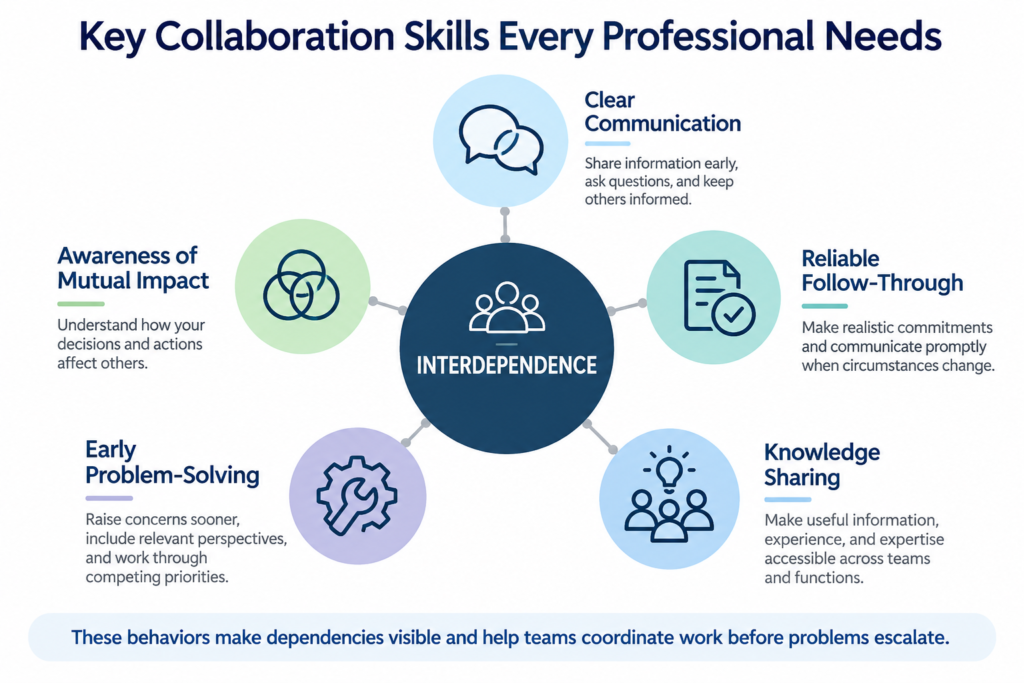
Cross-team communication: People share timely, relevant information with colleagues affected by their decisions and activities.
Awareness of mutual impact: Employees consider how their choices influence other people, workflows, and shared outcomes.
Reliable follow-through: Individuals honor commitments, clarify expectations, and communicate promptly when plans change.
Knowledge sharing: People make relevant expertise and lessons learned available to colleagues who need them.
Collaborative problem-solving: Teams address disagreements and operational problems constructively rather than defaulting to blame or departmental defensiveness.
Coordination of shared work: People clarify dependencies, responsibilities, handoffs, and timing so that connected activities move forward effectively.
These indicators provide a starting point for meaningful conversations about performance. They also help distinguish a genuine collaboration problem from an issue caused by inadequate resources, unclear authority, competing organizational priorities, or poorly designed processes.
Assessing Current Practices
Leaders can assess interdependence through structured observation, employee feedback, team discussions, project reviews, and appropriate behavioral assessments. Using more than one source of information can help reveal patterns that a single conversation or performance measure might miss.
For example, employees may report that communication across departments is difficult, while project reviews reveal that important information routinely arrives after decisions have already been made. Together, these findings point toward a specific opportunity for improvement.
Assessment should examine both the behaviors people demonstrate and the conditions that influence those behaviors. Employees may understand the importance of collaboration but lack access to necessary information, clear decision-making authority, or time to coordinate their work. Those organizational barriers require attention alongside individual development.
The purpose of assessment is not to label people as collaborative or uncollaborative. It is to identify strengths, uncover gaps, and establish a clearer picture of how work is connected across the organization.
Developing Interdependence Through Practice
Once development priorities are identified, leaders can help people practice the behaviors needed to improve coordination. Effective development connects learning to real work rather than treating collaboration as a concept employees understand simply because they have attended a workshop.
Teams can begin by identifying one recurring coordination problem. They might examine unclear handoffs, delayed communication, duplicated effort, or competing priorities. From there, they can agree on specific behavioral changes, assign responsibility, and establish a way to review progress.
For example, a team that regularly receives incomplete information from another department might agree on what information must accompany each handoff, who is responsible for providing it, and how exceptions will be communicated. The team can then review whether the new agreement reduces confusion and delays.
Leaders can reinforce learning through coaching, constructive feedback, peer discussion, and regular reviews of shared work. When people see how a change in behavior improves the work of others, the value of interdependence becomes more concrete.
Tracking Progress and Sustaining Improvement
Measuring progress requires looking beyond whether people say they collaborate more effectively. Organizations should examine whether observable behaviors change and whether those changes improve the coordination of work.
Depending on the situation, useful indicators may include fewer preventable handoff errors, earlier identification of project risks, reduced duplication, more timely information sharing, clearer ownership of commitments, or improved feedback from teams that depend on one another.
No single indicator proves that interdependence has improved. Results should be interpreted in context, because performance can also be influenced by staffing, technology, resources, workload, and other operational conditions.
A practical development cycle includes four steps:
Establish a baseline. Identify current behavioral patterns and the coordination problems they may contribute to.
Choose a priority. Select one or two behaviors that would make a meaningful difference to shared work.
Practice and observe. Introduce specific changes and review how consistently they occur.
Evaluate and adjust. Examine behavioral evidence and work outcomes, then refine the approach based on what the organization learns.
Repeating this cycle helps interdependence develop as an ongoing organizational capability rather than a one-time training outcome.
The objective is measurable behavioral improvement. People become more capable of coordinating their contributions, anticipating the effects of their decisions, and working together to achieve shared results.
Interdependence as an Organizational Capability
Building the Connections That Enable Organizational Performance
Organizations achieve their goals through connected contributions. Products and services depend on coordinated activities, customer outcomes depend on effective handoffs, and strategic initiatives depend on people across functions making decisions that support a common direction.
Yet these connections do not automatically work well simply because an organization has capable people, established processes, and clear goals. When coordination depends on personal relationships, informal workarounds, or a few individuals who know how everything fits together, performance can become fragile. Work may proceed smoothly under familiar conditions but break down when responsibilities change, workloads increase, or unexpected problems arise.
Interdependence becomes an organizational capability when the behaviors and systems that support coordinated work are practiced consistently across the organization. People understand how their responsibilities connect with others, leaders reinforce collaboration across boundaries, and organizational processes make it easier to share information, coordinate decisions, and resolve problems.
The result is a more reliable connection between what individuals contribute and what the organization is trying to accomplish.
Moving Beyond Individual Collaboration
Individual employees can demonstrate strong collaboration skills, yet the organization may still struggle with interdependence if its systems work against them. A person may communicate effectively while operating within a process that withholds critical information. A team may honor its commitments while being measured against goals that conflict with those of another team.
Organizational capability requires attention to both behavior and the conditions in which behavior occurs. Leaders need to examine whether reporting relationships, performance measures, decision-making processes, communication channels, and resource allocation support the coordination the organization expects.
For example, an organization may ask departments to improve customer experience while allowing each department to optimize its own performance without considering the customer’s journey across departments. Each group may meet its targets, but customers can still experience delays, inconsistent information, or repeated requests.
Strengthening interdependence means looking at the complete process and identifying where the connections between functions need improvement. The question shifts from whether each department is doing its job to whether the departments are working together to deliver the intended outcome.
This broader perspective does not diminish specialized expertise or individual accountability. It recognizes that organizational results depend on how effectively separate responsibilities connect.
Strengthening Coordination Across the Organization
As interdependence develops, organizations become better able to coordinate work across functions, levels, and professional boundaries. People know where their work intersects with others, understand the information required for successful handoffs, and have established ways to address competing priorities.
This capability supports several important organizational outcomes.
More reliable execution. Clear agreements and dependable communication reduce avoidable delays, duplicated effort, and confusion about responsibilities.
Earlier problem identification. People are more likely to raise concerns when they recognize that a decision or change may affect others. This gives teams more time to address emerging risks.
Better use of organizational knowledge. Information and expertise can reach the people who need them, reducing unnecessary repetition and helping teams learn from one another.
Greater adaptability. When circumstances change, connected teams can communicate the implications, reassess dependencies, and coordinate adjustments rather than responding in isolation.
Stronger collective accountability. Individuals remain responsible for their contributions while recognizing how their follow-through affects the work and results of others.
These outcomes are not automatic consequences of declaring collaboration a priority. They develop through consistent behavioral practices, supportive organizational systems, and leadership that reinforces coordination as part of everyday work.
Making Interdependence Sustainable
Sustainable interdependence requires more than a successful project or a well-functioning team. It must remain effective as people change roles, priorities shift, and new demands emerge.
Organizations can strengthen sustainability by building coordination into normal operating practices. Project planning can identify dependencies before work begins. Team agreements can clarify expectations for communication and handoffs. Performance reviews can address not only individual contributions but also behaviors that affect shared work. Regular reviews can help teams identify recurring coordination problems and improve the processes behind them.
Leaders also need to pay attention to the signals their systems send. If employees are rewarded exclusively for local results, cross-team collaboration may remain a secondary priority regardless of what leaders say. If people are expected to resolve problems together but lack the authority to make necessary decisions, frustration can replace cooperation.
Sustainable interdependence develops when expectations, leadership behavior, and organizational practices reinforce one another. The organization makes it possible for people to do what it asks of them.
Interdependence and the Larger Leadership Architecture
Interdependence does not operate in isolation from the other TIGERS 6 Principles™. Coordinated work depends on the quality of the relationships and behaviors that support it.
Trust helps people rely on commitments and share concerns. Genuineness supports direct, honest communication. Empathy helps people understand the pressures and perspectives affecting colleagues. Risk Resolution supports constructive action when disagreements, uncertainty, or problems arise. Success keeps attention on meaningful outcomes and the contribution each person makes toward achieving them.
Together, these principles provide a behavior-based foundation for how people work with one another. Interdependence focuses attention on the connections among their contributions and on the behaviors that allow those connections to produce better collective results.
For a deeper explanation of how the principles fit into a systematic approach to leadership and organizational development, explore the Behavior-Based Leadership Architecture.
Interdependence becomes a durable organizational capability when people consistently recognize their mutual impact, coordinate their work, and take responsibility for the connections that make shared achievement possible.
Put Interdependence to Work
Start Strengthening the Connections That Drive Results
Improving interdependence does not require an organization to change everything at once. A practical starting point is to identify where work depends on coordination between people or teams—and where those connections are creating unnecessary friction.
Consider a project that repeatedly misses deadlines, a customer process that breaks down between departments, or a decision that creates unexpected work for another team. Rather than treating each problem as an isolated failure, examine the connections between the people involved.
Ask three questions:
Where does our work depend on others? Identify the handoffs, shared decisions, information exchanges, and commitments that connect individual contributions.
What gets in the way of effective coordination? Look for unclear expectations, delayed communication, competing priorities, inaccessible information, or processes that encourage people to work in isolation.
What behavior or agreement would improve the connection? Choose a specific action, clarify who is responsible, and determine how the team will recognize progress.
These questions help leaders move from general expectations about teamwork to practical changes in how work gets done.
Make One Connection Stronger
Choose one recurring coordination challenge and bring the people affected by it together. Clarify the outcome everyone needs to achieve, identify what each person or team contributes, and agree on how information, decisions, and changes will be communicated.
Then observe what happens. Are expectations clearer? Are problems raised earlier? Are commitments more reliable? Has the handoff improved? Use what you learn to refine the agreement and determine whether the improvement should be applied elsewhere.
Small, deliberate changes can reveal larger opportunities to improve the way work moves across an organization. As these practices become consistent, interdependence becomes part of how people operate—not simply something they are asked to demonstrate during a team-building activity.
Build Organizational Capability Through Connected Contributions
The TIGERS® Interdependence Principle reminds leaders that organizational performance depends on more than the quality of individual effort. It also depends on how people communicate, coordinate decisions, honor commitments, share knowledge, and respond to the effects their actions have on others.
When organizations strengthen these connections, they are better positioned to reduce silos, address problems before they escalate, and turn specialized expertise into coordinated results.
Interdependence is not about making everyone responsible for everything. It is about helping people understand their mutual impact and fulfill their individual responsibilities in ways that enable others to succeed.
When people work with an understanding of how their contributions connect, the organization becomes better equipped to achieve what no individual or department can accomplish alone.
Explore the Behavior-Based Leadership Architecture to understand how Interdependence works within the broader TIGERS 6 Principles™ approach to developing leadership behavior and organizational capability.