
The 6 Principles

Move Beyond Corporate Buzzwords and Turn Workforce Culture into a Measurable Performance Asset

As organizations grow, communication breaks down, teams work in silos, accountability becomes inconsistent, and well-intentioned culture initiatives fail to change daily behavior. The 6 Principles—Trust, Interdependence, Genuineness, Empathy, Risk Resolution, and Success—provide a behavior-based framework for helping people work together more effectively. Rather than imposing a one-size-fits-all model, TIGERS helps organizations define observable behaviors that fit their mission, workforce, and operational realities—building stronger work communities where people are valued as stakeholders and human well-being is balanced with measurable business results.

What Are the TIGERS 6 Principles?

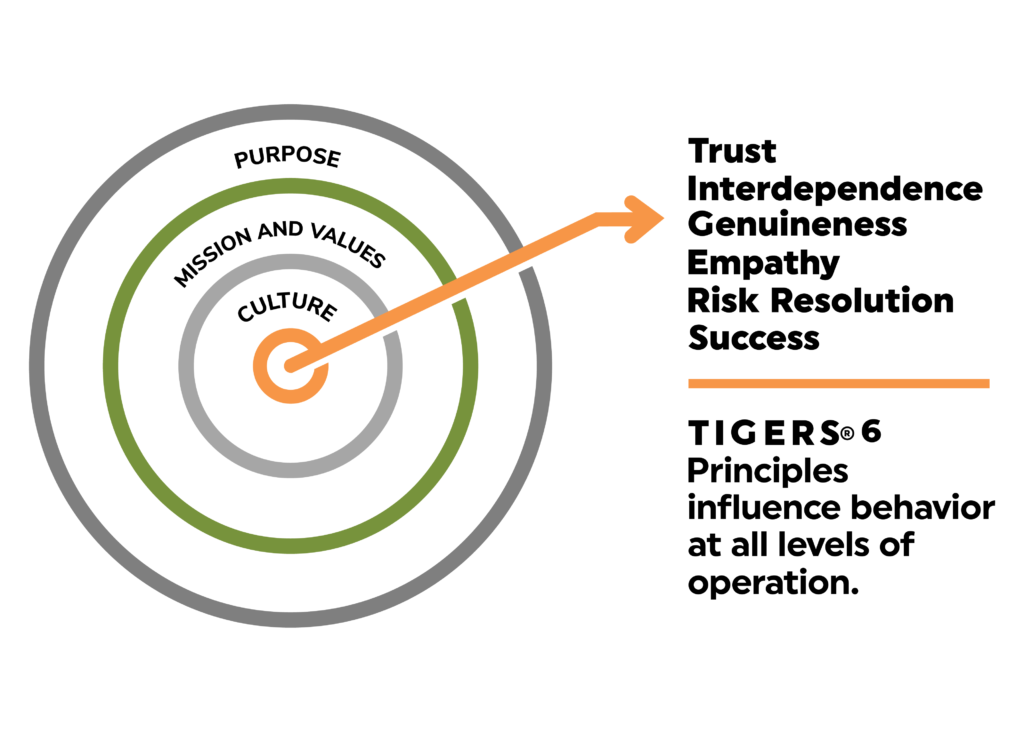
Many companies struggle because their grand organizational goals never translate into everyday employee actions. As the target diagram below illustrates, while your vision, mission, and culture form the vital outer rings of your strategy, the 6 Principles sit at the absolute epicenter of your operations. By focusing directly on this behavioral core, you give your stakeholders a shared, practical language that aligns daily habits with your overarching mission—transforming abstract corporate values into predictable, high-performance results.

Together, these six principles describe the exact conditions working people need to build ethical, quality-focused, and highly engaged collaboration. They are not abstract values or rigid personality labels. Instead, they are practical behavioral principles that help lean teams explicitly define how they communicate, cooperate, solve problems, keep agreements, and achieve sustainable results together.

Trust gives people confidence that commitments will be kept, communication will be honest, and people can rely on one another.

Interdependence helps people understand that their work affects others and that strong performance depends on shared responsibility, clear handoffs, and cooperation.

Genuineness supports honest communication, direct feedback, and the willingness to address what is real rather than working around tension or pretending problems do not exist.

Empathy helps people understand impact, listen with respect, and respond to others as stakeholders in shared success.

Risk Resolution gives teams a way to surface concerns, address conflict, solve problems early, and prevent avoidable breakdowns.

Success clarifies the shared outcomes, standards, and agreements that help people work together toward meaningful results.

When practiced together, these six principles build a reliable, behavior-based framework that transforms how your people communicate, decide, solve, and follow through on commitments. See exactly how these daily behaviors act as the engine at the absolute center of your organization’s strategy in the diagram below:

The tigers framework for building high0performance teams
The 6 Principles sit directly beneath culture formation. When they are practiced, they help make your purpose, mission, and values real through daily behavior. When they are ignored or omitted, culture still forms—but it often forms around inconsistent communication, weak accountability, conflict avoidance, disengagement, or uneven trust.

This is why values on a wall are not enough. Vision and mission statements only become credible when people experience the behaviors that support them. Trust, interdependence, genuineness, empathy, risk resolution, and success are the behavioral conditions that turn stated purpose into a lived stakeholder culture. 

🔍 The Practical Question for Your Team:
Are our daily behaviors making our purpose real, or are they quietly working against it?

The Research Foundation and How the TIGERS 6 Principles Were Validated

The TIGERS 6 Principles did not begin as a values exercise, personality model, or traditional team-building program. They began with one practical research question:
“What is required to build an ethical, quality-focused, productive, engaged, and highly successful group of working people?”

That question matters because group process alone does not guarantee a healthy workplace. Groups can have process and still fail. Teams can meet often and still avoid the truth, protect silos, reward poor behavior, or treat employees as costs rather than stakeholders.
 
To answer that question, Dianne Crampton studied group process and group dynamics research across three distinct lenses:
    • Business: Ensuring sharp quality standards, productivity, and bottom-line success.
    • Education: Understanding how adults actually learn, practice, and transfer new behaviors into daily work.
    • Psychology: Building the psychological safety, genuine communication, and empathy required to support a team.

 This interdisciplinary foundation is important because most workplace models come primarily from just one lens. TIGERS 6 Principles draws from all three because successful workplace groups require more than one perspective.
 
The result is a behavior-focused framework. It does not stop at just “understanding” people. It helps working groups explicitly define the behaviors required to work together ethically, productively, and successfully.

The Compounding Effect and How the 6 Principles Lock Together to Drive Velocity

The TIGERS 6 Principles operate in every group of two or more people who come together to achieve a goal. They influence group behavior every day—whether you are intentionally managing them or not.
 
🛑 The Cost of Friction: When Principles Are Weak
 
When these principles are ignored, companies of 10 to 500 experience predictable, expensive operational problems:
    • Trust breaks down and cooperation becomes uneven.
    • Communication becomes guarded as people avoid difficult truths.
    • Risk is handled too late, leading to costly project delays.
    • Success becomes fragmented because people work from different assumptions.
    • Stakeholders disengage when they are not given a meaningful way to contribute.

⚡ The Competitive Advantage: When Principles Are Unified
 
When these principles are intentionally understood, practiced, and reinforced, your team builds an unstoppable operational foundation:
    • Trust gives people the confidence to communicate honestly and rely on one another while elevating accountabiity.
    • Interdependence ensures people understand how their work affects others, making cooperation a requirement.
    • Genuineness makes daily conversations more truthful and efficient.
    • Empathy strengthens mutual respect, rapid learning, and psychological safety.
    • Risk Resolution empowers teams to surface and fix problems before they turn into major breakdowns
    • Success clarifies the shared outcomes people are working toward.

The six principles are not separate principles to admire. They are connected behavior conditions. Teams that intentionally build these principles into daily work easily outpace competitors. They are not relying on talent alone—they are building the exact ecosystem that helps people work together with clarity, quality, accountability, inclusion, and shared commitment.

Operational Alignment and Turning Soft Concepts Into Common-Sense, Observable Behaviors Behaviors

The TIGERS 6 Principles framework becomes practical only when abstract concepts are translated into behaviors people can physically see, discuss, and improve.
 
Because no two teams are exactly the same, TIGERS is not a cookie-cutter process. A team of emergency responders, a hair salon, and a software engineering team all require trust and empathy—but how those conditions show up in daily work looks completely different:
 
  • The Hair Salon: Tracks Interdependence through seamless customer handoffs and shared station cleanup.
  • The Software Team: Tracks Interdependence through clean code deployments and timely pull-request reviews.
 
🔍 Why Teams Actually Struggle
 
Most workforces do not fail because people dislike trust or collaboration. They struggle because those ideas are never clearly defined.
  • One person’s idea of Trust may mean being left completely alone.
  • Another person’s idea of Trust may mean receiving hourly updates.
  • One manager defines Accountability as consequences, while another defines it as clear, upfront agreements.
 
The TIGERS framework gives your stakeholders a shared playbook to make these hidden expectations visible, measurable, and highly observable:
  • Trust becomes observable when people keep agreements and follow through.
  • Interdependence becomes observable when teams clearly coordinate cross-functional handoffs.
  • Genuineness becomes observable when people give useful feedback and address what is real.
  • Empathy becomes observable when people listen to understand impact and treat coworkers as core stakeholders.
  • Risk Resolution becomes observable when people surface concerns early—before they damage performance.
  • Success becomes observable when outcomes, standards, and shared commitments are clear enough to act on.
 
🔄 The Post-Merger Advantage
 
In post-merger integration or rapid scaling, this behavioral mapping is vital. One company culture should not simply swallow the other. The stronger opportunity is to use this framework to identify the exact conditions and behaviors that elevate both groups, building a brand-new, high-performance way of working together.

Operational Alignment and How TIGERS Differs from Traditional Tools

The TIGERS 6 Principles framework did not begin as an administrative exercise. While traditional tools have their place, they rarely show an agile workforce how to change the daily habits that build or damage team performance. Teams do not improve by admiring good words on a wall; they improve when they can name what is happening and agree on better behaviors.
 
The Culture Framework Matrix

Focus AreaTraditional Values StatementsIndividual Personality ToolsThe TIGERS Behavioral Framework
The Core PurposeDescribes what an organization hopes to stand for.Explains personal preferences and individual communication styles.Defines the exact conditions required for ethical, quality-focused work.
The Operational LevelFunctions at a high-level, corporate-enterprise marketing tier.Focuses heavily on the individual psychological profile.Operates entirely at the group behavior and daily execution level.
The Everyday OutcomeOften results in unread words painted on an office wall.Generates a one-time profile that is rarely converted into daily actions.Creates clear agreements that define how people communicate, coordinate, and follow through. 

Rather than forcing a cookie-cutter template onto your business, TIGERS gives your stakeholders a researched structure. It allows your unique team—whether you run a high-volume salon or a complex software engineering department—to define the precise agreements that eliminate performance drag and protect your culture.

This structural overview is just the beginning. To help you fully operationalize this behavioral framework, we have built exhaustive, 2,000+ word deep-dive playbooks for each of the 6 principles.

Simply hover over The 6 Principles tab in our main navigation menu to open the dropdown list. From there, you can click directly into any individual workplace principle—such as Trust in the Workplace or Risk Resolution—to access industry-specific behavioral metrics, customizable trackers, and real-world case studies designed specifically for your workforce headcount. 

 Bring a Proven Behavioral Architecture to Your Workforce
 
Don’t spend hundreds of hours building leadership or onboarding resources from scratch. Access a ready-to-use, turn-key organizational development system designed to align your managers, protect your human stakeholders, and stabilize performance across your entire company size.