
Why Leadership Development Doesn't Improve Performance
What Great Organizations Do Differently
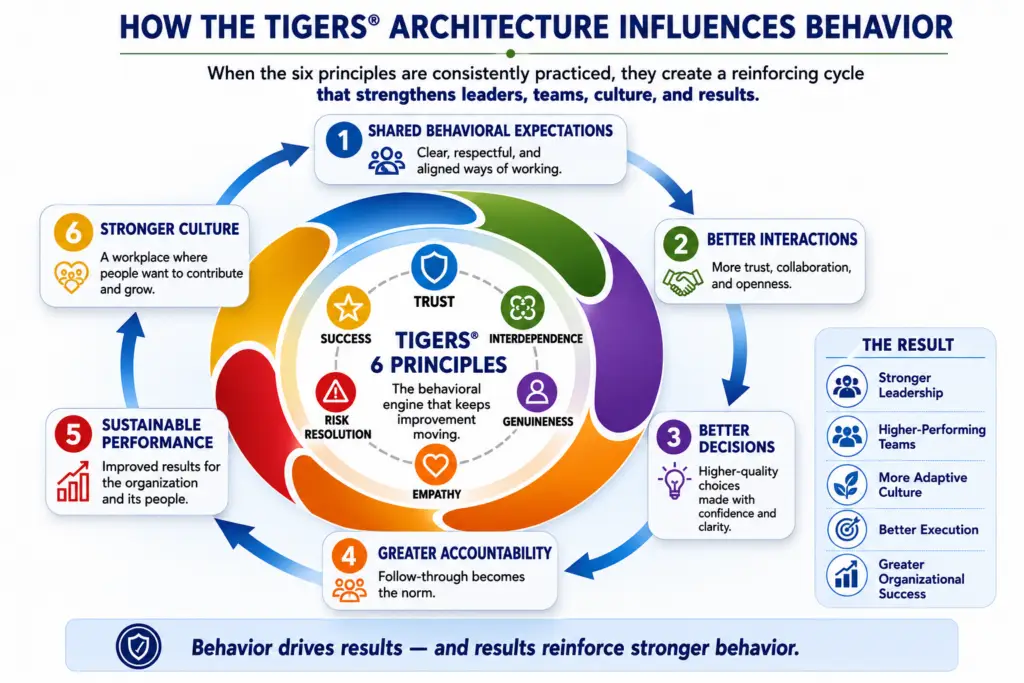
Leadership development has never been more important. Organizations invest billions of dollars each year helping leaders strengthen communication, improve emotional intelligence, develop coaching skills, and become more effective managers. Leadership books fill bestseller lists. Conferences attract thousands of participants. New assessment tools, certifications, and training programs promise better leadership.
Yet despite decades of investment, many organizations continue to face familiar challenges. Trust breaks down under pressure. Accountability becomes inconsistent. Departments work in silos instead of collaborating. High-performing employees become frustrated and disengage. Strategic priorities stall because follow-through varies from one manager to the next.
If leadership development has advanced so dramatically, why do so many organizations continue to struggle with organizational performance?
Perhaps leadership development has been solving only part of the problem. Developing better leaders matters. Developing the behavioral conditions that enable people to succeed together may matter even more.
Leadership Development Has Improved. So Why Haven't the Results?
Over the past several decades, leadership development has evolved dramatically. Organizations have expanded far beyond traditional management training to include executive coaching, emotional intelligence, strengths-based leadership, personality assessments, mentoring programs, and communication skills.
These investments matter. Better leaders often become better listeners, stronger communicators, more thoughtful decision makers, and more effective coaches.
So why do many organizations continue to struggle with trust, accountability, collaboration, and execution? The answer may be simpler than most organizations expect.
Leadership development primarily focuses on improving individual capability. It helps leaders become more knowledgeable, more self-aware, and more effective in their roles.
Organizations, however, succeed or struggle because of something larger than individual capability. They succeed because people know how to work together.
When expectations for everyday behavior differ from one manager to another, employees spend unnecessary time interpreting priorities, adjusting to different leadership styles, and deciding what is acceptable in each department. One team encourages candid feedback. Another avoids difficult conversations. One manager consistently follows through on commitments. Another rarely does.
The result is inconsistency. And inconsistency is expensive. It slows decisions, weakens accountability, erodes trust, and makes collaboration more difficult than it should be.
Leadership development can strengthen individual leaders. But organizational performance depends on something more.
It depends on creating shared behavioral expectations that are understood, practiced, and reinforced throughout the organization.
Organizations Experience Behavior, Not Personality
Leadership development has traditionally focused on developing the individual. Leaders learn to communicate more effectively, coach employees, manage conflict, and understand their own strengths and growth opportunities. These investments are valuable because organizations benefit from capable leaders.
Yet organizations do not experience a leader’s intentions, personality, or leadership philosophy. Organizations experience behavior.
Employees experience whether commitments are honored or forgotten. They experience whether difficult conversations happen respectfully or are avoided. They experience whether managers encourage collaboration or unintentionally create competition between departments. They experience whether people are held accountable consistently or whether expectations change depending on who is leading the meeting.
Behavior is what employees observe every day. Behavior is what shapes trust. Behavior is what influences accountability. Behavior is what determines whether collaboration becomes routine or remains an aspiration.
This distinction matters because organizations are not simply collections of individuals. They are systems of people working together toward shared goals. Every day, hundreds or thousands of interactions either strengthen or weaken those systems.
One leader can inspire a team for a period of time. A system of shared behavioral expectations enables an entire organization to perform consistently over time.
That is why sustainable organizational performance cannot depend solely on developing exceptional leaders. Organizations also need a common behavioral framework that helps people make consistent decisions, build trust across departments, resolve differences constructively, and work toward shared objectives regardless of personality, title, or reporting relationship.
When behavior becomes predictable, trust becomes easier to establish. When trust becomes more consistent, collaboration improves. When collaboration improves, organizations execute more effectively.
Leadership development still matters. It always will.
But lasting organizational performance depends on more than leadership. It depends on creating an environment where people understand the behaviors that enable everyone to succeed together.
Shared Behavioral Norms Create Alignment
Every organization develops behavioral norms. Some emerge intentionally through thoughtful leadership development and organizational design. Others evolve accidentally through habits, assumptions, and inconsistent management practices.
Behavioral norms are the shared patterns of behavior that tell people, “This is how we work together here.” They influence how decisions are made, how disagreements are resolved, how information is shared, and whether commitments are consistently honored. More than policies or mission statements, behavioral norms shape what employees experience every day.
Organizational psychologist Edgar Schein, whose work has influenced leaders and researchers for decades, described organizational culture as the shared assumptions, values, and norms that guide how people think and act within an organization. In other words, culture is not simply what an organization says it values—it is what employees repeatedly experience through everyday behavior.
That distinction is important because behavior becomes visible long before culture becomes measurable.
Employees quickly learn whether meetings start on time, whether leaders keep commitments, whether disagreement is welcomed or discouraged, and whether accountability applies equally to everyone. These repeated experiences become behavioral norms, and those norms begin shaping future behavior.
Research in social psychology has consistently shown that people look to the behavior of others to determine what is expected within a group. Robert Cialdini’s work distinguishes between descriptive norms, what people observe others doing, and injunctive norms, what people believe they are expected to do. When those two align, behavior becomes remarkably consistent across a community or organization.
This helps explain why leadership development alone does not always produce lasting organizational change. It was also important to TIGERS 6 Principles™ original group process research.
A leadership development program may teach a manager how to conduct effective feedback conversations. But if the organization’s behavioral norms reward avoiding conflict, protecting silos, or overlooking broken commitments, the surrounding environment quietly pulls people back toward the established norm. Conversely, when leaders consistently model behaviors that the organization reinforces through recognition, accountability, and shared expectations, those behaviors become the norm rather than the exception.
Researchers Robert Cooke and Denise Rousseau took this idea a step further by demonstrating that organizational culture can be assessed through the behavioral norms and expectations employees experience. Their work shifted attention away from abstract values alone and toward the observable behaviors that employees encounter every day.
That perspective closely reflects the philosophy behind the TIGERS 6 Principles™. Organizations do not strengthen trust because they publish values on a wall. They strengthen trust because people repeatedly experience behaviors that reinforce those values.
They do not improve collaboration because teamwork appears in a strategic plan. They improve collaboration because behavioral norms make cooperation the expected way of working.
They do not create accountability because leaders ask for it once a year during performance reviews. They create accountability because shared behavioral norms make follow-through part of everyday work.
Leadership development remains an essential investment because organizations need capable leaders. Yet sustainable organizational performance emerges when leadership development is reinforced by shared behavioral norms that create consistency across teams, departments, and leadership transitions.
Those norms become the invisible architecture that aligns behavior throughout the organization.
Leadership Development and Lasting Organizational Change Requires More Than Good Intentions
Most leaders already know what good leadership looks like. They understand the importance of trust. They recognize the value of accountability. They appreciate honest communication, collaboration, and employee engagement. Few organizations struggle because they lack awareness of these ideas.
The greater challenge is turning those ideas into consistent organizational practice.
Management scholars Jeffrey Pfeffer and Robert Sutton described this challenge as the knowing-doing gap—the distance between understanding what should happen and consistently making it happen. Organizations often possess the knowledge to improve performance, yet struggle to translate that knowledge into everyday behavior.
Leadership development can close part of that gap by increasing individual knowledge and capability. But knowledge alone rarely changes an organization.
People return from conferences energized. Leadership teams complete strategic planning retreats with renewed commitment. Managers leave training programs with notebooks full of ideas.
Then everyday work resumes. Deadlines compete with development. Urgent problems crowd out important conversations. Existing habits quietly reassert themselves. Before long, many organizations find themselves operating much as they did before the training occurred.
This pattern is not evidence that leadership development has failed. It is evidence that organizational change requires more than individual learning. Behavior becomes sustainable when organizations intentionally reinforce it through everyday work.
That is why many organizational development professionals have shifted their focus from delivering information to creating environments where desired behaviors are easier to practice, observe, reinforce, and sustain over time.
Organizations that consistently improve performance rarely depend on inspiration alone. They build systems that help people apply what they already know.
Those systems create structure without becoming rigid. They provide common language without eliminating flexibility. They help managers reinforce shared behavioral norms while allowing individual leadership styles to flourish.
Over time, implementation becomes less about remembering a training program and more about strengthening the everyday habits that define how people work together. That is where lasting organizational transformation begins.
In Leadership Development and Organizational Development Consistency Creates Trust
Trust is often described as the foundation of high-performing organizations and leaders. Less often discussed is how trust actually develops.
Trust does not emerge because an organization values it, writes it into a mission statement, or includes it in a leadership development program. Trust develops when people repeatedly experience consistent behavior over time.
Employees begin asking themselves important questions, even if they never say them aloud.
Can I rely on what I’m being told?
Will commitments be honored?
Will expectations remain consistent?
Will I be treated fairly if something goes wrong?
Can I safely raise a concern or offer a different perspective?
Every interaction provides another answer. Over time, those answers form a pattern.
When behavior is consistent, people begin to anticipate what will happen before it happens. That predictability reduces uncertainty. As uncertainty declines, confidence grows. People become more willing to collaborate, share information, solve problems together, and make commitments because they trust the environment in which they are working.
The opposite is equally true. When expectations shift without explanation, accountability depends on who is leading the meeting, or similar situations receive different responses, uncertainty increases. People become more cautious. They protect information, avoid difficult conversations, delay decisions, and spend more time managing risk than creating value.
Inconsistent behavior doesn’t simply create confusion. It gradually weakens trust.
This is why behavioral norms are so important. Shared behavioral norms increase the likelihood that employees experience similar expectations regardless of department, manager, or organizational level. They reduce the need for employees to constantly interpret changing expectations and instead allow people to focus their energy on accomplishing meaningful work.
Leadership development helps leaders understand the importance of trust. Shared behavioral norms help organizations practice trust every day. That distinction is significant.
Organizations become trustworthy not because every leader has the same personality or leadership style, but because people experience a consistent pattern of behaviors that they can rely upon across the organization. When consistency becomes part of everyday work, trust becomes less dependent on individual leaders and more characteristic of the organization itself.
From Intended Culture to Experienced Culture
Every organization has an intended culture. Founders and senior leaders define it through their vision, mission, values, and strategic goals. They describe the kind of organization they want to build, the standards they expect, and the impact they hope to achieve.
For some organizations, employees are viewed primarily as a cost of doing business. For others, employees are recognized as essential stakeholders in creating long-term organizational success. That foundational belief shapes countless decisions, from hiring and leadership development to customer service, innovation, quality, and accountability.
An organization’s intended culture begins with these choices. But employees do not experience vision statements. They experience behavior.
Every interaction answers an important question. “How do people really work together here?”
Employees notice whether commitments are honored or forgotten. They observe whether leaders welcome different perspectives or discourage disagreement. They watch how conflict is handled, whether accountability is applied consistently, and whether collaboration is genuinely encouraged or simply discussed. These repeated experiences become the organization’s experienced culture.
When the experienced culture reflects the organization’s intended culture, employees develop confidence that leadership means what it says. Vision, mission, and values become more than aspirational statements. They become visible in everyday decisions and relationships.
When the two are misaligned, however, employees receive conflicting messages. The organization may promote teamwork while rewarding individual competition, emphasize quality while celebrating speed at any cost, or encourage open communication while avoiding difficult conversations. Over time, those inconsistencies weaken trust, create uncertainty, and make it difficult for people to know what behaviors are truly expected.
This is why organizational transformation cannot be achieved through vision, mission, and values alone. Those elements establish direction. Shared behavioral norms translate that direction into daily practice. They provide the consistent behavioral expectations that help people understand not only what the organization is trying to accomplish, but how people are expected to work together to accomplish it.
When shared behavioral norms are reinforced consistently over time, the gap between intended culture and experienced culture begins to close. That is where meaningful organizational transformation occurs.
Employees no longer have to interpret what the organization values. They experience those values through the behaviors they encounter every day.
A Behavior-Based Leadership Development Architecture
Most leadership models focus on developing better leaders. Behavior-based leadership development architecture asks a broader question. How does an organization create the behavioral conditions that enable people to work together consistently, regardless of individual leadership style? That distinction matters.
Exceptional leaders can inspire teams, communicate a compelling vision, and influence the people around them. Yet even the most capable leaders eventually discover that lasting organizational performance depends on more than individual leadership ability. It depends on whether the organization itself reinforces the behaviors that support trust, cooperation, accountability, quality, and shared success.
Leadership architecture provides that organizational framework. Rather than relying on individual personalities or isolated leadership practices, it establishes shared behavioral expectations that become part of how the organization operates every day. Those expectations help align decision making, communication, problem solving, conflict resolution, and accountability across teams and departments.
When these behaviors are consistently reinforced, they evolve into behavioral norms. Over time, those norms strengthen the organization’s ability to adapt, solve problems, maintain quality, and build trusting relationships across all levels of the organization.
Leadership development remains essential. People grow. Leaders grow. Organizations should continue investing in developing leadership capability.
Leadership architecture complements that investment by creating an organizational environment where those leadership skills can be practiced consistently and reinforced through everyday work. Instead of depending on exceptional individuals, organizations begin developing exceptional ways of working together. That is the purpose of a behavior-based leadership development architecture.
Universal Behavioral Principles Operate Whether We Intend Them to or Not
Organizations often invest considerable time defining their vision, mission, values, and strategic objectives. Those efforts establish direction and express what leaders hope to accomplish.
Yet every organization is also influenced by another set of forces. These are behavioral forces that shape how people actually work together every day.
These forces are not created simply because an organization chooses to acknowledge them. Nor do they disappear when they are overlooked.
People will either trust one another or they won’t. They will either share responsibility for collective success or retreat into silos. They will either communicate openly or withhold important information. Conflict will either be resolved constructively or allowed to damage relationships and performance. People will either feel respected and understood or become increasingly disengaged. Success will either be pursued in ways that strengthen the organization or in ways that undermine long-term cooperation.
These realities exist wherever people work together toward shared objectives. The question is not whether these behavioral principles influence organizational performance. The question is whether leaders intentionally strengthen them or allow them to develop by default.
Organizations cannot opt out of the behavioral conditions that shape collective performance. They can only choose whether those conditions evolve intentionally or unintentionally. That distinction is significant.
When behavioral principles are left to chance, each leader, department, or team gradually develops its own interpretation of what good leadership, accountability, cooperation, and success look like. Over time, those differences become inconsistent behavioral norms that weaken organizational alignment and make sustainable performance more difficult.
When organizations intentionally define and reinforce shared behavioral expectations, those same principles become a source of stability. People understand not only what the organization is trying to accomplish, but also how they are expected to work together to accomplish it.
This is why behavior-based leadership architecture begins with universal behavioral principles rather than management techniques or personality styles. The principles themselves remain constant because they reflect recurring patterns of human interaction that influence collective performance in every organization.
How those principles are expressed, however, should be customized to the organization’s mission, work, responsibilities, and strategic objectives. A manufacturing company and a hospital will not demonstrate these behaviors in exactly the same ways. A school district and a technology company will develop different behavioral examples.
The principles remain the same. The behaviors that express those principles are intentionally designed to support the organization’s unique work. That combination, a universal behavioral foundation expressed through work-specific behavioral expectations, is what enables organizations to build cultures that are both consistent and uniquely their own.
Closing the Manager Alignment Gap
What happens when every manager sincerely believes they are leading well—but they are leading differently? That question gets to the heart of one of the most common and costly challenges organizations face.
Most managers are committed professionals. They care about their employees, want their teams to succeed, and work hard to achieve organizational goals.
The challenge is rarely commitment. The challenge is alignment.
Without a shared behavioral framework, managers naturally develop their own interpretations of accountability, communication, collaboration, conflict resolution, recognition, and success. Each interpretation may seem reasonable in isolation, yet together they create inconsistent experiences for employees across the organization.
Over time, those inconsistencies become the Manager Alignment Gap. The gap is the difference between the leadership experience employees should have and the one they actually have.
That gap cannot be closed through good intentions alone. It closes when managers share common behavioral expectations while retaining the flexibility to lead in ways that fit their personalities, responsibilities, and teams.
Behavioral alignment does not require leaders to become identical. It enables them to become consistently effective.
When managers reinforce the same behavioral principles, employees experience greater consistency, trust becomes more predictable, collaboration improves across organizational boundaries, and the organization’s intended culture is reflected more accurately in everyday work.
That is why leadership architecture matters. It provides the common behavioral foundation that allows leadership development to scale beyond individual excellence into organizational excellence.