
How TIGERS Works
Strengthen Leadership, Collaboration, and Accountability to Improve Organizational Performance
Why Leadership and Culture Initiatives Often Fall Short
Behavior-based organizational development helps organizations translate their mission, values, and strategic priorities into the everyday behaviors needed to achieve results. Without a shared behavioral foundation, communication breaks down, collaboration weakens, accountability becomes inconsistent, and managers struggle to resolve problems before they disrupt performance.
When behaviors are left open to interpretation, consistency disappears. Managers develop different expectations. Teams establish different informal norms. Trust becomes inconsistent, collaboration depends on individual personalities, and accountability is experienced differently across the organization. Over time, even well-designed initiatives lose momentum because people are no longer working from the same shared behavioral expectations.
Lasting organizational improvement requires more than a compelling vision, good intentions, or another leadership initiative. It requires a shared behavioral foundation that helps people work together consistently.
The challenge is rarely commitment.
The challenge is creating consistency.
For a deeper look at why leadership development alone may not translate into better organizational results, read Why Leadership Development Doesn’t Improve Performance.
Organizational Problems That Undermine Performance
Organizational performance depends on more than having capable people and well-defined goals. It also depends on how effectively people coordinate their efforts, communicate expectations, make decisions, and address problems together. When these behaviors are inconsistent, organizations can experience recurring problems that consume time, weaken collaboration, and make results more difficult to achieve.
Misalignment among managers. When managers interpret priorities, responsibilities, and accountability differently, employees receive inconsistent direction. Teams may work toward the same organizational goals without a common understanding of expectations or how their work connects. The Manager Alignment Gap explores this challenge in greater depth.
Communication breakdowns. Important concerns may go unspoken, feedback may be avoided, and misunderstandings can persist. Decisions become harder to make when people lack the information or candor needed to address issues directly.
Siloed departments and teams. People may concentrate on their own responsibilities and departmental targets without coordinating effectively with others. This can contribute to duplicated effort, delays, competing priorities, and missed opportunities to achieve shared goals.
Inconsistent accountability. When commitments, responsibilities, and follow-through are not clearly understood, work can stall. Managers may spend time chasing commitments or resolving problems that could have been addressed earlier through clearer expectations and better coordination.
Unresolved conflict and recurring problems. Differences in priorities, assumptions, or perspectives can become personal disputes or remain unaddressed. Problems that are not surfaced and resolved constructively may recur, disrupting relationships and work.
Leadership development that fails to translate into daily practice. People may learn useful concepts in training without consistently applying them in the workplace. Without opportunities to practice, reinforce, and assess new behaviors, the benefits of development can be difficult to sustain.
These problems often reinforce one another. Misaligned expectations affect communication. Poor communication complicates accountability. Unresolved differences weaken collaboration. Over time, the organization can expend considerable effort managing preventable friction instead of advancing its priorities.
Addressing these challenges requires more than telling people to communicate better, collaborate more, or take greater responsibility. Organizations need a practical way to clarify the behaviors that support their goals and develop greater consistency in how people work together.
Behavior-Based Organizational Development Connects Goals and Workplace Behavior
Organizations can have a clear mission, a compelling vision, established values, and well-defined strategic goals—and still struggle to turn those intentions into consistent results. The challenge often lies in how people communicate, make decisions, coordinate their efforts, address problems, and fulfill their commitments in everyday work.
Organizational goals depend on how people work together to achieve them. When expectations for workplace behavior differ across leaders, teams, or departments, misunderstandings can persist, collaboration can become inconsistent, and accountability can be difficult to sustain. People may be working hard toward the same organizational goals without sharing a clear understanding of how their efforts need to come together.
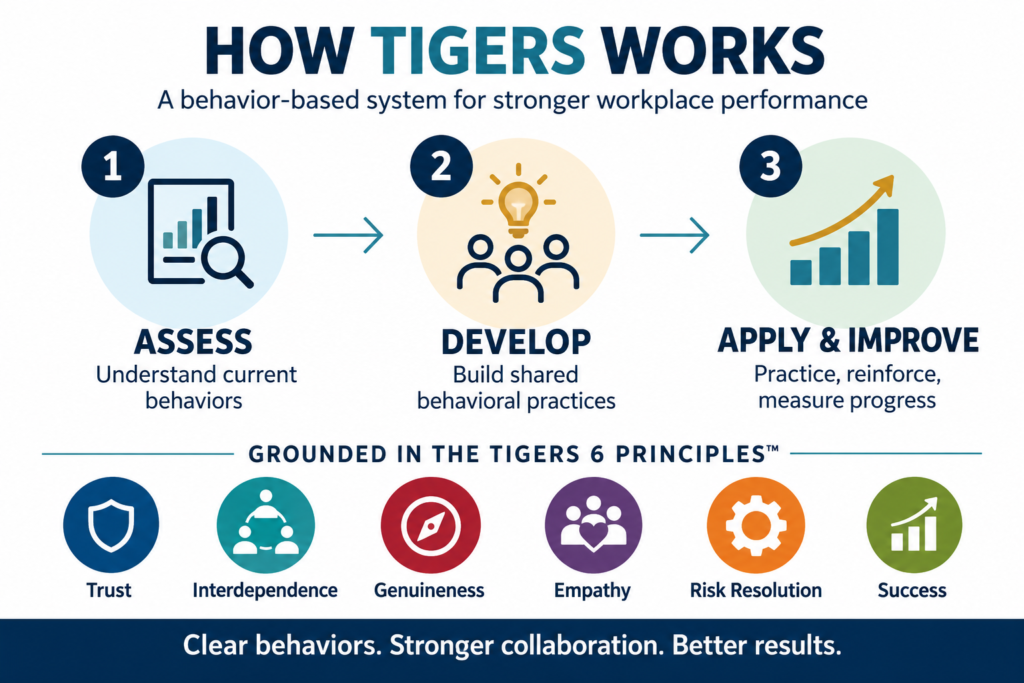
The TIGERS® Behavior-Based Leadership Architecture addresses this challenge by connecting organizational purpose and goals to the behaviors people need to work together effectively. Its foundation is the TIGERS 6 Principles™: Trust, Interdependence, Genuineness, Empathy, Risk Resolution, and Success.
These six universal behavioral principles provide a common foundation for developing shared behavioral expectations. They do not prescribe identical behaviors for every organization. Instead, each organization translates the principles into practices that reflect its mission, responsibilities, operating environment, and goals.
Whether people work in emergency response, education, healthcare, manufacturing, government, technology, or nonprofit organizations, the specific practices will differ. The underlying need remains the same: people must be able to work together effectively to accomplish a shared purpose.
How TIGERS Turns Principles into Workplace Practice
The TIGERS 6 Principles™ provide a universal behavioral foundation for people who combine their efforts to accomplish a shared purpose. But knowing the principles is only the beginning. Organizations must translate them into observable behaviors that reflect their mission, responsibilities, operating environment, and goals.
TIGERS helps leaders and teams establish clear expectations for how people communicate, make decisions, coordinate responsibilities, address differences, resolve problems, and follow through on commitments. These expectations create a shared understanding of what effective collaboration looks like in everyday work.
The practices are tailored to the organization rather than prescribed identically for every workplace. Leaders and teams can identify the behaviors that support their goals, recognize where inconsistent practices create obstacles, and determine what needs to change.
Through leadership development, facilitated application, feedback, and practical tools, organizations can build the capabilities people need to put those behaviors into practice. The goal is not simply to understand the principles, but to make them part of how people work together.
Behavior-based organizational development connects the principles to observable workplace practices that reflect each organization’s mission and goals.
Turning Behavior into Measurable Improvement
Organizations cannot improve behaviors they cannot clearly observe, discuss, reinforce, and assess. Behavior-based organizational development helps leaders identify behavioral gaps, reinforce effective practices, and evaluate progress over time.
When behavioral expectations remain vague, progress is difficult to recognize. Teams rely on assumptions, leaders interpret success differently, and improvement depends too heavily on individual effort rather than shared organizational learning.
The TIGERS 6 Principles™ provide a framework for making workplace behavior more visible and understandable. When behavioral expectations are clearly defined, leaders and teams can recognize effective practices, identify gaps, and establish a basis for ongoing improvement.
This approach helps transform organizational development from a series of isolated initiatives into a continuous learning process in which workplace behavior and organizational capabilities can develop over time.
The TIGERS Workforce Behavioral Profile™ and organizational diagnostics support this process by helping organizations examine current behavioral patterns, recognize strengths, identify opportunities for development, and assess progress.
When workplace behavior becomes observable and assessable, organizations have a clearer basis for continuous improvement.
Built Through Research, Application, and Continuous Learning
The TIGERS 6 Principles™ did not begin with six predetermined principles or another leadership model.
They began with a simple question:
What conditions are required for people to work together ethically, productively, collaboratively, and successfully whenever they share a common purpose?
The search for that answer led across business, education, and the behavioral sciences. Rather than finding a single theory or management approach that fully explained organizational success, recurring patterns emerged across decades of research, practical application, and continuous learning.
One discovery became increasingly clear.
Shared behavior was the common thread.
Organizations differed in their missions, industries, structures, and goals, yet the conditions that consistently supported successful collaboration remained remarkably similar. Those recurring patterns became the foundation for the six universal behavioral principles that today form the TIGERS 6 Principles™ Behavior-Based Organizational Architecture.
The framework continues to evolve through research, practical application, organizational feedback, and ongoing validation while remaining grounded in the same six universal behavioral principles.
Discover Your Organization's Starting Point
Understanding how organizations improve naturally leads to another question.
How do these behavioral conditions show up in our organization today?
Every organization has strengths. Every organization also has opportunities to strengthen the behaviors that influence leadership effectiveness, collaboration, communication, accountability, and organizational performance.
The first step toward meaningful improvement is understanding your organization’s current behavioral conditions. Before organizations can strengthen trust, improve collaboration, increase accountability, or build healthier workplace relationships, they first need a clear picture of the behaviors that already support—or limit—their success.
Our complimentary diagnostic helps leaders identify behavioral strengths, uncover opportunities for improvement, and establish a practical baseline for continuous organizational improvement.
Better organizational decisions begin with a clearer understanding of current conditions.
Download the complimentary diagnostic and discover where your greatest opportunities for improvement may exist.
Every meaningful organizational improvement begins with understanding today’s behavioral reality.