How leadership behavior, uncertainty, AI and organizational pressure contribute to a toxic workplace culture
Toxic workplace conditions rarely emerge from one decision, one difficult employee, or one bad day. They develop when the behaviors, relationships, decisions, and conditions within an organization begin reinforcing fear, uncertainty, self-protection, and silence.
That distinction matters. Because a toxic workplace is often discussed as though the problem resides in a person. A toxic leader. A difficult manager. A disengaged employee. A dysfunctional team.
But organizations don’t operate as collections of isolated people. They operate as systems. And when the behavior of one part of the system changes, other parts respond.
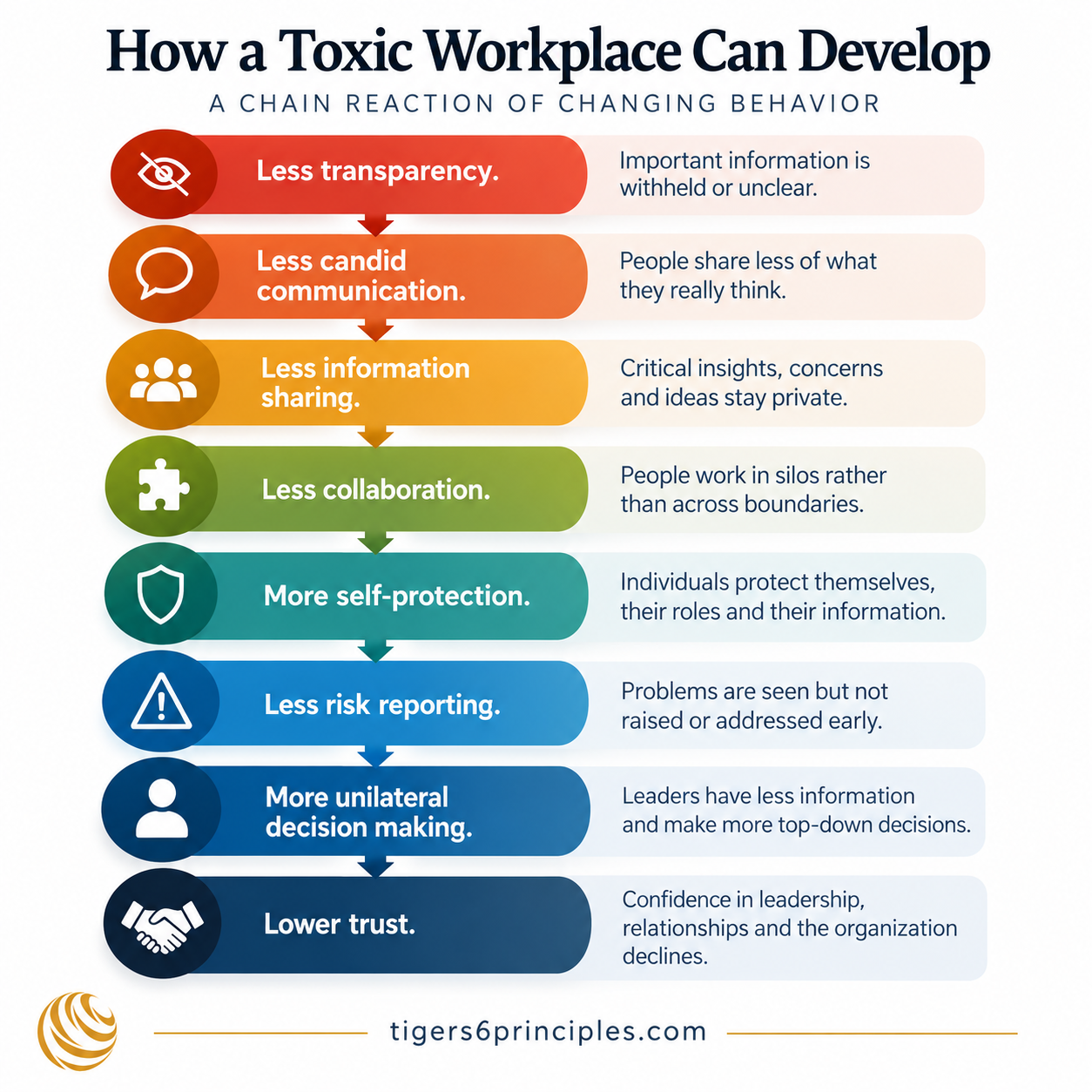
A leader becomes less transparent. Employees become more cautious. Cautious employees share less information. Less information makes problems harder to see. Problems that are harder to see become harder to solve. Leaders then have less information and may centralize more decisions. Employees experience greater uncertainty.
And the cycle continues. That is how a toxic workplace can develop without anyone formally deciding to create one.
What makes a toxic workplace toxic?
The American Psychological Association’s 2024 Work in America survey found that 15% of respondents described their workplace as somewhat or very toxic. The APA describes toxic workplaces as environments involving behaviors such as infighting, intimidation and other harmful conditions, with potential consequences including absenteeism, lower productivity and turnover.
But the word toxic can sometimes become too broad to be useful. It can become a label applied to almost anything people dislike about work. The more useful question is, what is happening behaviorally?
Are people afraid to speak?
Are concerns being suppressed?
Are employees withholding information?
Are leaders responding differently under pressure?
Are people becoming less willing to disagree?
Are teams protecting themselves rather than working across boundaries?
Are problems being surfaced later—or not at all?
Those are observable behaviors. And observable behaviors can tell us much more about a toxic workplace than a label alone.
Fear Can Look Like Compliance Before It Looks Like Failure
One of the most dangerous characteristics of a toxic workplace is that it may function reasonably well on the surface.
People still come to work.
Projects still move.
Meetings still happen.
Employees may still meet their deadlines.
There may even be less visible conflict.
But less visible conflict is not necessarily healthier conflict. People may simply have learned that speaking up isn’t worth the risk.
They may stop challenging decisions.
They may agree in meetings and complain privately.
They may see a problem and decide not to report it.
They may have an idea and keep it to themselves.
They may know something important about a customer, process, employee or emerging risk and decide that remaining silent is safer. Fear can look like compliance before it looks like failure.
That is why the behavioral effects of a toxic workplace can be difficult to detect early. The organization doesn’t necessarily become dysfunctional overnight. The behavioral system shifts incrementally. And the organization itself can teach employees how to respond.
The Behavior of the Organization Teaches the Behavior of the Workforce
Imagine an employee raises a difficult concern. Something happens afterward. Perhaps the employee loses influence. Perhaps they are removed from a project. Perhaps they are excluded from important conversations. Perhaps they leave. Perhaps they are terminated. There may be legitimate reasons for the decision. But everyone watching the event receives information about the consequences of speaking up.
They don’t need a memo explaining the lesson. They observe it. And they adapt.
“Be careful.”
“Don’t become the next person.”
“Keep your concerns to yourself.”
This is one of the mechanisms through which a toxic workplace can reproduce itself. Research published in 2026 examining a six-year case study of a technology company found that patterns of employee voice and silence can become part of the mechanisms through which toxic organizational cultures emerge and persist. The researchers specifically examined how fear of retaliation, organizational norms and power relationships influence whether people speak or remain silent.
That is an important shift in perspective. The question isn’t only, what did the leader do? It is also, what did everyone else learn from watching it happen?
A Toxic Workplace Is a System
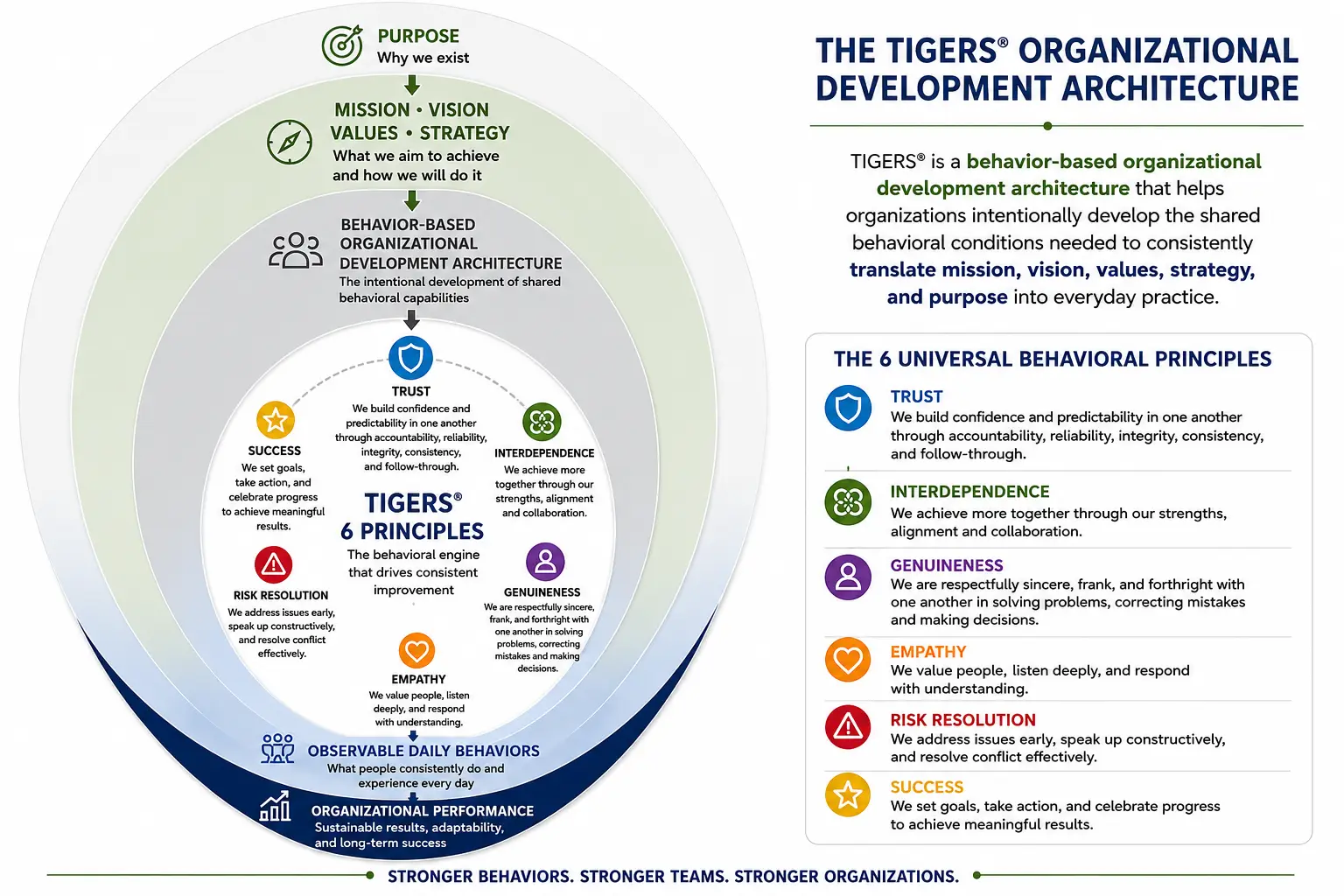
This is where the six TIGERS® Principles become particularly useful. Trust. Interdependence. Genuineness. Empathy. Risk Resolution. Success.
They are not six independent boxes. They describe interconnected behavioral conditions. When one begins to deteriorate, the effects can move through the others. Consider what happens when fear enters the system.
Trust
Can I trust leadership with what I really think?
Trust is affected when employees cannot predict how leadership will respond to disagreement, bad news, mistakes or concerns. The issue isn’t whether leadership believes it is trustworthy. The issue is whether people experience enough consistency and competence to trust the relationship.
Genuineness
Is it safe to be respectfully sincere, frank and forthright?
Genuineness becomes especially important when circumstances are difficult. If employees believe that frank communication creates personal risk, they may continue communicating—but with less of the information leadership most needs. The organization may hear communication without hearing the truth.
Empathy
Does anyone understand what this uncertainty is doing to people?
Empathy requires understanding and valuing different perspectives, without having to agree. A decision can be operationally necessary and still have significant consequences for how people experience their work. When those experiences aren’t understood, people may conclude that their perspective doesn’t matter.
Interdependence
Can I rely on other people—or do I need to protect myself?
Interdependence requires people to work across roles and boundaries. Fear can push behavior in the opposite direction. People protect information. Protect relationships. Protect their jobs. Protect themselves. The organization becomes more fragmented precisely when it needs people to work together.
Risk Resolution
Should I raise this problem—or keep my head down?
This may be one of the most consequential changes in a toxic workplace. Organizations need people to identify risk. They need people to challenge assumptions. They need people to say, “Something isn’t working.” But if raising risk has consequences, employees may stop making risk visible. The risk hasn’t disappeared. Visibility of the risk has disappeared.
Success
Are we balancing organizational performance with the satisfaction people feel in accomplishing their work?
Success is not simply a financial or operational result. It includes the balance between organizational performance and the satisfaction people feel in accomplishing their work. A workplace can achieve short-term output while simultaneously damaging the behavioral conditions required for sustainable performance. That is why Success belongs in the system.
What History Tells Us About Power and Employee Voice
The relationship between organizational power and employee voice is not a new concern. American labor history provides an important example.
Before the modern federal labor-relations framework developed, employers could use powerful tools against organized workers, including surveillance, interrogation, discipline, discharge and blacklisting. The National Labor Relations Board’s historical account describes intense labor-management hostility during the 1920s and notes that the use of labor injunctions to stop strikes reached its peak during that period.
This is important because it shows that workplace behavior has never existed entirely outside the larger social and economic system. When the balance of power between employers and workers becomes highly contested, the consequences can extend beyond individual employment relationships.
During the Great Depression, Congress intervened. The Norris-LaGuardia Act of 1932 restricted federal courts’ ability to issue injunctions against strikes and declared a federal policy supporting workers’ freedom to organize and bargain collectively. Then came the National Labor Relations Act of 1935, commonly known as the Wagner Act. The law created the National Labor Relations Board and established protections for employees’ rights to organize, bargain collectively and engage in certain concerted activities. The National Archives describes the law as an effort to address labor disputes that burdened or obstructed interstate and foreign commerce.
The significance for today’s organizations isn’t that history is repeating itself. It isn’t. And this isn’t an argument about any particular political administration.
The historical lesson is more fundamental. When the relationship between authority and employee voice becomes sufficiently unstable, society may eventually intervene because the consequences extend beyond one workplace.
Government intervention addressed questions of legal rights and bargaining power. But government cannot create the behavioral conditions required for people to trust one another, communicate honestly, collaborate effectively and solve problems together. That remains an organizational responsibility. And that distinction is important. Legal power and organizational wisdom are not the same thing.
The Modern Version of the Problem Is More Complicated
Today, the pressures entering a toxic workplace can be very different. Organizations face restructuring. Global competition. Economic uncertainty. Rapid technological change. Artificial intelligence. Changing workforce expectations. And repeated organizational transformation.
AI is particularly important because it can introduce a new form of uncertainty. But AI itself is not necessarily the cause of a toxic workplace. The question is how people experience the way AI is introduced and governed.
A 2026 study of 407 employee-HR dyads across Korean industries found that AI-induced job insecurity operated through psychological safety and knowledge-sharing behavior in its relationship with sustainable innovation. The researchers also found that AI transparency and employee agency could buffer the negative effect of insecurity on psychological safety.
The population matter. This was research involving Korean organizations, not a representative study of American workers. But the behavioral pathway is important.
Uncertainty can affect psychological safety. Psychological safety can affect whether people share knowledge. Knowledge sharing affects how organizations learn and innovate. That is a system. And that is why simply asking whether AI will eliminate jobs is too narrow a question.
Employees may also be asking:
- Will I have a voice in what happens?
- Will leadership explain what is changing?
- Will my knowledge still matter?
- Can I disagree?
- Can I tell someone when the technology isn’t working?
- Will someone listen?
Those are behavioral questions.
Change Can Expose the System
Recent research from Insights provides another reason to look at organizational behavior as a system rather than as a collection of individual leadership traits. Its 2026 Global Change Readiness Report surveyed 880 HR and people leaders across 11 markets.
Eighty-one percent reported observing senior executives behaving differently during their organization’s most recent significant change. Even more revealing, 44% of leaders whose behavior became more negative were perceived as unaware that their behavior had changed.
That finding challenges a simple explanation of toxic workplace behavior. The problem isn’t always a leader consciously deciding to intimidate people. Pressure can change behavior.
A leader who normally welcomes disagreement may become more unilateral. A leader who normally communicates openly may become less transparent. A leader who normally collaborates may centralize decisions. A leader who normally tolerates uncertainty may become much less patient with questions.
The organization experiences the behavior. The leader may not recognize the change. And employees adapt. That is why behavioral awareness before and during significant change matters.
The Question Is Not Only Whether a Leader Is Toxic
This is where organizational conversations can become trapped. We look for the bad actor. We identify the problem leader. We recommend coaching. Or we eventually ask whether the leader needs to be replaced.
Sometimes leadership change is necessary. But what if the question is coming too late? What if the organization could identify the behavioral deterioration before it became a leadership crisis? Consider the progression.
Less transparency. Less candid communication. Less information sharing. Less collaboration. More self-protection. Less risk reporting. More unilateral decision making. Lower trust.
By the time the organization recognizes a “culture problem,” the pattern may have been developing for months or years. That is the opportunity for behavioral measurement.
From Culture Diagnosis to Behavioral Micro-Adjustment
Traditional organizational development often asks large questions. Are employees engaged? Do employees trust leadership? Is the culture healthy? Are people ready for change?
Those questions have value. But they can also produce a problem. They tell us that something is happening without always telling us enough about how the behavior is changing.
A behavioral-systems approach asks smaller questions. Where is trust beginning to weaken? Where is frank communication declining? Where are people becoming more protective of information? Where are teams collaborating less across boundaries? Where are concerns being raised later? Where are leaders changing their behavior under pressure? And perhaps most importantly, what small behavioral adjustment could change the trajectory?
That is where the concept of micro-adjustment becomes important.
A micro-adjustment might involve:
- changing how a leader responds to bad news
- clarifying who has decision authority
- creating a safer mechanism for disagreement
- making communication more transparent
- explicitly inviting dissenting perspectives
- changing how risk is surfaced
- repairing a relationship between two roles or teams
- reinforcing accountability without creating fear
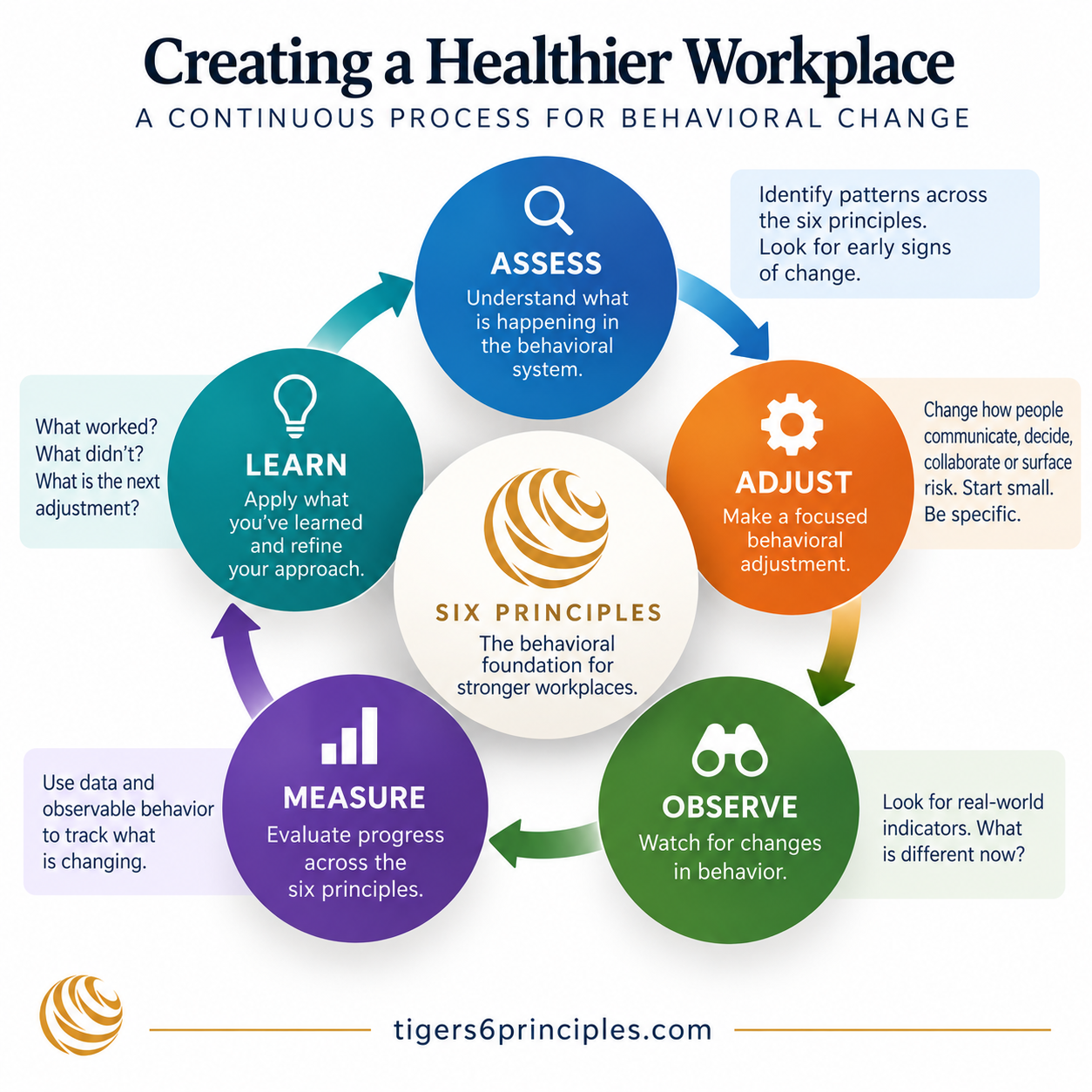
Then observe. Measure. Learn. Adjust again.
The process becomes:
Assess → Adjust → Observe → Measure → Learn
Rather than:
Wait → Diagnose → Intervene
That is a very different model of organizational development.
What the TIGERS Workforce Behavioral Profile Makes Possible
This is the direction in which the TIGERS Workforce Behavioral Profile™ becomes particularly relevant. Its purpose is not simply to give an organization another employee survey. The larger opportunity is to understand behavioral patterns across the six principles and identify where attention may be warranted.
The principles are simple by design. The behavioral architecture, measurement and application behind them are not. And every organization is different. The behavioral patterns needed in a hair salon may be very different from those required in emergency response.
A hospital.
A technology company.
A manufacturing operation.
A professional-services firm.
A nonprofit.
The principles can remain constant while the behavioral expression changes according to the organization’s mission, people, work and environment. That distinction matters. Because organizational development shouldn’t require every organization to behave the same way. It should help each organization understand the behaviors it needs to accomplish its work—and recognize when those behaviors are beginning to change.
A Toxic Workplace Does Not Have to Begin With a Toxic Leader
This may be the most important distinction in the entire conversation. A toxic workplace can emerge from a system of reinforcing behaviors.
Fear can lead to silence. Silence can reduce information. Reduced information can weaken decisions. Weaker decisions can increase uncertainty. Uncertainty can increase self-protection. Self-protection can reduce collaboration. Reduced collaboration can make problems harder to solve. And the resulting performance pressure can create more fear.
That is a system.
It doesn’t require one person to be intentionally toxic at every stage. It requires behaviors to reinforce one another. And once the pattern becomes established, changing one individual may not change the system.
What Happens When People Stop Telling Leaders What They Need to Hear?
This is ultimately a leadership question. Not a political question. Not simply an HR question. Not simply an AI question. Not even simply a culture question. It is a behavioral-system question.
What happens when people become afraid to tell those in power what they need to hear? What happens when the organization teaches people that compliance is safer than candor? What happens when leaders stop receiving the information they need to make good decisions? And what happens to the organization when everyone becomes very good at protecting themselves?
These questions matter because organizations depend on something that cannot be mandated by a policy. People telling the truth about what is happening, simply doesn’t happen in a toxic workplace environment.
The Organization Is Always Teaching
Every leadership decision teaches something. Every reaction to bad news teaches something. Every response to disagreement teaches something. Every employee who raises a concern teaches something. And every response to that employee teaches everyone watching what behavior is safe.
That is why the six TIGERS Principles should not be treated as six isolated leadership competencies. They are part of a behavioral system.
Trust affects whether people speak.
Genuineness affects whether they speak frankly and respectfully.
Empathy affects whether different perspectives are understood.
Interdependence affects whether people work together across boundaries.
Risk Resolution affects whether problems are surfaced and solved.
Success asks whether organizational performance remains balanced with the satisfaction people feel in accomplishing their work.
Change one part of that system, and the others may respond. That is the deeper question behind a toxic workplace. Not simply, who is the toxic person?” But, what is the organization teaching people to do?”
And perhaps the question that matters even more, how would we know the behavioral system was changing before the consequences became impossible to ignore?” That is where measurement matters. That is where behavioral micro-adjustments matter. And that is where organizational development can move beyond reacting to dysfunction toward understanding and changing the system while it is still capable of change.
Sources
- APA, Toxic workplaces leave employees sick, scared, and looking for an exit (2024). APA workplace research
- Kim & Lee, How Human-Centered AI Buffers the Negative Effects of AI-Induced Job Insecurity on Sustainable Innovation (2026). Research article and DOI
- Insights, Global Change Readiness Report 2026. Insights Global Change Readiness research
- National Labor Relations Board, Pre-Wagner Act Labor Relations. NLRB historical account
- National Archives, National Labor Relations Act (1935). National Archives source
- U.S. Code, Norris-LaGuardia Act. Norris-LaGuardia Act text