
Leadership architecture ideas did not exist thirty-five years ago. Leadership has never lacked ideas.
For decades, organizations have invested in leadership development, culture initiatives, employee engagement, strategic planning, team building, and organizational change. New models emerge. New terminology gains attention. New approaches promise to strengthen communication, accountability, trust, and collaboration.
Yet many of the same leadership challenges continue to surface. Organizations still struggle with trust. Teams still work in silos. Managers still avoid difficult conversations. Good employees still leave because of unhealthy working relationships. Leaders still ask how to build accountability, strengthen collaboration, and create cultures where people can do their best work.
These are not new challenges. They are enduring human challenges.
That raises an important question. If organizations have invested so heavily in leadership development, why do many continue to struggle with the same patterns decade after decade?
At TIGERS 6 Principles™, we believe the answer lies not in discovering another leadership trend, but in building a leadership architecture—one grounded in the observable behaviors that enable people to work well together every day.
Leadership succeeds or fails through behavior. When those behaviors become visible, teachable, measurable, and consistently reinforced, organizations create stronger cultures, better decisions, healthier relationships, and more sustainable results.
Why Leadership Architecture Exists
The TIGERS 6 Principles™ Leadership Architecture was developed from a simple observation.
Healthy organizations are not created by good intentions alone. Nor are they sustained by mission statements, organizational charts, policies, or inspirational leadership.
Healthy organizations are built through the consistent practice of behaviors that strengthen trust, improve relationships, support responsible decision-making, and help people succeed together.
These behaviors are neither accidental nor mysterious. They can be observed. They can be practiced. They can be reinforced. They can be measured. Most importantly, they can be learned.
Rather than asking, “What kind of personality makes an effective leader?”, TIGERS asks a different question. What observable behaviors consistently strengthen people, teams, and organizations regardless of personality, position, or profession?
Answering that question became the foundation for the TIGERS 6 Principles™ Leadership Architecture—a practical framework for helping organizations transform values into consistent daily behavior.
What Is TIGERS 6 Principles™ Leadership Architecture?
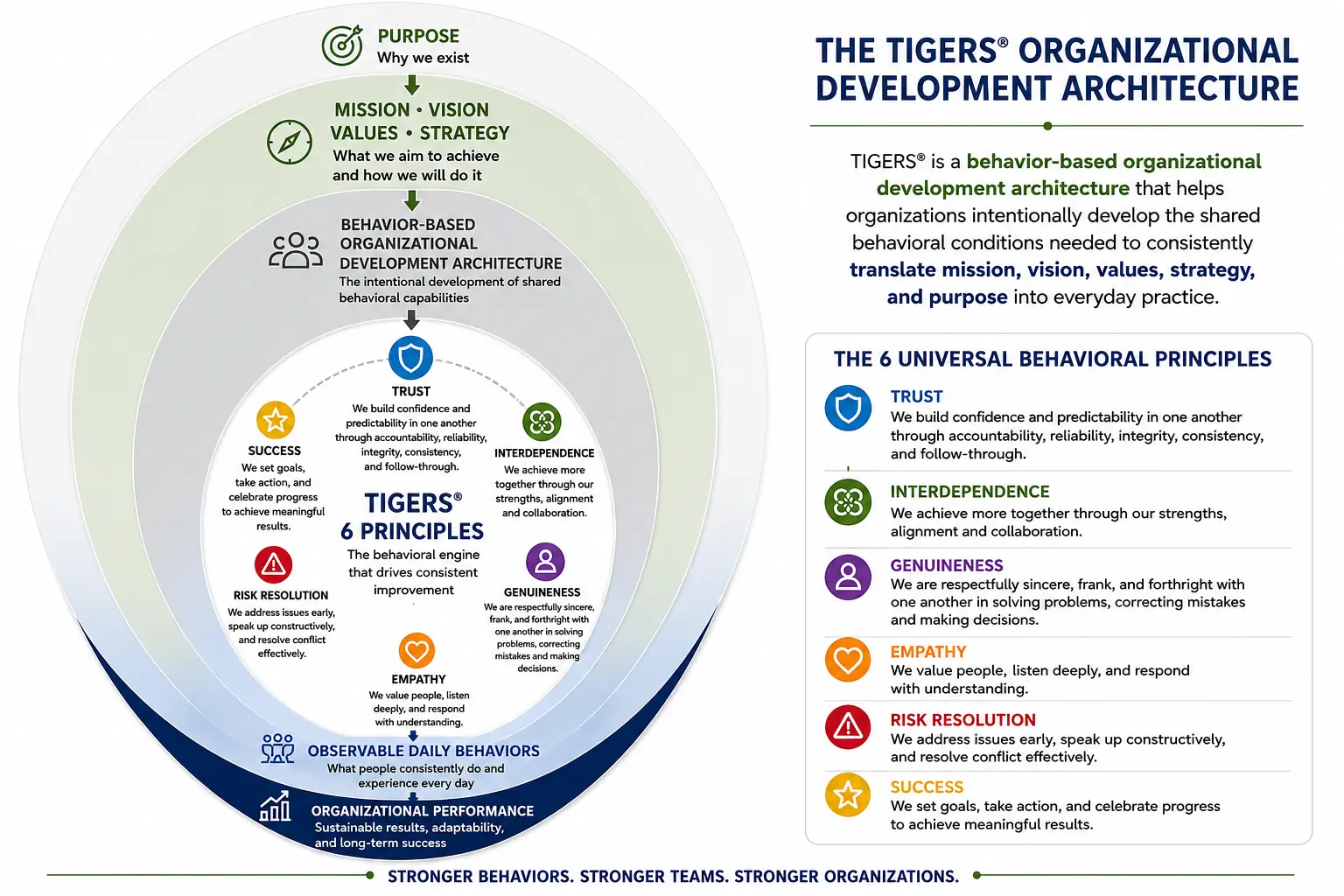
The TIGERS 6 Principles™ Leadership Architecture is a behavior-based leadership and organizational development architecture that identifies the observable behaviors that strengthen people, teams, organizations, and communities.
Rather than focusing primarily on leadership style, personality, or management philosophy, TIGERS provides a practical framework for understanding the everyday behaviors that influence trust, collaboration, communication, accountability, learning, and long-term organizational success.
The architecture is built around six interdependent principles:
- Trust — Creating confidence and predictability in one another through accountability, reliability, integrity, consistency, and follow-through
- Interdependence — Achieving more together through strengths, alignment and collaboration
- Genuineness — Encouraging respectfully sincere, frank, and forthright communication with one another for solving problems, correcting mistakes and making decisions.
- Empathy — Understanding the experiences and perspectives of others while maintaining accountability.
- Risk Resolution — Addressing mistakes, problems, disagreements, uncertainty, and misunderstandings constructively before they become barriers to success.
- Success — Achieving meaningful results while strengthening the relationships and systems that make future success possible, so people want to work together again.
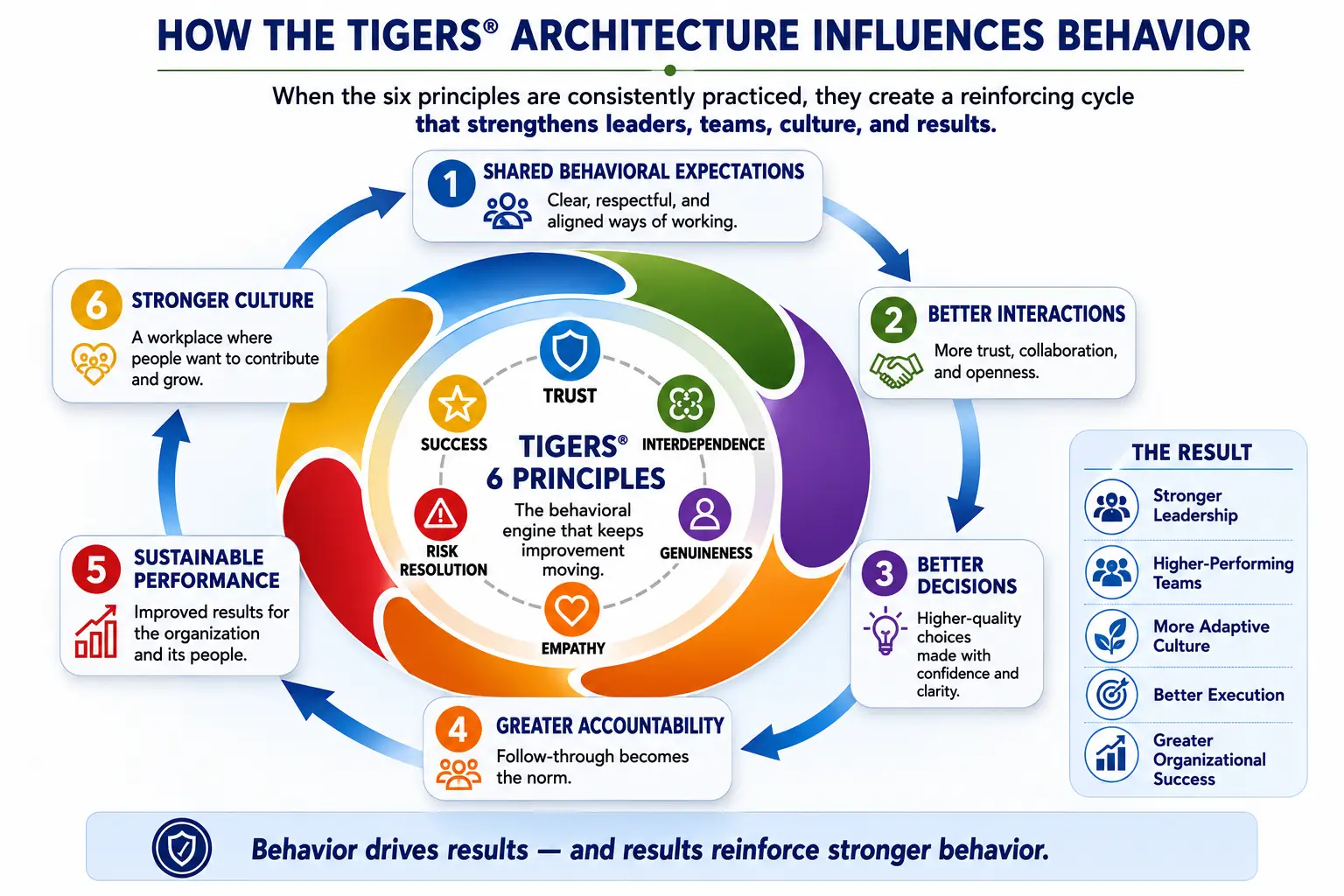
These principles are not intended to operate independently. Together, they form an integrated leadership architecture that helps organizations make trust, accountability, collaboration, and healthy working relationships more visible, teachable, measurable, and sustainable.
Why Leadership Architecture Matters
Leadership is often discussed in terms of individual capability. Organizations invest in leadership competencies, personality assessments, coaching, and management training to help people become better leaders.
These investments matter. Yet many organizations discover that developing individual leaders does not automatically create consistent leadership throughout the organization. People still experience different expectations from one manager to the next. Trust grows in one department while deteriorating in another. Teams interpret accountability differently. Collaboration depends more on personalities than shared expectations. The result is inconsistency.
Leadership architecture addresses this challenge by focusing on the behavioral conditions that support effective leadership across an entire organization.
Rather than asking individual leaders to “be better,” leadership architecture establishes shared expectations for how people work together. It makes critical behaviors visible, teachable, measurable, and easier to reinforce over time.
When those expectations become part of daily practice, trust becomes more predictable, accountability becomes more consistent, and collaboration becomes less dependent on individual personalities. Leadership becomes something the organization builds together—not something left to individual style or good intentions alone.
How the TIGERS Leadership Architecture Is Different
Leadership theories often focus on who leaders are or what leaders should do. They describe leadership styles, competencies, personality traits, emotional intelligence, or management techniques.
The TIGERS 6 Principles™ Leadership Architecture begins from a different premise.
Organizations do not succeed because people understand leadership concepts. They succeed when people consistently practice the behaviors that enable trust, collaboration, responsible decision-making, and shared success.
Rather than asking people to adopt another leadership style, TIGERS helps organizations establish a common behavioral language that guides everyday interactions.
This shift changes the conversation.
Instead of asking:
- Which leadership style is best?
- What personality traits make an effective leader?
- Which management philosophy should we adopt?
TIGERS 6 principles asks:
- What behaviors strengthen trust?
- What behaviors encourage people to contribute their best thinking?
- What behaviors increase accountability without creating fear?
- What behaviors help people resolve disagreements before they become barriers to success?
- What behaviors make people want to work together again?
When those behaviors become visible and consistently reinforced, leadership becomes less dependent on individual personalities and more dependent on shared expectations.
That is the purpose of a leadership architecture.
The TIGERS Six Principles Work Together as Integrated Leadership Architecture
Many leadership frameworks present a collection of competencies, values, or behaviors that can be developed independently. While each may provide value, they are often taught as separate topics rather than as parts of an integrated system.
The TIGERS 6 Principles™ Leadership Architecture takes a different approach. Each principle strengthens and depends upon the others.
Trust grows when people communicate with genuineness, demonstrate empathy, resolve problems constructively, recognize their interdependence, and work toward shared success.
Likewise, accountability becomes more sustainable when trust already exists. Collaboration improves when disagreements are addressed before they damage relationships. Success becomes repeatable when people strengthen both results and the quality of their working relationships.
No single principle stands alone. Weakness in one principle eventually influences the effectiveness of the others. Strength in one principle reinforces the entire system.
This is why TIGERS is described as a leadership architecture rather than a collection of leadership techniques.
Like the structural framework of a well-designed building, each principle supports the stability and effectiveness of the whole. When one area weakens, the effects are often felt throughout the organization. When all six principles are practiced together, they create the conditions for healthy relationships, sound decisions, effective collaboration, and sustainable organizational performance.
The objective is not to master six separate ideas. The objective is to build an environment where the principles reinforce one another through everyday behavior.
Where the TIGERS 6 Principles™ Leadership Architecture Is Applied
Although originally developed to strengthen leadership and organizational effectiveness, the TIGERS 6 Principles™ Leadership Architecture applies wherever two or more people depend on one another to achieve meaningful results.
Whether in business, education, healthcare, manufacturing, government, nonprofit organizations, or community groups, people must build trust, communicate effectively, solve problems, make responsible decisions, and work together toward shared goals.
The six principles are universal because these human challenges exist wherever people work together.
What differs is not the principles themselves, but how organizations define the behaviors that bring those principles to life.
Every organization has a unique mission, operating environment, culture, and performance expectations. Consequently, the behaviors that demonstrate Trust, Interdependence, Genuineness, Empathy, Risk Resolution, and Success are expressed in ways that support those realities.
For example, an emergency response team, a manufacturing company, a public school, and a customer service organization all depend upon trust, effective communication, accountability, and collaboration. Yet the specific behaviors that demonstrate those principles are shaped by the work they perform and the outcomes they must achieve.
For an emergency response team, success may mean achieving the mission while ensuring every team member returns home safely. For a customer service organization, success may be reflected in resolving problems quickly while strengthening long-term customer relationships. For a school, success includes creating an environment where students, educators, and families can learn and work together with confidence and mutual respect.
The TIGERS 6 Principles™ Leadership Architecture does not prescribe identical behaviors for every organization.
Instead, it provides a common behavioral framework that helps organizations identify, define, teach, reinforce, and measure the behaviors that best support their mission, values, and strategic objectives.
The principles remain constant. The behavioral definitions are developed locally.
This balance allows organizations to build a shared leadership architecture without sacrificing the uniqueness of their profession, culture, or purpose.
The TIGERS 6 Principles™ Leadership Architecture provides a common framework—not a standardized culture.
The Evidence Behind the Leadership Architecture
The TIGERS 6 Principles™ Leadership Architecture was not developed by selecting six desirable values or creating another leadership philosophy.
It emerged from a fundamental question:
What is required to build an ethical, quality-focused, productive, cooperative, and successful group of people who experience genuine satisfaction in the work they accomplish together?
Answering that question required looking beyond leadership theories to the research on how groups actually function.
Research in education, psychology, and business group process was examined to identify the behavioral conditions that consistently influenced group effectiveness. Across these disciplines, common themes emerged. Although researchers often used different terminology, the underlying behavioral patterns were remarkably consistent.
Over time, those recurring patterns became the six interdependent principles that now form the TIGERS 6 Principles™ Leadership Architecture.
The research also clarified important distinctions that are often overlooked. For example, TIGERS distinguishes Genuineness from Authenticity.
Within the TIGERS architecture, Genuineness refers to the process of communicating honestly, respectfully, sincerely, frankly, and forthrightly so people can plan, make decisions, solve problems, and work together effectively.
Authenticity, by contrast, describes congruence between a person’s values, identity, and actions. While authenticity is an important personal characteristic, genuineness is the observable communication process that enables people to accomplish work together.
Once the six principles had been identified, another important question emerged.
Were the six principles simply a collection of desirable behaviors, or could each principle be independently measured within group performance?
To answer that question, the architecture was examined through two independent research studies conducted over a four-year period.
The findings demonstrated that each principle could be evaluated independently while also functioning as part of an integrated behavioral system. The studies further showed that differences among the principles helped identify specific strengths and opportunities for improvement, providing practical direction for targeted team and organizational development interventions.
The TIGERS 6 Principles™ Leadership Architecture continues to evolve through research, application, and practice. Its purpose is not to prescribe perfect behavior, but to provide organizations with a practical, evidence-informed framework for strengthening the behaviors that enable people and organizations to succeed together.
Continue Exploring the TIGERS 6 Principles™ Leadership Architecture
Understanding the architecture is the beginning.
Each of the six principles explores a distinct set of behaviors that contribute to healthy relationships, effective leadership, and sustainable organizational success. Together, they provide a practical framework for strengthening the way people work together every day.
Continue exploring:
- Trust — How confidence is built through reliable and consistent behavior.
- Interdependence — Why sustainable success depends upon people working effectively together.
- Genuineness — How respectful, sincere, frank, and forthright communication strengthens collaboration and decision-making.
- Empathy — Understanding others while maintaining accountability and high performance.
- Risk Resolution — Addressing mistakes, problems, disagreements, uncertainty, and misunderstandings before they become barriers to success.
- Success — Achieving meaningful results while strengthening the relationships and systems that make future success possible.
You can also explore how the architecture is applied through the TIGERS Workforce Behavioral Profile™, Leadership Academy, Leadership licensing, implementation resources, and organizational development services.
Whether you are leading a team, developing managers, strengthening organizational culture, or building a learning organization, the TIGERS 6 Principles™ Leadership Architecture provides a common framework—not a standardized culture—for defining and reinforcing the behaviors that help people succeed together.