
What Leaders Must Do Before, During, and After Workforce Reductions
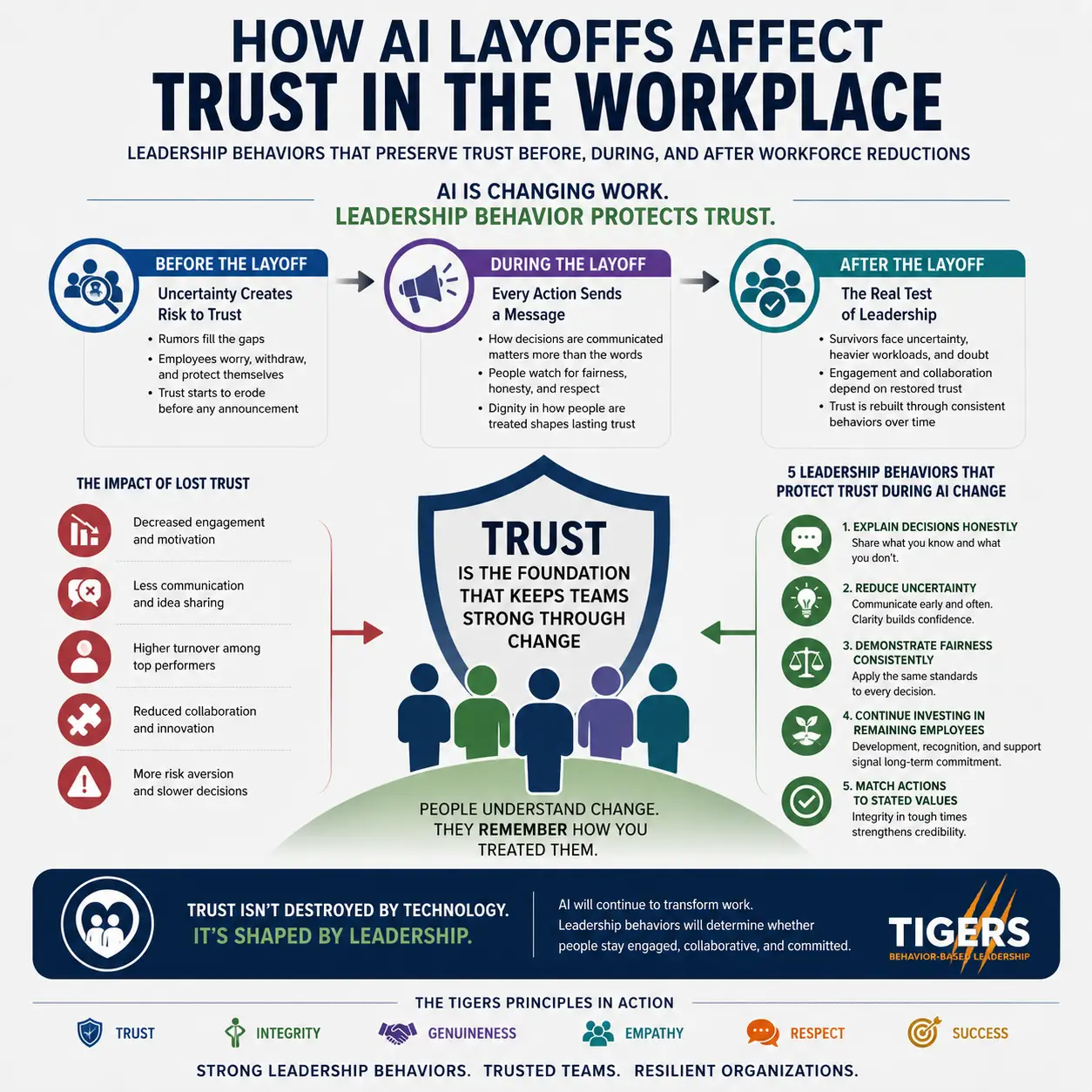
How AI layoffs affect workplace trust has become one of the defining leadership questions of our time. As organizations adopt artificial intelligence to improve efficiency, reduce costs, and remain competitive, many leaders are discovering that the greatest challenge isn’t implementing new technology. It’s preserving the trust that holds people together during times of uncertainty.
The conversation about artificial intelligence often centers on productivity, automation, innovation, and return on investment. Those are important business considerations. Yet every organizational decision also sends a message to employees. Long before people understand the technical reasons behind workforce reductions, they begin interpreting leadership’s behaviors. They notice what is communicated, what is left unsaid, how decisions are explained, and whether people are treated with dignity and respect throughout the process.
Employees understand that organizations must evolve. Most recognize that technology will continue to reshape jobs and redefine how work gets done. What employees struggle with is uncertainty. When uncertainty grows, people naturally begin asking questions that leaders may never hear spoken aloud.
“Am I next?”
“Does my experience still matter?”
“Should I keep investing my best ideas here?”
“Can I still trust leadership?”
These questions are rarely answered through speeches, emails, or carefully crafted announcements. They are answered through leadership behavior.
That is why how AI layoffs affect workplace trust depends less on the technology itself and far more on how leaders navigate the human experience of organizational change.
How AI Layoffs Affect Workplace Trust Feels Different
Organizations have always adapted to new technologies. From mechanization to computers to the internet, every generation has experienced change that altered the nature of work. Artificial intelligence, however, introduces a unique challenge because it directly affects knowledge work—the very work many employees believed would remain secure.
Unlike previous technological shifts, AI often changes jobs that rely on experience, analysis, communication, creativity, and professional judgment. Employees aren’t simply wondering whether a machine will perform repetitive tasks faster. They’re wondering whether parts of their own expertise may eventually become unnecessary.
This uncertainty changes workplace behavior long before any workforce reduction occurs. Employees may become more cautious about sharing ideas. Managers may hesitate to make long-term commitments. Teams may quietly reduce collaboration as individuals begin focusing on protecting their own positions.
Instead of openly discussing innovation, conversations often become guarded. People become more selective about what they say, what they volunteer, and how much initiative they demonstrate.
None of this necessarily reflects a lack of commitment. It reflects a natural human response to uncertainty. When people cannot predict what tomorrow may bring, they naturally devote more energy to reducing personal risk.
That’s why how AI layoffs affect workplace trust is ultimately a leadership issue rather than a technology issue. The behaviors leaders demonstrate during uncertainty determine whether employees move toward greater collaboration or greater self-protection.
How AI Layoffs Affect Workplace Trust Often Begins Eroding Before the Layoffs
Many organizations assume trust declines only after layoffs occur. In reality, trust often begins weakening much earlier.
Employees are remarkably observant. They notice executive calendars becoming unusually private. They notice projects quietly slowing down. They notice postponed hiring decisions, canceled meetings, unexpected budget reviews, and leadership teams spending more time behind closed doors. Rumors begin filling the information gaps. Unfortunately, rumors rarely reduce uncertainty. They multiply it.
As uncertainty grows, employees start interpreting every leadership decision through a different lens. A delayed response becomes evidence that something must be wrong. A routine organizational review suddenly feels significant. A cancelled meeting becomes another reason to speculate. Leaders often underestimate how quickly people begin constructing explanations when communication is limited.
This creates an important leadership lesson. Silence is not neutral. In periods of uncertainty, silence becomes communication. Employees naturally interpret what leaders choose not to say.
That doesn’t mean leaders should disclose confidential information or speculate about decisions that haven’t been made. Responsible leadership requires discretion. But it does mean acknowledging uncertainty honestly rather than pretending it doesn’t exist.
One of the fastest ways to damage trust is allowing uncertainty to become the primary source of information.
Employees Watch Behavior More Than Announcements
Organizations invest enormous effort crafting official communications during workforce reductions. Announcements are reviewed. Frequently asked questions are prepared. Legal language is carefully examined. Town hall meetings are scheduled.
These efforts matter. But they rarely determine whether employees continue trusting leadership. Employees place far greater weight on what leaders actually do.
Do leaders make themselves available after difficult announcements? Do managers answer questions honestly when they don’t have all the answers? Do executives remain visible, or do they disappear behind closed doors? Do people who are leaving receive respect, appreciation, and dignity?
Are remaining employees given time to process the changes, or are they expected to immediately return to business as usual? These everyday behaviors become far more memorable than prepared statements. Employees don’t evaluate trust based on one announcement. They evaluate trust based on patterns they observe over time.
That’s one reason how AI layoffs affect workplace trust should never be viewed as a communication strategy. Trust is the outcome of consistent leadership behavior. It grows when employees repeatedly experience fairness, transparency, dependability, empathy, and follow-through. Conversely, trust begins declining when leadership behaviors become inconsistent with the values the organization claims to uphold.
This distinction is critical because how AI layoffs affect worplace trust is influenced less by the existence of workforce reductions than by the experiences employees have before, during, and after those reductions.
Every Leadership Behavior Is Teaching Something
One of the most important principles I’ve learned during decades of working with organizations is this. Leadership is always teaching. Every interaction communicates expectations.
When leaders explain difficult decisions with honesty, they teach that transparency matters. When commitments are honored despite changing circumstances, they teach that promises still have meaning. When people are treated respectfully, even during painful organizational changes, they teach that dignity isn’t reserved only for good times.
The opposite is equally true. When difficult conversations are avoided, employees learn that silence is safer than honesty. When accountability becomes inconsistent, people learn that fairness depends on circumstances rather than principles. When stated organizational values disappear during times of pressure, employees learn which values are truly negotiable.
These lessons become part of an organization’s culture. Not because leaders intended them. Because employees experienced them.
This is why behavior-based leadership becomes especially important during periods of uncertainty. Culture isn’t sustained by posters on a wall or carefully written value statements. It is reinforced, or weakened, through thousands of observable leadership behaviors.
Artificial intelligence may change the nature of work. Leadership behavior determines whether those changes strengthen or weaken the relationships that allow organizations to thrive.
How AI Layoffs Affect Workplace Trust for the Employees Who Stay
When organizations announce layoffs, most of the attention naturally focuses on the employees whose positions have been eliminated. Leaders work through difficult conversations, severance packages, legal considerations, and transition plans. These are necessary responsibilities and deserve careful attention.
Yet an equally important leadership challenge begins after the announcements are over. The employees who remain. Often referred to as “layoff survivors,” these employees inherit far more than additional responsibilities. They inherit uncertainty, unanswered questions, and a new way of evaluating leadership.
Many organizations expect people to feel grateful simply because they still have a job. Human behavior is rarely that simple.
Remaining employees often experience a mixture of relief, sadness, guilt, anxiety, and skepticism. They may be wondering why certain people were selected while others remained. They may question whether another round of layoffs is coming. Some quietly begin updating résumés while continuing to perform their daily work. Others become hesitant to volunteer ideas or pursue innovation because uncertainty changes how people calculate risk.
This is where how AI layoffs affect workplace trust becomes especially important. Employees who remain are watching leadership more closely than ever before.
They notice whether leaders acknowledge the emotional impact of the changes. They notice whether workloads are adjusted realistically or whether fewer people are simply expected to accomplish the same amount of work. They notice whether leaders continue investing in employee development or quietly abandon those commitments. Most importantly, they notice whether leadership behaviors remain consistent with the organization’s stated values.
Trust after layoffs isn’t restored through reassurance alone. It is rebuilt through consistent experiences that demonstrate respect, fairness, and dependability over time.
How AI Layoffs Affect Workplace Trust Through Everyday Leadership Behaviors
Leaders often ask what they should say during periods of organizational change. A better question may be what are employees experiencing?
Employees experience whether leaders are available when questions arise. They experience whether managers are honest enough to admit when they don’t yet have every answer. They experience whether difficult conversations are handled with dignity rather than avoidance. They experience whether expectations remain clear despite changing circumstances. And they experience whether promises continue to be honored.
These everyday experiences become evidence. Over time, that evidence shapes trust.
One consistent behavior cannot erase months of uncertainty. Likewise, one difficult decision does not automatically destroy trust.
People look for patterns. They ask themselves:
“Can I depend on leadership?”
“Do our stated values still guide decisions?”
“Will people continue to be treated fairly when circumstances become difficult?”
These questions are answered behavior by behavior, conversation by conversation, and decision by decision. This is why behavior-based leadership becomes so important during organizational disruption.
Employees don’t need leaders to eliminate every uncertainty. They need leaders whose behaviors remain dependable even when circumstances are not. That consistency becomes an anchor during change.
Leadership During AI Change Is Ultimately About Trust
Artificial intelligence will continue changing organizations. New technologies will emerge. Some jobs will disappear. Others will evolve. Entirely new roles will be created that don’t yet exist. History tells us this pattern will continue.
The lasting leadership question, however, isn’t whether organizations should adopt new technology. The lasting question is whether leaders can guide people through change without sacrificing the trust that makes high-performing organizations possible.
Employees generally understand that organizations must adapt. What they remember is how leaders behaved while those changes were taking place.
Did leaders communicate honestly? Did they remain visible? Did they explain decisions respectfully? Did they listen? Did they demonstrate empathy without abandoning accountability? Did their actions reinforce—or contradict—the organization’s values?
These are the moments that employees remember long after the restructuring is complete. Technology may reshape work. Leadership behaviors shape culture. That distinction is what separates organizations that merely survive disruption from those that emerge stronger because people continue believing in one another and in the leadership guiding the journey.
Conclusion
Understanding how AI layoffs affect workplace trust requires looking beyond technology and beyond workforce reductions themselves. Artificial intelligence is accelerating organizational change, but technology does not determine whether trust grows or declines. Leadership behavior does.
Employees observe far more than strategic decisions. They observe consistency. They observe fairness. They observe whether leaders communicate openly, treat people with dignity, follow through on commitments, and continue demonstrating the values they expect others to uphold.
Those observations become expectations. Those expectations influence behavior. Those behaviors ultimately shape organizational culture.
The organizations that navigate AI successfully won’t simply be the ones with the most advanced technology. They’ll be the ones whose leaders understand that trust remains one of their greatest competitive advantages.
Employees don’t expect leaders to eliminate uncertainty. They do expect leadership behaviors that make uncertainty easier to navigate. Because long after new technologies become routine, people will remember how they were treated. And that memory will influence whether they choose to contribute their ideas, collaborate with their colleagues, and invest their future in the organization.
Leadership Reflection
As AI continues transforming the workplace, consider these questions with your leadership team.
- How are our current leadership behaviors shaping how AI layoffs affect workplace trust during organizational change?
- If workforce reductions became necessary, what experiences would employees remember most about how they were treated?
- What signals are we unintentionally sending through our communication—or our silence?
- Which leadership behaviors strengthen trust even when difficult decisions must be made?
- If employees described our leadership using only the behaviors they experience each day, what would they say?
Trust has never depended on perfect circumstances. It has always depended on consistent leadership behavior.