
Why Consistent Leadership Behaviors Matter More Than Good Intentions.
How to build team trust is one of the most important questions leaders ask, especially when communication begins to break down, accountability weakens, or employees become hesitant to share ideas and solve problems together. Trust influences every workplace relationship, yet many organizations approach it as something people either have or don’t have. The reality is far different. Trust is not created by good intentions, charismatic personalities, or mission statements displayed on office walls. It develops when leaders consistently demonstrate behaviors that employees experience as fair, dependable, respectful, and credible.
Today’s workplace makes trust more important than ever. The 2026 Edelman Trust Barometer found that while confidence in many institutions remains fragile, people increasingly place their trust in those closest to them—including coworkers, supervisors, and organizational leaders. As uncertainty grows outside the workplace, employees pay even closer attention to the daily behaviors of the people leading them.
That presents both a challenge and an opportunity.
Leaders cannot control economic uncertainty, political division, or global events. They can, however, control how they communicate, how they make decisions, how they resolve conflict, and whether they consistently follow through on their commitments. Those observable behaviors shape how employees decide whether leadership can be trusted.
At TIGERS®, we define trust differently than many leadership models. Trust is not simply a feeling or a personality characteristic. It is an experience that develops through repeated interactions. Every conversation, every commitment, every difficult decision, and every follow-through either strengthens or weakens that experience.
For more than three decades, I have watched organizations invest tremendous effort trying to rebuild trust after relationships have deteriorated. Rarely did the damage begin with one catastrophic event. More often, trust eroded through dozens of small inconsistencies that leaders barely noticed but employees experienced every day. A commitment wasn’t honored. A difficult conversation was postponed. Expectations shifted without explanation. Individually these moments seemed insignificant. Collectively they shaped how people answered one fundamental question, can I depend on my leaders?
That question lies at the heart of every high-performing organization.
How to Build Team Trust Starts with Leadership Consistency
Many leaders believe trust is earned because they care about their employees, possess technical expertise, or make sound business decisions. Those qualities certainly matter, but they are not how employees determine whether a leader is trustworthy.
Employees observe behavior.
They notice whether leaders follow through on commitments. They notice whether expectations remain consistent from one employee to another. They notice whether difficult conversations are handled respectfully or avoided altogether. They notice whether leaders admit mistakes or defend them. They notice whether decisions reflect the values leadership claims to uphold.
Employees may not consciously score each interaction, but over time those experiences accumulate into a powerful conclusion about leadership credibility.
Consistency does not mean treating every employee identically. Effective leaders understand that people have different strengths, responsibilities, and circumstances. Consistency means applying principles fairly so employees understand what they can expect regardless of the situation.
When leaders consistently communicate expectations, explain decisions, keep commitments, and respond respectfully, uncertainty declines. Employees become more willing to contribute ideas, solve problems collaboratively, and accept accountability because they trust the environment in which they are working.
When those behaviors become inconsistent, uncertainty grows.
People begin asking themselves questions they should never have to ask. Will today’s priorities be different tomorrow? Will commitments actually be honored? Will everyone be held to the same standards? Is it safe to disagree respectfully?
The energy spent answering those questions is energy no longer available for serving customers, improving processes, solving problems, or helping teammates succeed.
How to Build Team Trust by Eliminating Inconsistent Leadership
One of the fastest ways to weaken trust is through inconsistent leadership behavior.
Most leaders do not intentionally create inconsistency. In fact, many are surprised when employees describe them as unpredictable. The inconsistency usually appears under pressure.
A manager promises transparency but withholds information when problems arise. A supervisor encourages initiative but criticizes employees whenever mistakes occur. An executive asks for honest feedback but becomes defensive when people disagree. A leader speaks about accountability yet excuses poor performance from favored employees.
Each incident may appear minor when viewed independently. Together they communicate something much larger.
Employees begin questioning whether leadership’s words can be trusted.
That uncertainty changes behavior. People become cautious instead of creative. They protect themselves instead of taking initiative. Collaboration slows because employees become less willing to depend on one another. Conversations become guarded. Innovation declines. Accountability weakens because people are no longer confident the system will respond fairly.
The consequences reach far beyond morale. Trust influences the speed of decision-making, the quality of collaboration, the willingness to resolve conflict, and an organization’s ability to adapt to change.
The encouraging news is that trust is not beyond a leader’s influence. Every leader has opportunities every day to strengthen trust through consistent behavior.
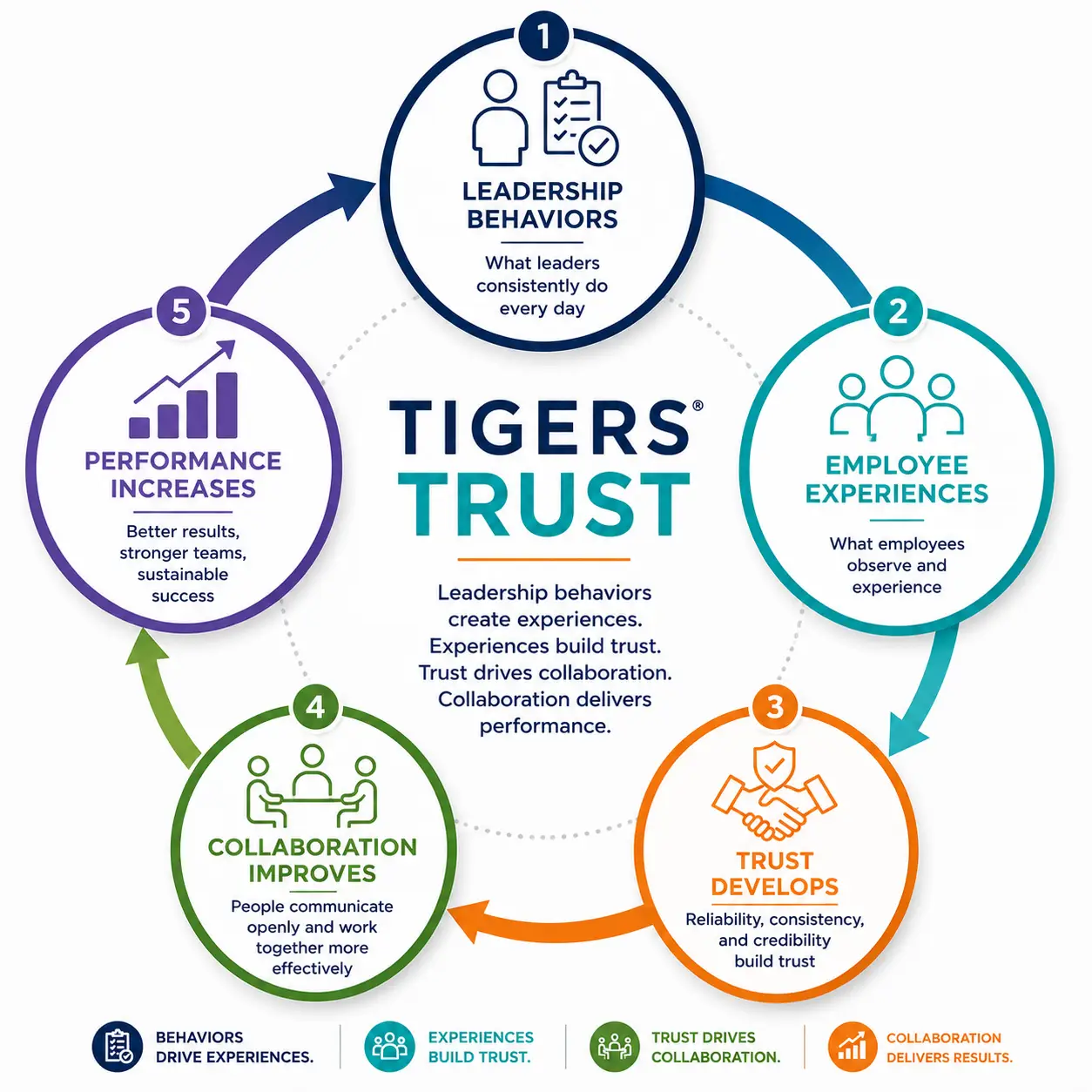
How to Build Team Trust Through Observable Leadership Behaviors
One reason many leadership programs struggle to improve trust is that they focus on intentions rather than behaviors.
Advice such as “be trustworthy” or “build stronger relationships” sounds helpful, but it provides little practical guidance. Leaders are left wondering what they should actually do differently on Monday morning.
Behavior provides the answer. Every interaction creates evidence.
Employees notice whether promises are kept. They notice whether expectations are communicated clearly. They notice whether questions are welcomed or discouraged. They notice whether leaders explain the reasons behind important decisions. They notice whether respect is demonstrated consistently, especially during difficult conversations.
Trust grows because these experiences become predictable. Rather than wondering how leadership might respond, employees develop confidence in what they can expect.
Within the TIGERS® framework, trust is measured through observable leadership behaviors because behaviors can be strengthened, practiced, discussed, and improved. They create patterns that leaders can intentionally influence.
Trust, therefore, becomes more than a desirable outcome. It becomes a leadership practice.
Trustworthy leaders typically demonstrate behaviors such as:
- Keeping commitments.
- Explaining decisions.
- Communicating expectations clearly.
- Addressing problems respectfully.
- Encouraging questions.
- Admitting mistakes.
- Applying standards consistently.
- Following through when action has been promised.
None of these behaviors is dramatic.
Collectively, they transform how people experience leadership.
Trust Is Built During Ordinary Moments
One of the greatest misconceptions about leadership is that trust is built during extraordinary events.
It is not. Trust is built during ordinary workdays.
It grows when supervisors arrive prepared for meetings because preparation demonstrates respect for other people’s time.
It grows when priorities change and leaders explain why instead of simply issuing new directives.
It grows when difficult conversations occur promptly rather than being postponed until frustration has accumulated.
It grows when leaders acknowledge mistakes before employees point them out because accountability is being modeled rather than demanded.
Employees do not expect perfection. They understand that every leader faces competing priorities, incomplete information, and unexpected challenges.
What they do expect is consistency in how those situations are handled.
Honesty often strengthens trust more than perfection ever could because honesty reduces uncertainty. Even when employees dislike the answer, they appreciate knowing where they stand.
Trust grows when people no longer have to guess what leadership believes, values, or intends. Instead, they experience it consistently.
How to Build Team Trust Within an Integrated Leadership System
Many leadership models treat trust as though it were the single ingredient that determines organizational success. Build trust, they suggest, and everything else will naturally improve.
Our research led us to a different conclusion.
Within the TIGERS® Behavior-Based Leadership Architecture, trust is one of six observable behavioral principles that work together as an integrated system. Each principle influences the others, but no single principle operates independently or serves as the foundation for all the rest.
One of the most significant findings from our research was the strong relationship between Interdependence, Success, and the other TIGERS principles. As teams become more interdependent—coordinating their efforts, sharing responsibility, communicating openly, and relying appropriately on one another—trust often increases because employees experience greater consistency, reliability, and follow-through.
The reverse, however, is not always true.
A team may report high levels of trust while still struggling with collaboration, shared accountability, or coordinated action. Trust by itself does not automatically create effective teamwork.
The same relationship exists throughout the TIGERS framework. Genuineness encourages respectful candor that improves decision-making. Empathy strengthens understanding and helps people address concerns before misunderstandings become barriers. Risk Resolution equips teams to work through disagreements constructively rather than allowing conflict to undermine relationships. Success reinforces behaviors that people want to repeat because they can see how their individual contributions support shared results.
Each principle strengthens the overall behavioral system. Improving one principle often supports improvement in another, although not always equally or in the same direction.
That distinction matters. Organizations sometimes search for a single leadership trait that will solve every cultural challenge. Healthy workplace cultures rarely develop that way. They develop because leaders consistently reinforce a system of behaviors that help people work together effectively every day.
Understanding trust as part of an integrated behavioral system changes the leadership conversation. Instead of asking, “How do we make people trust one another?” leaders begin asking, “What behaviors will help our people work together more effectively?”
That question leads to sustainable organizational improvement because it focuses on behaviors that leaders can observe, discuss, strengthen, and reinforce.
Trust Reduces the Friction That Slows Teams Down
Trust is often described as the “glue” that holds organizations together. The TIGERS framework offers a different perspective.
Interdependence creates the working relationships that connect people and coordinate their efforts. Trust reduces the friction within those relationships.
Think about a well-engineered machine. The oil does not create the machine. It does not hold the parts together. Its purpose is to reduce friction so the parts work together efficiently without unnecessary wear and resistance.
Organizations function in much the same way. Every workplace experiences changing priorities. People disagree. Mistakes happen. Difficult conversations are unavoidable. New employees must learn. Projects encounter obstacles. Departments compete for limited resources.
None of those realities automatically weaken an organization. What determines whether they become barriers is the amount of behavioral friction leaders create—or reduce—through their actions.
When trust is high, people ask questions earlier instead of waiting until problems become larger. Information moves more freely because employees are less concerned about protecting themselves. People recover from mistakes more quickly because accountability is viewed as learning rather than blame. Leaders receive more honest feedback because employees believe their perspectives will be considered respectfully. Decisions are implemented faster because fewer people question hidden motives. Collaboration becomes easier because people spend less time managing uncertainty and more time coordinating their efforts.
Trust does not eliminate disagreement. It does not guarantee success. It does not prevent difficult decisions. What trust does is reduce the behavioral friction that makes collaboration, decision-making, and coordinated action more difficult than they need to be.
That is why leaders should concentrate less on trying to make people “feel” trusting and more on consistently demonstrating behaviors that deserve trust. Feelings follow experience. Experience follows behavior.
How to Build Team Trust Is a Daily Leadership Practice
Every organization wants employees who communicate openly, solve problems collaboratively, accept accountability, adapt to change, and support one another’s success. Those outcomes rarely occur because leaders ask for them.
They occur because leaders consistently demonstrate behaviors that make those outcomes possible. Building team trust is not about becoming more charismatic or trying to be liked by everyone. It is about creating an environment where people know what to expect from leadership because leadership behaves consistently.
When leaders communicate expectations clearly, explain important decisions, keep commitments, address concerns respectfully, and model accountability, they reduce the uncertainty that causes employees to hesitate, withdraw, or protect themselves.
As uncertainty decreases, confidence grows. People contribute more freely. Collaboration becomes more natural. Decision-making improves. Shared accountability becomes easier because employees believe everyone is working within the same behavioral expectations.
Trust is never finished. It is strengthened—or weakened—through hundreds of daily interactions.
Each interaction provides employees with additional evidence about whether leadership can be depended upon. That is why trust should never be viewed as a personality trait. It is a leadership practice that is demonstrated every day through observable behavior.
Organizations do not become high-trust workplaces by accident. They become high-trust workplaces because leaders intentionally create the behavioral conditions that allow trust to develop.
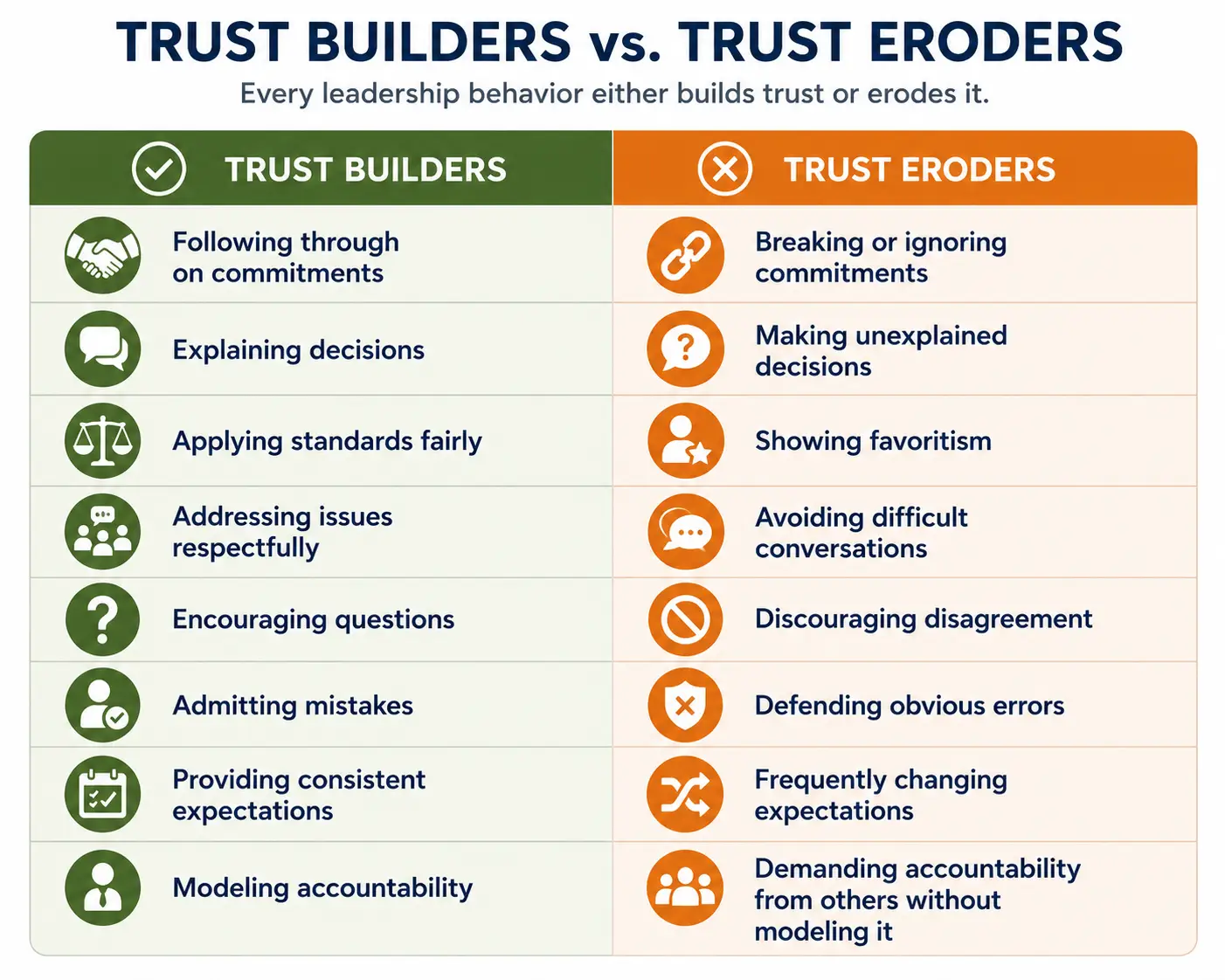
Leadership Reflection
As you think about your own leadership, consider these questions:
- Which of my daily behaviors consistently strengthen trust?
- Where might inconsistency be creating unnecessary resistance for my team?
- If my employees judged my leadership only by what they observe—not by what I intend—what conclusions would they reach?
- What is one leadership behavior I can intentionally strengthen this week that would make trust easier for others to experience?
Continue Building a High-Trust Workplace
Trust is one essential component of a healthy organizational culture, but lasting performance requires more than trust alone.
The TIGERS® Behavior-Based Leadership Architecture helps leaders build workplaces where trust, collaboration, respectful communication, accountability, and shared success become observable daily behaviors—not simply organizational values.
If this article challenged the way you think about trust, continue with our Trust in the Workplace cornerstone guide, where you’ll explore practical leadership strategies, supporting research, and additional tools for strengthening trust through observable behaviors.
If you’re ready to help managers, supervisors, teams, or your entire organization build these behaviors consistently, explore the TIGERS Leadership Learning Center, workshops, and certification programs designed to create measurable, sustainable behavioral change.
Because organizations don’t become high-performing workplaces by accident. They become high-performing workplaces because leaders intentionally build behavioral systems that help people trust one another, work together effectively, and achieve results that no individual could accomplish alone.