
Trust in the Workplace
Building Organizational Trust Through Observable Behavior
Most organizations recognize that trust matters. Yet many struggle to build it consistently because trust is often treated as a value to promote, a leadership quality to develop, or a feeling to earn. While each of these contributes to trust, none explains how organizations intentionally create the everyday behaviors that allow trust to grow across teams, departments, and leadership levels.
The TIGERS® Trust Principle approaches trust differently. It views trust in the workplace as an organizational capability that can be intentionally developed through observable behaviors. As those behaviors become part of how people communicate, make commitments, solve problems, and work together, organizations reduce unnecessary friction and create the conditions for stronger collaboration, better decisions, and more consistent results.
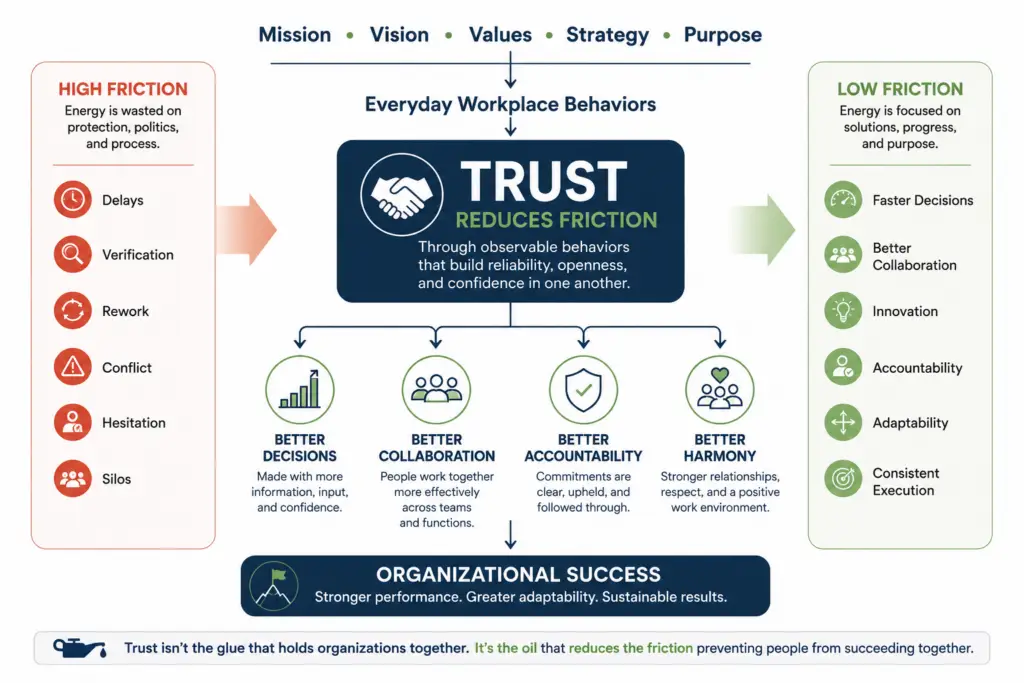
Trust isn’t the glue that holds organizations together. It’s the oil that reduces the friction preventing people from succeeding together.
The questions isn’t whether trust matters. The questions is what behaviors actually build organizational trust, and how can leaders intentionally develop them?
Why Trust in the Workplace Matters
Trust in the workplace is fundamental to how people work together. Every decision to share information, ask for help, solve a problem, make a commitment, or depend on another person involves an element of trust. When trust is present, people communicate more openly, coordinate more effectively, and focus their energy on accomplishing shared goals. When trust is weak, uncertainty grows, collaboration slows, and valuable time is spent protecting against disappointment rather than creating results.
Research across organizational development, psychology, sociology, neuroscience, and economics consistently demonstrates that trust in the workplace influences nearly every aspect of organizational performance. Higher levels of workplace trust are associated with stronger collaboration, greater employee engagement, more effective decision making, increased innovation, improved adaptability, and healthier working relationships. Trust does not guarantee organizational success, but without it, organizations experience greater friction in nearly every process that depends on people working together.
The TIGERS Trust Principle emerged from independent interdisciplinary research conducted as the focus of advanced graduate study, integrating insights from business, education, psychology, and group process research. The resulting behavior-based framework was refined through extensive field application and later evaluated through four years of independent studies by Gonzaga University and the Washington Education Association. Rather than viewing trust as a personality trait or abstract organizational value, the TIGERS framework defines trust as a pattern of observable behaviors that reduces friction and enables people to work together more effectively. This practical, behavior-based perspective gives leaders and organizations a way to intentionally develop trust rather than simply hoping it emerges over time.
Rethinking Trust in the Workplace
Trust is often described as confidence in another person’s character, integrity, reliability, or predictability. These qualities help explain how trust in the workplace is experienced and why people decide to rely on one another. Yet they offer limited guidance for leaders who want to intentionally build trust within teams and organizations. While these attributes describe the outcomes people associate with trust, they do not explain the everyday behaviors that consistently create those outcomes.
The TIGERS Trust Principle approaches trust from a different perspective. Rather than beginning with personal attributes, TIGERS begins with observable workplace behaviors. When people consistently keep their commitments, follow through on responsibilities, act dependably, and demonstrate consistency over time, they create experiences that strengthen confidence, reliability, and predictability. Trust grows because these behaviors reduce uncertainty, making it easier for people to rely on one another and work together effectively.
This behavior-based perspective gives leaders and organizations something they can intentionally influence. Instead of hoping trust develops on its own, they can establish shared behavioral expectations that make trust visible, teachable, measurable, and sustainable. As these behaviors become part of everyday work, organizational friction declines, enabling better decisions, stronger collaboration, greater accountability, improved harmony, and ultimately, greater organizational success.
Why Trust in the Workplace Continues to Break Down
For decades, organizations have recognized that trust is essential to performance, collaboration, innovation, and employee engagement. Yet research continues to report declining confidence in many institutions and growing skepticism toward organizational leadership. Employees increasingly question whether organizational decisions reflect the values leaders promote, whether commitments will be honored, and whether systems are fair and consistent. If trust has been studied for so long, why do the same challenges continue to surface?
The answer is unlikely to be found in a single cause. Organizations operate in increasingly complex environments shaped by economic pressures, rapid technological change, restructuring, competing stakeholder expectations, and growing demands for transparency and accountability. At the same time, employees experience the workplace through everyday interactions—with supervisors, coworkers, policies, and decisions—not through mission statements or corporate values alone. Trust is shaped less by what organizations intend and more by what people consistently experience.
Many organizations have responded by investing in leadership development, communication initiatives, employee engagement programs, values campaigns, and team-building activities. These efforts often produce positive intentions and greater awareness, but lasting change remains difficult when organizations have not established the observable behavioral expectations that consistently reduce uncertainty and strengthen confidence. Without a shared behavioral framework, trust in the workplace becomes dependent on individual personalities and leadership styles rather than embedded in the way the organization functions.
The TIGERS Leadership Architecture approaches the challenge differently. Rather than treating trust as an outcome to be achieved, it focuses on the observable and measurable behaviors that make trust possible. As those behaviors become consistent throughout an organization, trust becomes more than an aspiration. It becomes an organizational capability that can be intentionally developed, reinforced, and sustained.
How Do You Know Trust Exists?
Trust in the Workplace Is Present When…
Commitments are kept.
Trust grows when people consistently do what they say they will do. Every fulfilled commitment strengthens confidence. Every broken commitment—especially when repeated without accountability—introduces uncertainty. People begin to verify, remind, follow up, and protect themselves instead of moving forward with confidence.
Responsibilities are fulfilled.
Organizations function best when people accept ownership for their work rather than shifting blame or waiting for someone else to solve the problem. Trust in the workplace increases when responsibilities are clearly understood and consistently fulfilled. It weakens when accountability depends on who is watching.
Expectations are clear.
People cannot consistently meet expectations they do not understand. Trust is strengthened when leaders and team members establish clear agreements about priorities, responsibilities, decision-making authority, and follow-through. Ambiguity invites misunderstanding, while clarity reduces unnecessary friction.
Reliability becomes consistent.
Trust in the workplace is built through patterns, not isolated moments. One dependable action is encouraging, but consistent reliability over time creates confidence that people, teams, and systems can be counted on even when challenges arise.
Uncertainty decreases.
When commitments are dependable and expectations are clear, people spend less time checking, reminding, questioning, or protecting themselves from disappointment. Instead, they can direct their energy toward serving customers, improving quality, solving problems, and achieving organizational goals. This is how trust reduces organizational friction.
Why Organizations Struggle to Build Trust
The Missing Leadership and Organizational Architecture
If trust in the workplace contributes to better decisions, stronger collaboration, greater innovation, and higher organizational performance, why do so many organizations continue to struggle with it?
The answer is more complex than poor communication, ineffective managers, or a lack of good intentions. Most organizations recognize that trust is important. Many invest in leadership development, employee engagement, team-building activities, culture initiatives, and communication training. Yet surveys consistently report that many employees have low confidence in organizational leadership, experience declining engagement, and voluntarily leave organizations because of their workplace experiences rather than the work itself.
If organizations understand the importance of trust, why has progress been so difficult?
The answer lies in how organizations have historically been designed.
Rather than intentionally designing systems that reinforce trust-building behaviors, most organizations have developed management systems optimized for efficiency, productivity, compliance, financial performance, and risk reduction. These systems are essential for organizational success, but they were never intended to create trust. As a result, trust often depends on the personality and leadership style of individual managers instead of becoming a predictable capability of the organization itself.
That distinction is fundamental.
TIGERS proposes that trust should not be viewed as an individual leadership trait or an organizational aspiration. It should be designed into the way people work together every day.
Trust Was Rarely Designed Into Management Systems
For more than a century, management has continually evolved.
Early industrial organizations focused on increasing production efficiency. Scientific management improved consistency, quality, and productivity through standardization and supervision. Later, the Human Relations Movement demonstrated that relationships, morale, and belonging influenced performance. Behavioral scientists expanded our understanding of motivation, participation, and leadership. More recently, organizations have invested heavily in employee engagement, organizational culture, psychological safety, diversity, inclusion, and employee experience.
Each of these movements contributed valuable insights.
Yet throughout this evolution, one important question has received surprisingly little attention. How should organizations be intentionally designed to reinforce trust-building behaviors every day?
Instead, trust in the workplace has often been treated as an outcome of good leadership rather than something leadership systems themselves should produce.
Organizations routinely design systems for budgeting, quality assurance, customer service, strategic planning, cybersecurity, compliance, and performance measurement. Few, however, intentionally design the everyday leadership practices that consistently reinforce behaviors such as keeping commitments, clarifying expectations, strengthening accountability, reducing uncertainty, and building confidence among colleagues.
Without that architecture, trust becomes inconsistent. Some departments flourish while others struggle. Teams experience very different cultures under different managers. Employees describe the organization not by its stated values but by the daily behaviors they experience.
Employees Create Value And They Are More Than a Cost
Another challenge is the way organizations often think about people.
From an accounting perspective, employee compensation appears as a labor expense. That is appropriate within financial reporting. Problems arise, however, when leaders unconsciously begin managing people primarily as costs to control rather than as stakeholders who create organizational value.
Employees do far more than perform assigned tasks. They solve problems, build customer relationships, improve processes, share knowledge, mentor colleagues, identify risks, innovate, and represent the organization’s values through their daily interactions.
Organizations grow because people grow.
When leadership decisions focus primarily on reducing labor costs, increasing oversight, or tightening control without simultaneously developing capability, ownership, and shared responsibility, employees often experience management as something done to them rather than with them.
High-performing organizations recognize a different reality.
People are not simply the largest expense on the balance sheet. They are the organization’s greatest source of adaptability, innovation, judgment, and sustained competitive advantage.
Trust grows when leaders invest in developing those capabilities rather than merely controlling them.
Control Can Produce Compliance, But It Cannot Produce Commitment
Organizations need controls. Financial controls protect assets. Quality controls improve consistency. Safety controls protect lives. Regulatory controls ensure legal compliance.
The question is not whether organizations need control. The question is whether control becomes the primary leadership philosophy.
When employees are managed primarily through surveillance, excessive approvals, micromanagement, or rigid command-and-control structures, they may comply with requirements, but they are less likely to exercise initiative, assume ownership, or contribute their best thinking.
Compliance answers the question, “Will people follow the rules?”
Trust answers a different question. “Will people willingly contribute their judgment, creativity, and commitment because they have confidence in one another and in the organization?”
Those are fundamentally different organizational objectives.
TIGERS does not reject accountability or organizational discipline. Instead, it recognizes that accountability becomes far more effective when employees understand expectations, believe commitments will be honored, and experience fairness and consistency in everyday leadership practices.
Why Good Leaders Are Not Enough
Organizations frequently invest in developing better leaders. Leadership programs teach communication, emotional intelligence, coaching, delegation, conflict management, strategic thinking, and decision making. These are valuable skills.
However, leadership development alone cannot overcome organizational systems that unintentionally reinforce distrust. A highly capable manager operating within inconsistent policies, unclear expectations, conflicting priorities, and weak accountability structures will often struggle to sustain trust over time.
Conversely, organizations that intentionally reinforce trust-building behaviors through shared expectations, consistent leadership practices, measurable behaviors, and organizational accountability create environments where trust becomes less dependent on individual personalities. That is the difference between developing better leaders and designing a better leadership architecture.
The TIGERS Perspective
This is where the TIGERS Leadership Architecture offers a different perspective.
For decades, organizations have searched for better leadership competencies, stronger cultures, higher engagement, and improved communication.
Those efforts matter. Yet they often overlook the system that connects them.
The TIGERS Leadership Architecture begins with a different question. What observable and measurable behaviors should an organization consistently reinforce if it wants trust in the workplace to become a predictable organizational capability rather than an occasional leadership success?
That question changes everything. Instead of hoping trust develops naturally, organizations intentionally design for it. Instead of relying on exceptional leaders, they establish shared behavioral expectations. Instead of assuming culture will improve over time, they reinforce the behaviors that create culture.
Trust then becomes not an abstract value or a soft skill. Trust is the natural outcome of a leadership architecture deliberately designed to reduce uncertainty, increase confidence, and strengthen organizational performance.
Designing Organizations That Reinforce Trust
https://tigers6principles.com/behavior-based-leadership-architecture/Many organizations hope trust will emerge naturally. They hire talented people, communicate organizational values, provide leadership training, and occasionally invest in team-building activities. While these efforts can strengthen relationships, they do not explain why some organizations consistently sustain trust while others struggle despite having capable leaders, committed employees, and a sincere desire to create a positive workplace.
The question is no longer whether trust matters. Decades of organizational research have demonstrated that trust influences collaboration, engagement, innovation, employee retention, organizational commitment, and performance. The more important question is this, How should an organization be intentionally designed so that trust becomes the predictable result of everyday work rather than the occasional outcome of exceptional leadership?
This question represents a fundamental shift in thinking. Rather than asking how individual leaders can become more trustworthy, it asks how organizations can create an environment where trustworthy behaviors are consistently reinforced, expected, and sustained across every team, every department, and every level of leadership.
Trust Begins with Organizational Design
Organizations are not accidental. Every organization is intentionally designed in some way, whether that design is carefully planned or has evolved over time.
Someone determines how decisions are made, how authority is distributed, how employees are hired and onboarded, how performance is evaluated, how conflict is addressed, how leaders are developed, and how success is recognized. These decisions become the organization’s operating system. They shape the daily experiences of employees far more than mission statements or motivational speeches.
People do not simply respond to organizational values. They respond to the systems that reinforce those values—or contradict them.
An organization that claims collaboration is important while rewarding individual competition teaches one lesson. An organization that encourages innovation but punishes thoughtful risk-taking teaches another. Likewise, organizations that speak about trust while tolerating inconsistent accountability, unclear expectations, or broken commitments unintentionally undermine the very culture they hope to create.
Trust is not strengthened by intention alone. It is strengthened when organizational design consistently reinforces behaviors that reduce uncertainty and increase confidence in one another.
Every Organizational System Teaches Behavior
Every organizational system teaches employees what is truly important. Hiring communicates what qualities the organization values. Onboarding teaches new employees how work really gets done. Performance evaluations reveal which behaviors are rewarded. Recognition programs demonstrate what success looks like. Promotion decisions communicate who is trusted with greater responsibility. Meetings teach whether diverse perspectives are welcomed or merely tolerated. Conflict resolution practices determine whether disagreements become opportunities for learning or sources of fear.
Even the smallest everyday experiences become lessons. Employees carefully observe whether leaders keep commitments, whether expectations remain consistent, whether accountability applies equally to everyone, and whether concerns can be raised without negative consequences.
Collectively, these experiences answer an important question every employee asks, “Can I rely on this organization and the people within it?
Over time, those answers shape the level of trust people extend to one another. Trust therefore becomes less a matter of personality and more a reflection of the behavioral patterns consistently reinforced throughout the organization.
Leadership Architecture Connects the System
This is where many organizations encounter an invisible challenge.
Most organizations have well-developed financial systems. They have operational systems, quality systems, information systems, governance structures, strategic planning processes, and performance management systems. These are essential for organizational success.
Far fewer organizations intentionally develop a leadership architecture.
Leadership architecture is the framework that connects the everyday practices through which people work together. It establishes shared behavioral expectations, creates consistency across managers, reinforces accountability, guides decision making, supports constructive feedback, and provides common approaches for resolving disagreements and strengthening collaboration.
Without this architecture, trust often depends upon individual personalities. One manager creates a highly trusting team while another struggles with conflict, inconsistency, or disengagement. Employees experience dramatically different workplace cultures depending upon where they work within the same organization.
Trust should not depend upon luck.
Organizations that consistently build trust recognize that leadership is more than a collection of individual skills. It is a system of reinforcing behaviors that employees experience every day.
The TIGERS Leadership Architecture
The TIGERS Leadership Architecture was developed from this understanding.
Rather than treating trust as an isolated leadership competency or an organizational value, TIGERS views trust as one of six interconnected behavioral principles that collectively shape how people work together. Trust grows stronger when it is reinforced by healthy interdependence, respectful genuineness, empathy, constructive risk resolution, and shared success. Each principle strengthens the others, creating a leadership architecture that enables organizations to build confidence, reduce organizational friction, and improve performance through observable and measurable behaviors.
This perspective moves beyond simply encouraging people to trust one another. It asks a more practical and enduring question, what behaviors should leaders consistently reinforce so trust becomes part of the organization’s everyday way of working?
When organizations answer that question intentionally, trust is no longer left to chance. It becomes a capability that can be developed, reinforced, measured, and sustained over time.
Designing organizations that reinforce trust is not about creating another leadership initiative. It is about creating the conditions where people can confidently rely on one another to solve problems, make sound decisions, fulfill commitments, learn together, and achieve results that no individual could accomplish alone.
Leadership Succession Should Reinforce Trust
One of the clearest indicators that trust has become part of an organization’s leadership architecture is found in its succession planning. Organizations often identify future leaders based on technical expertise, business results, or years of experience. While these qualifications are important, they do not necessarily indicate an individual’s ability to create the conditions where trust flourishes.
If trust is central to organizational performance, then it should also become central to leadership selection and development.
Organizations that intentionally reinforce trust establish clear behavioral expectations long before an employee assumes a management role. Emerging leaders are observed, coached, and evaluated not only on what they accomplish but also on how they accomplish it. They are expected to build confidence through clear expectations, fulfill commitments, strengthen accountability, encourage respectful dialogue, develop others, and contribute to an environment where people willingly work together.
When trust-building behaviors become part of leadership development, performance reviews, succession planning, and promotion decisions, organizations begin creating a leadership bench that is prepared to sustain a high-trust culture rather than inherit one by chance.
Leadership transitions become less disruptive because new leaders are already practicing the behaviors the organization expects. Trust is no longer dependent on the personality of the next manager. It has become part of the organization’s leadership architecture.
Organizations measure financial performance because it reports on and helps predict financial health. They measure quality because it predicts customer satisfaction and reduces rework. They measure safety because it protects employees and customers while helping reduce organizational risk. If trust is essential to organizational performance, organizations should also measure the observable and measurable behaviors that predict whether current and future leaders are capable of building and sustaining high-trust teams.
Trust Is Universal. Its Expression Is Contextual.
One of the most common questions leaders ask is whether trust can truly be developed in every type of organization. After all, the work performed by an emergency response team bears little resemblance to that of a manufacturing plant, school district, engineering firm, healthcare organization, nonprofit, construction company, or neighborhood hair salon.
The work is different. The pace is different. The consequences of failure are different. The technical skills required are different.
Yet one element remains remarkably consistent.
Every organization depends on people who can confidently rely on one another.
Trust is universal because people share fundamental workplace needs regardless of industry or profession. They want clear expectations, dependable follow-through, fair accountability, respectful working relationships, and confidence that the people around them will fulfill their responsibilities. These universal human needs form the foundation upon which productive organizations are built.
What changes is not the principle. What changes is how the principle is expressed through observable workplace behaviors.
An emergency response team builds trust through disciplined communication, role clarity, rapid coordination, and absolute confidence that each team member will perform under pressure. In healthcare, trust depends upon accurate patient handoffs, coordinated care, respectful communication across disciplines, and the willingness to speak up when patient safety is at risk. Manufacturing organizations reinforce trust through consistent quality standards, dependable production practices, and confidence that every employee will protect both product quality and workplace safety.
Even organizations whose work appears less complex depend upon trust every day. In a neighborhood hair salon, trust grows when appointments are honored, coworkers support one another during busy periods, client concerns are handled professionally, schedules are coordinated fairly, and commitments made to both clients and teammates are consistently fulfilled.
The environments differ.
The behaviors differ.
The principle does not.
This distinction is one of the defining characteristics of the TIGERS Leadership Architecture.
Rather than prescribing identical behaviors for every organization, TIGERS begins with six universal behavioral principles that apply wherever people work together. The principles are trust, interdependence, genuineness, empathy, risk resolution and success. Thee principles provide a common leadership framework while allowing every organization to define the specific observable and measurable behaviors that best support its mission, values, customers, employees, and operational realities.
In other words, the principles remain constant.
The practices become contextual.
This distinction allows organizations to build a leadership architecture that reflects who they are rather than forcing them into a standardized leadership model. A high-performing emergency response agency should not look exactly like a university, a technology company, or a family-owned business. Each organization must identify the behaviors that best reinforce trust within its own environment while remaining grounded in universal principles that strengthen human relationships and organizational performance.
This is where behavior-based leadership becomes especially powerful. Rather than asking employees to interpret broad concepts such as trust, teamwork, accountability, or respect, organizations define what those principles look like in the everyday work people perform together. Observable and measurable behaviors create clarity. Clarity reduces uncertainty. Reduced uncertainty strengthens confidence. Over time, confidence becomes trust—not as an abstract ideal, but as an organizational capability that can be intentionally developed, reinforced, and sustained.
The goal is never to make every organization look the same.
The goal is to help every organization intentionally define and reinforce the behaviors that allow its people to work together with confidence, consistency, and shared purpose.
Some organizations face an even greater challenge. Years of inconsistent leadership, broken commitments, organizational change, or unresolved conflict can create levels of distrust that are difficult to address from within. When trust itself becomes the “hot potato” that no one wants to own, organizations often benefit from an experienced, impartial facilitator. TIGERS 6 Principles™ licensees are trained to help leaders design and implement a behavior-based leadership architecture that enables organizations to navigate the change dynamics required to intentionally rebuild trust and strengthen organizational performance.
Building a Culture Where Trust Can Thrive
Trust is often described as the foundation of organizational culture. While this is true, trust does not emerge simply because leaders value it or employees desire it. High-trust cultures are intentionally built. They develop when an organization’s systems, leadership practices, and daily interactions consistently reinforce behaviors that strengthen confidence, reliability, and mutual accountability.
Organizations do not become trustworthy by declaring trust as a core value. They become trustworthy by designing systems that consistently reinforce trust-building behaviors.
This is where many organizations encounter an important distinction. They may aspire to build trust, yet continue operating systems that unintentionally reward behaviors that undermine it. Mixed messages create uncertainty. Employees quickly notice the difference between what leaders say and what organizational systems actually reinforce.
A culture where trust thrives is created through intentional alignment. Leadership expectations, hiring practices, onboarding, performance management, coaching, recognition, succession planning, team agreements, conflict resolution, and continuous learning all communicate what the organization genuinely expects from its people. When these systems reinforce consistent trust-building behaviors, trust becomes part of the organization’s operating rhythm rather than depending upon the personality of individual leaders.
Building this kind of culture requires more than goodwill. It requires behavioral clarity.
Employees should understand not only what results are expected, but also the behaviors expected while achieving those results. Clear expectations reduce uncertainty. Consistent follow-through strengthens confidence. Fair accountability reinforces reliability. Respectful communication strengthens relationships. Over time, these repeated experiences create the confidence people need to collaborate effectively, solve problems together, and navigate change with resilience.
This is why the TIGERS Leadership Architecture emphasizes observable and measurable behaviors rather than abstract leadership concepts. Organizational culture is not created by mission statements or inspirational posters. It is created by the thousands of daily interactions that either reinforce or diminish trust.
As trust becomes embedded within organizational systems, its influence extends well beyond individual relationships. Decision-making becomes more effective because people have greater confidence in one another’s intentions. Teams coordinate more efficiently because expectations are understood and commitments are fulfilled. Leaders spend less time resolving unnecessary conflict and more time developing people, improving processes, and advancing organizational goals. Employees become more willing to contribute ideas, raise concerns, learn from mistakes, and support one another because they believe those behaviors will be valued rather than punished.
A high-trust culture is never static. Organizations continually hire new employees, promote new leaders, respond to changing markets, adopt new technologies, and adapt to evolving customer expectations. Each transition presents an opportunity to strengthen—or weaken—the trust that has been built. For this reason, trust must be intentionally reinforced through the organization’s leadership architecture so that it remains resilient during periods of growth, uncertainty, and change.
The goal is not to create a perfect organization. The goal is to create an organization that consistently reinforces the behaviors that allow trust to grow stronger over time.
When trust becomes part of the organization’s leadership architecture, it is no longer dependent upon charismatic leaders or favorable circumstances. It becomes a sustainable organizational capability that supports better decisions, stronger relationships, healthier workplaces, and higher performance.
The next logical question is one every leader eventually asks, how do we know whether trust is actually improving?
Answering that question begins by identifying the observable and measurable behaviors that strengthen—or weaken—trust throughout the organization.
Measuring Trust Through Observable and Measurable Behaviors
Organizations observe trust every day. Most simply do not observe it intentionally.
Leaders notice when commitments are honored, when coworkers willingly support one another, when expectations are clarified before work begins, and when people accept responsibility without waiting to be reminded. They also recognize when accountability weakens, communication becomes inconsistent, responsibilities are neglected, or uncertainty begins to replace confidence.
These observations influence leadership decisions every day. The difference is that they are often informal, inconsistent, and highly subjective.
One leader may interpret the same behavior differently than another. Employees may experience different expectations depending upon the manager they report to. Valuable observations remain isolated rather than becoming part of an organization’s continuous learning process.
The challenge, therefore, is not whether trust can be observed. It already is.
The challenge is learning to observe trust through a common behavioral framework that enables leaders throughout the organization to recognize, discuss, reinforce, and improve the same trust-building behaviors.
Behavior Makes Trust Visible
Trust itself cannot be directly observed. It exists in the confidence people place in one another.
Behavior, however, can be observed. People either fulfill commitments or they do not. Expectations are either clarified or left to assumptions. Responsibilities are either accepted or avoided. Accountability is either applied fairly or inconsistently. Leaders either reinforce dependable behaviors or unintentionally reward behaviors that increase uncertainty.
These observable behaviors become evidence of the organizational conditions that either strengthen or weaken trust over time.
Observable Behavior Creates Measurable Patterns
One behavior rarely tells the entire story. Patterns do.
Organizations improve quality by identifying patterns that contribute to defects. They improve safety by identifying patterns that increase risk. They improve financial performance by monitoring patterns that influence results.
Trust should be approached with the same discipline.
When organizations consistently observe behaviors associated with trust, patterns begin to emerge. Some teams consistently establish clear expectations before beginning projects. Others frequently experience misunderstandings because expectations remain ambiguous. Some leaders reliably fulfill commitments and communicate openly during change. Others unintentionally create uncertainty through inconsistent follow-through or unclear priorities.
These behavioral patterns provide meaningful information.
Rather than relying upon assumptions or isolated experiences, organizations begin identifying where trust is consistently reinforced, where it is vulnerable, and where leadership attention will have the greatest impact.
Behavior Is the Leading Indicator. Culture Is the Outcome.
Organizations often attempt to measure culture through engagement surveys, climate assessments, interviews, or employee satisfaction studies. These tools provide valuable insight into how employees experience their workplace.
Behavior answers a different question. What experiences are creating those perceptions?
Observable behaviors are the leading indicators. Culture is the organizational outcome those behaviors produce.
When leaders intentionally reinforce trust-building behaviors, they shape the daily experiences that ultimately become organizational culture. This distinction moves organizations beyond simply describing culture toward intentionally designing it.
Continuous Improvement Begins with Shared Observation
Organizations cannot continuously improve what they cannot consistently observe. A behavior-based leadership architecture creates a common language that allows leaders, teams, and employees to recognize the same trust-building behaviors, discuss them constructively, reinforce them consistently, and strengthen them over time.
The objective is not to assign a single trust score or reduce human relationships to numbers. The objective is to help organizations learn.
As observable behaviors become measurable patterns, leaders gain practical insight into where trust is growing, where uncertainty is increasing, and where leadership systems may require attention.
Trust becomes less of a mystery and more of a management discipline. Rather than hoping trust improves over time, organizations intentionally develop the behavioral conditions that allow trust to grow stronger with every interaction, every commitment fulfilled, every expectation clarified, and every opportunity to work together with confidence.
This is how organizations transform trust from an aspiration into a measurable organizational capability that supports stronger leadership, healthier workplace relationships, and sustained organizational performance.
The Evidence Behind Behavior-Based Trust
Trust has been studied for decades across organizational development, psychology, sociology, education, leadership studies, economics, and behavioral science. Although researchers often use different terminology and explore trust from different perspectives, they consistently reach similar conclusions. Organizations characterized by higher levels of trust generally experience stronger collaboration, greater employee engagement, healthier workplace relationships, improved knowledge sharing, more effective decision-making, greater adaptability, and stronger organizational performance.
While this growing body of research has significantly expanded our understanding of trust, many organizations continue to ask a practical question. How do we intentionally build it?
Research consistently demonstrates that trust influences organizational effectiveness. The greater challenge has been translating those findings into a practical leadership framework that organizations can consistently apply across teams, departments, and leadership levels.
The TIGERS Leadership Architecture was developed to help answer that question.
The Trust Principle emerged through interdisciplinary graduate research that integrated organizational development, business, education, psychology, and group process. Rather than viewing trust primarily as a personality characteristic or organizational value, the research explored trust as a pattern of observable workplace behaviors that could be intentionally reinforced throughout an organization.
That research became the foundation for years of practical application with organizations representing a wide variety of industries, professions, and organizational cultures. As the framework evolved through implementation, the underlying principles remained remarkably consistent while the specific behaviors organizations chose to reinforce reflected their unique missions, work environments, and operational realities.
This distinction remains one of the defining characteristics of the TIGERS Leadership Architecture. The principles are universal. The practices are contextual. As organizations implemented the framework, they identified the observable behaviors that best reinforced trust within their own environments while remaining grounded in the same universal behavioral principles.
The framework was later strengthened through four years of independent evaluation conducted by both Gonzaga University and the Washington State Education Association. These studies provided additional insight into how behavior-based leadership practices influence collaboration, organizational relationships, and workplace effectiveness. While no single study can fully explain the complexity of organizational trust, independent evaluation contributed valuable evidence supporting the practical application of a behavior-based leadership approach.
Like every healthy organization, leadership architecture should never remain static. Organizations change. Leaders retire. Employees join new teams. Technology transforms how people communicate and collaborate. Customer expectations evolve. Markets shift.
The behaviors that strengthen trust must therefore be intentionally reinforced, periodically evaluated, and continuously improved as organizations adapt to changing circumstances. This is why behavior-based leadership is not a one-time initiative.
It is a continuous organizational discipline. Evidence informs leadership decisions. Leadership decisions influence behavior. Behavior shapes everyday workplace experiences.
Those experiences become organizational culture. Over time, culture influences organizational performance.
The goal is not to prove that trust matters. Decades of research have already demonstrated its importance. The goal is to help organizations intentionally create the behavioral conditions that allow trust to grow stronger over time.
When leaders consistently observe, reinforce, evaluate, and improve the behaviors that strengthen trust, organizations move beyond assumptions and good intentions. They create a leadership architecture grounded in evidence, strengthened through experience, and sustained through continuous learning.
Evidence builds confidence.
Confidence encourages action.
Action creates experience.
Experience reinforces trust.
Trust Produces Measurable Organizational Results
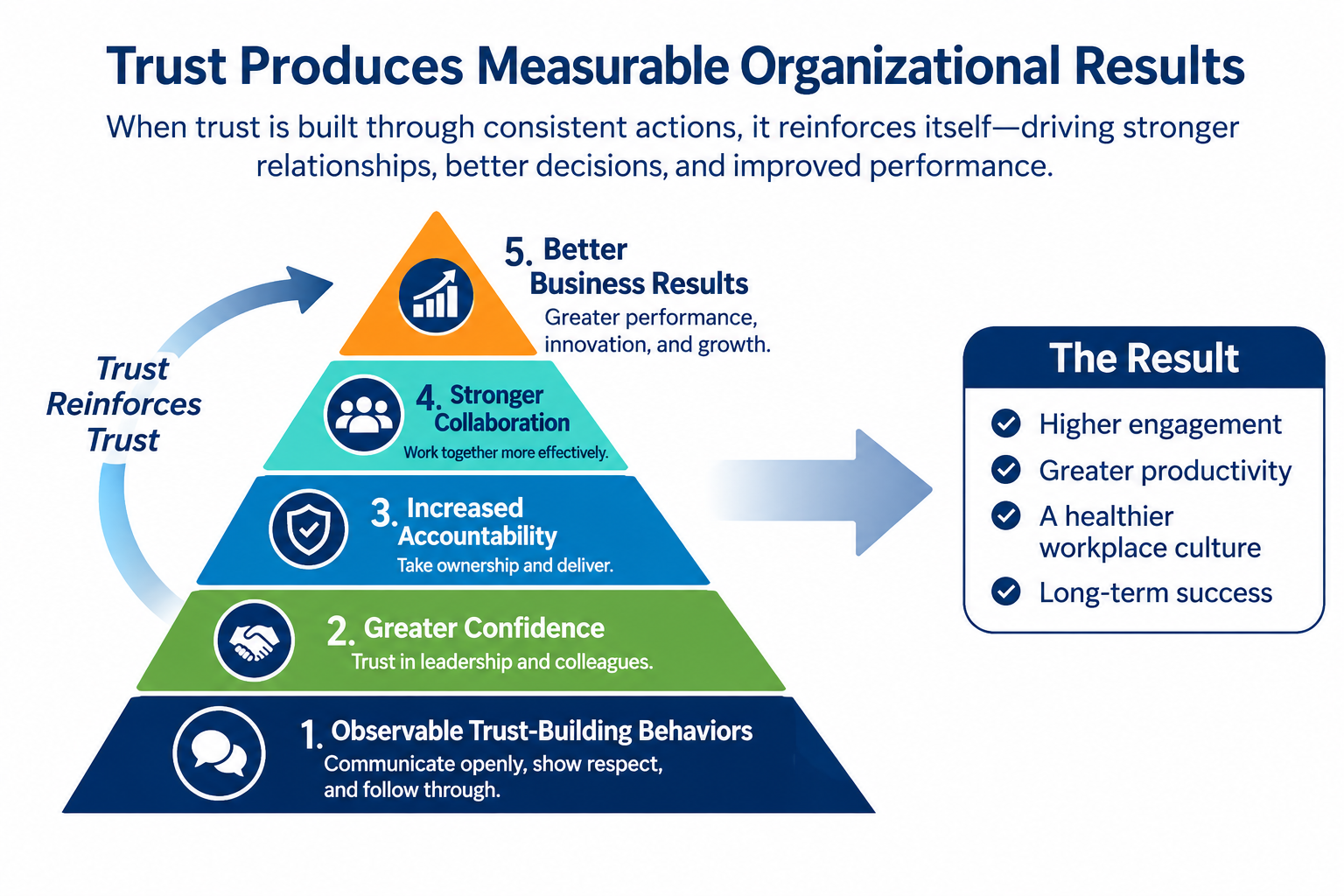
Trust is often described as an intangible organizational asset, yet its effects are anything but invisible. While trust itself does not appear on a balance sheet, the organizational outcomes associated with high-trust workplaces can be observed in everyday operations and reflected in business performance.
Organizations that intentionally reinforce behaviors that strengthen trust often experience measurable improvements in employee retention, collaboration, communication, accountability, knowledge sharing, innovation, customer relationships, and organizational adaptability. As these behaviors become part of the organization’s daily operating rhythm, they contribute to greater consistency, stronger execution, and more effective teamwork.
The opposite is equally important to recognize.
When trust is weak or inconsistent, organizations frequently incur significant hidden costs. Voluntary turnover increases recruiting, hiring, onboarding, and training expenses. Miscommunication and unresolved conflict slow projects and reduce productivity. Employees become less willing to share ideas, collaborate across departments, or raise concerns before problems escalate. Customer relationships suffer when internal friction affects service quality, responsiveness, and consistency.
These costs rarely appear under a single line item in a financial statement. Instead, they accumulate across the organization through delayed decisions, duplicated effort, quality problems, missed opportunities, disengagement, absenteeism, and preventable turnover.
A growing body of organizational research has strengthened the business case for trust by demonstrating its relationship to employee engagement, collaboration, psychological safety, organizational resilience, customer satisfaction, and financial performance. While no single metric fully captures the value of trust, together these measures show that trust is far more than a cultural aspiration. It is a strategic organizational capability with measurable operational and economic implications.
The objective of the TIGERS Leadership Architecture is not simply to help organizations create more trusting workplaces. It is to help leaders intentionally reinforce the observable behaviors that contribute to stronger relationships, more effective execution, healthier organizational systems, and sustainable organizational performance.
When organizations consistently reinforce the behaviors that build trust, they are not investing in something intangible. They are investing in the human behaviors that influence operational excellence, long-term resilience, and bottom-line results.
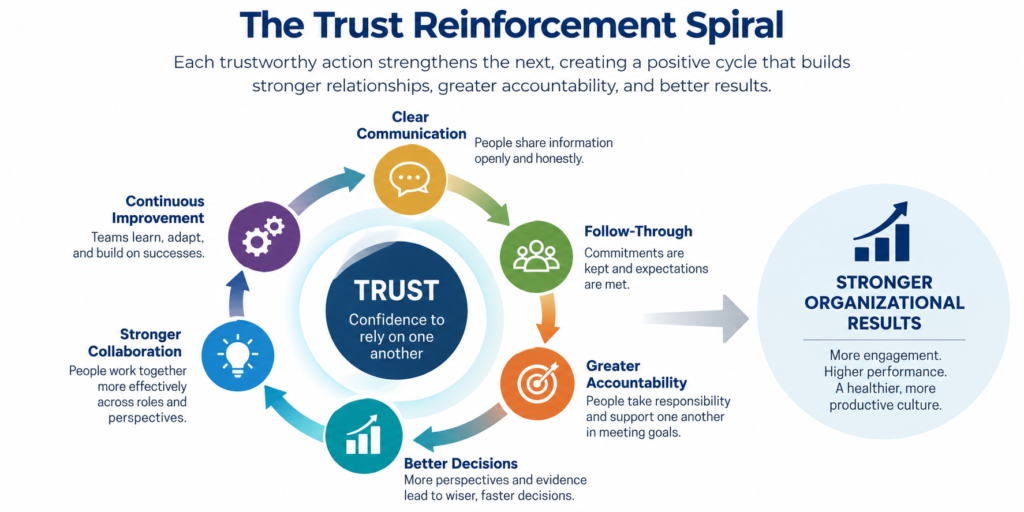
The relationship between trust and organizational performance becomes easier to understand when viewed as a reinforcing system rather than a single cause-and-effect relationship.
Trust Is Built One Behavior at a Time
Organizations do not become high-trust workplaces because leaders announce trust as a value or include it in a mission statement. Trust grows through the thousands of interactions people experience every day—keeping commitments, clarifying expectations, demonstrating accountability, communicating respectfully, resolving conflict constructively, and supporting one another in achieving shared goals.
These behaviors may appear ordinary when viewed individually, yet together they shape how people experience the organization. Over time, repeated behaviors establish expectations. Expectations influence relationships. Relationships shape culture. Culture ultimately affects organizational performance.
This is why trust should be viewed as an organizational capability rather than simply an interpersonal quality. Like any capability, it can be intentionally designed, reinforced, observed, measured, evaluated, and continuously improved.
The organizations that sustain high levels of trust understand that trust is never finished. New employees join the organization. Leaders retire or change roles. Teams are reorganized. Customer expectations evolve. Technology changes how work is performed. Markets shift. Every change creates new opportunities to strengthen—or unintentionally weaken—the behaviors that reinforce trust.
The responsibility of leadership is therefore not simply to encourage trust, but to create the conditions where trust can flourish. This requires more than good intentions. It requires a leadership architecture that intentionally aligns expectations, reinforces observable behaviors, develops leaders, and continuously improves how people work together.
Trust is the first principle of the TIGERS Leadership Architecture because it provides the foundation for employee belonging, effective leadership, and healthy organizational relationships. When trust is intentionally reinforced, organizations create an environment where collaboration becomes stronger, communication becomes more effective, accountability becomes clearer, and people are more willing to solve problems, learn together, and adapt to change.
Trust is never built all at once. It is built one conversation. One commitment. One decision. One act of accountability. One respectful interaction. One leader. One team. One behavior at a time.
Every behavior reinforces the organization people experience tomorrow.
The question is not whether your organization is reinforcing behaviors every day. It is.
The more important question is, are those behaviors intentionally building the kind of organization you want to become?
Related Articles and Resources
How AI Layoffs Affect Workplace Trust
How to Build Team Trust and Eliminate Inconsistent Leadership
What AI Layoffs Reveal About Trust, Morale, and Manager Alignment
Low-Trust Leadership Evolves When Wrong Behaviors Are Rewarded
Inconsistent Leadership Breaks Trust and Slows Execution
Behavior-Based Leadership System for Enhanced Trust, Accountability, and Retention
Workplace Trust Leadership for Rebuilding in the AI Era
Leadership Systems That Make Trust and Results Inevitable
Transform Your Team Culture into a Powerful High-Trust Catalyst
Why Trust Is the Foundation of Every Great Team
Building High-Trust Teams in the Age of AI with the Power of Collaboration
The Link Between Trust and Performance Is Competence
How the TIGERS 6 Principles and Mastering High-Trust Leadership Mitigate Toxic Workplace Behavior