
Behavior-Based Leadership Architecture
Behavior-based leadership architecture is the structure that helps leaders turn strategy, trust, accountability, feedback, collaboration, and follow-through into daily workplace behavior. It gives managers and teams a shared way to define how people work together, how agreements are kept, how risks are resolved, and how success is measured.
Most organizations already have leadership language. They have values, strategy, goals, training, assessments, and performance expectations. But many still struggle because those ideas do not always become consistent behavior across managers and teams.
That is the gap behavior-based leadership architecture is designed to close.
It helps leaders move beyond inspiration, personality insight, or one-time training and build a practical system for how people work together every day. This matters because employees do not experience leadership as a theory. They experience it through communication, decisions, feedback, accountability, conflict resolution, and follow-through.
When those behaviors are consistent, trust grows and execution improves. When they are inconsistent, strategy weakens, morale drops, and teams lose momentum. This is also why behavior-based leadership architecture helps close the Manager Alignment Gap.
What Is Behavior-Based Leadership Architecture?
Behavior-based leadership architecture is the practical structure that turns leadership expectations into observable behavior.
It answers a question many organizations overlook. Once leaders agree on the strategy, how will managers and teams behave consistently enough to make that strategy real?
Most organizations have values. Many have leadership training. Some use personality tools, engagement surveys, coaching models, or culture statements. These resources can be useful, but they often stop short of changing the daily behavior that determines whether people trust one another, follow through, resolve risk, and work across functions.
Behavior-based leadership architecture closes that gap by giving leaders and managers a shared operating system for how work gets done.
It helps define what trust looks like in practice. It clarifies how teams depend on one another. It strengthens honest communication, feedback, empathy, risk resolution, accountability, and shared success.
Instead of leaving every manager to interpret leadership expectations differently, behavior-based leadership architecture creates a common structure. That structure helps people move from good intentions to daily agreements, from values language to measurable conduct, and from isolated training events to consistent workplace behavior.
Why Leadership Training Alone Is Not Enough
Leadership training can build awareness, introduce useful models, and give managers new language. But training alone does not always change what happens after people return to work.
That is where many organizations lose momentum.
A manager may understand the importance of trust and still avoid a difficult feedback conversation. A leadership team may agree that accountability matters and still tolerate missed agreements. Employees may attend a workshop on collaboration and still return to unclear handoffs, competing priorities, and unresolved tension.
The problem is not that training has no value. The problem is that training often stops before the behavior system is built.
Behavior-based leadership architecture extends the value of training by giving leaders and teams a practical way to apply what they learn. It helps translate concepts into agreements, routines, coaching conversations, team norms, and follow-through.
Without that architecture, leadership development can become a series of disconnected events. People leave inspired, but the workplace system pulls them back into old patterns.
With behavior-based leadership architecture, the learning has somewhere to land. Managers know what behaviors to reinforce. Teams know what agreements to use. Leaders can see whether trust, accountability, feedback, collaboration, and risk resolution are improving in daily work.
How Behavior-Based Leadership Architecture Closes the Manager Alignment Gap
Behavior-based leadership architecture helps close the Manager Alignment Gap by giving managers a consistent way to translate strategy into daily behavior.
The Manager Alignment Gap happens when executive intent does not become clear, consistent, and trusted in the way managers lead their teams. Senior leaders may know the strategy, but if managers interpret expectations differently, employees experience confusion instead of alignment.
This is where behavior-based leadership architecture becomes practical.
It gives managers a shared framework for how to communicate priorities, reinforce agreements, give feedback, resolve risk, and support follow-through. Instead of leaving each manager to decide what trust, accountability, collaboration, or success means on their own, the organization creates a common language for the behaviors that matter most.
That common language reduces mixed messages. It helps managers lead with more consistency. It gives employees clearer expectations. It also gives senior leaders a better way to see where strategy is being supported, diluted, or blocked in daily work.
When behavior becomes visible, alignment becomes easier to strengthen.
The TIGERS 6 Principles as Leadership Architecture
The TIGERS 6 Principles form the foundation of behavior-based leadership architecture because they define the conditions teams need to perform well together.
The six principles are Trust, Interdependence, Genuineness, Empathy, Risk Resolution, and Success. These are not treated as slogans or values to admire from a wall. They become practical behaviors managers and teams can observe, discuss, strengthen, and measure.
Trust helps people tell the truth, keep agreements, and rely on one another.
Interdependence helps teams understand how their work connects, where handoffs matter, and why shared responsibility is essential.
Genuineness supports honest communication, direct feedback, and the willingness to address what is real instead of working around it.
Empathy helps leaders understand impact, listen well, and support people through change without dismissing their concerns.
Risk Resolution gives teams a way to surface problems early, work through disagreement, and prevent avoidable breakdowns.
Success clarifies what the team is working toward and what behaviors are required to achieve results together.
Together, these principles create a leadership architecture that moves culture from abstract intention to daily practice. They help managers define what good leadership behavior looks like, help teams name what is working or damaging performance, and help organizations build trust and accountability into the way work gets done.
For teams that need to strengthen trust as a daily leadership behavior, explore High-Trust Leadership Training.
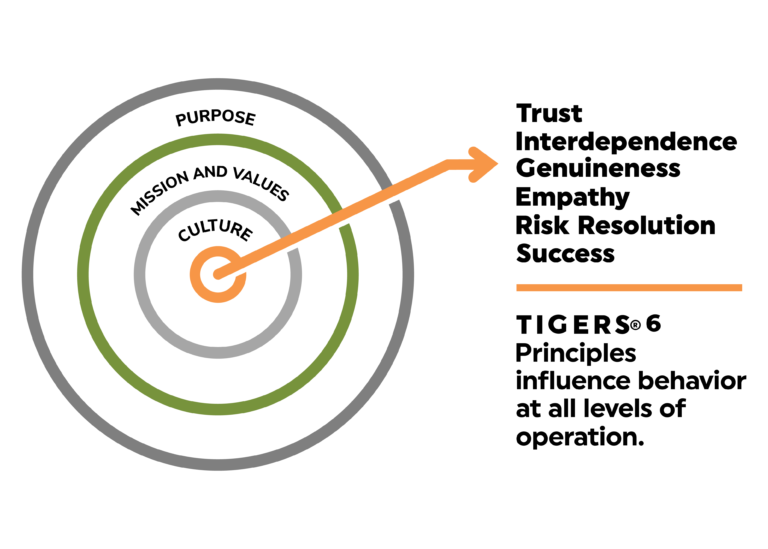
The TIGERS 6 Principles help translate purpose, mission, values, and culture into observable workplace behavior.
What Behavior-Based Architecture Makes Measurable
Behavior-based leadership architecture makes leadership behavior easier to see, discuss, and improve.
Instead of measuring culture only through broad opinions or delayed performance indicators, leaders can look at the behaviors that shape trust, accountability, feedback, collaboration, risk resolution, and follow-through in daily work.
This matters because many workplace problems are not caused by a lack of effort. They are caused by unclear agreements, inconsistent expectations, weak handoffs, avoided conflict, poor feedback habits, and uneven team accountability across managers and teams.
When behavior is made visible, leaders can ask better questions.
Where is trust strong, and where is it breaking down?
Where are teams depending on one another well, and where are handoffs failing?
Where is feedback honest and useful, and where is it avoided?
Where are risks being surfaced early, and where are people staying silent?
Where is success clearly defined, and where are people working from different assumptions?
Behavior-based architecture helps leaders move from guessing to diagnosing. It gives teams a way to identify what to strengthen, what to reduce, and what must stop because it damages trust, performance, or follow-through.
Why This Matters in the Age of AI and Organizational Change
AI is accelerating work, flattening layers, and increasing pressure on leaders to move faster with fewer resources. But speed without shared behavior creates more confusion, not better execution.
Organizations still need people who can build trust, clarify expectations, give useful feedback, resolve tension, make decisions, and follow through together. These are not soft extras. They are the behavior patterns that determine whether strategy becomes action.
That is why behavior-based leadership architecture matters now. Leadership development, AI tools, and organizational change efforts all become more effective when managers and teams share a practical structure for how work gets done.
The TIGERS 6 Principles give leaders, consultants, HR professionals, fractional executives, and internal change partners a way to make trust, accountability, feedback, collaboration, and follow-through visible enough to strengthen.
This is also why behavior-based leadership architecture connects naturally to organizational development licensing. Qualified professionals need a practical system they can use to help organizations move from insight to application and from change pressure to measurable behavior change.
How Leaders, Consultants, and HR Professionals Can Use It
Behavior-based leadership architecture gives leaders and experienced professionals a practical way to move from ideas to implementation.
Executives and senior leaders can use it to clarify the behaviors needed to support strategy, culture, trust, accountability, and execution. Managers can use it to strengthen team agreements, feedback practices, decision-making, and follow-through. HR and OD professionals can use it to align leadership development, onboarding, team performance, and workplace culture around shared behavior expectations.
Consultants, fractional executives, facilitators, coaches, and internal change partners can also use behavior-based leadership architecture to support client or internal teams without starting from scratch. The TIGERS 6 Principles give them a common language and implementation structure for helping people identify what is working, what is getting in the way, and what needs to change.
This matters because teams rarely improve from information alone. They improve when people have a shared way to discuss behavior, practice new agreements, reinforce progress, and connect daily work to measurable results.
For professionals who want to facilitate this work with teams, leadership facilitation certification provides a pathway for applying the TIGERS 6 Principles in structured team development.
Build Leadership Architecture That Changes Daily Behavior
Behavior-based leadership architecture is valuable because it changes what people do, not just what they understand.
When leaders and teams share a practical behavior framework, trust becomes easier to discuss. Accountability becomes easier to clarify. Feedback becomes easier to give and receive. Conflict becomes easier to surface before it damages relationships. Follow-through becomes easier to observe, reinforce, and improve.
That is why TIGERS focuses on daily workplace behavior. The TIGERS 6 Principles help organizations move beyond isolated training events and into a more consistent way of leading, communicating, deciding, collaborating, and executing.
For consultants, HR professionals, fractional executives, facilitators, and internal leaders, this creates a stronger foundation for behavior-based organizational development. It gives them a practical system for helping teams turn insight into agreements, agreements into practice, and practice into measurable behavior change.
Professionals who want to bring this work into client organizations or internal teams can explore the TIGERS organizational development licensing vision and the Founder Licensing path in the TIGERS Learning Center.
See how behavior-based leadership architecture helps close the Manager Alignment Gap.
Related TIGERS Resources
Behavior-based leadership architecture connects to several TIGERS 6 Principles resources that help leaders, managers, consultants, and HR professionals turn strategy, trust, accountability, feedback, and collaboration into daily workplace behavior.
High-Trust Leadership Training for Teams
Team Accountability Training for Collaborative Teams
Workplace Culture Training to Strengthen Trust
Leadership Facilitation Certification
These articles extend the behavior-based leadership architecture conversation into AI, trust, leadership systems, and measurable behavior change.
Leadership Architecture and How AI Exposes the Manager Alignment Gap
Leadership Architecture Is Indispensable in the Age of AI
Leadership Systems That Make Trust and Results Inevitable
Behavior-Based Leadership System for Enhanced Trust, Accountability, and Retention