
Questions CEOs Should Ask Leadership During Organizational Change Before Change Breaks Trust
Leadership during organizational change is where CEOs discover whether their leaders can carry strategy into daily behavior without breaking trust.
Change does not usually break an organization all at once.
It breaks in small, quiet places first.
A senior team agrees on the strategy. The slide deck is clear. The priorities are announced. Everyone nods. Then the work moves into the organization, where people are tired, uncertain, overloaded, skeptical, hopeful, guarded, and watching.
They watch what leaders say.
They watch what leaders do.
They watch what happens when someone raises a concern, misses a deadline, questions a decision, asks for help, or tells the truth too early.
That is where change either gains trust or starts losing it.
For CEOs, the question is no longer simply, “Do we have the right strategy?” The harder question is, “Do we have leaders who can carry this strategy into daily behavior without breaking trust?”
From a TIGERS 6 Principles perspective, this leadership during organizational change conversation needs to go one layer deeper.
Leadership readiness is not proven by confidence, charisma, credentials, or strategic language. It is proven by the behavior people can trust under pressure.
Because when change becomes real, employees are not asking abstract leadership questions. They are asking human ones.
Can I trust what this leader says?
Will they tell us the truth?
Do they understand what this change is costing us?
Will they listen if the plan is not working?
Will they protect accountability without humiliating people?
Will they resolve conflict fairly?
Will they define success clearly enough that we can actually deliver it?
These are not soft questions. They are execution questions.
The Strategy Gap Is Often a Leadership Behavior Gap
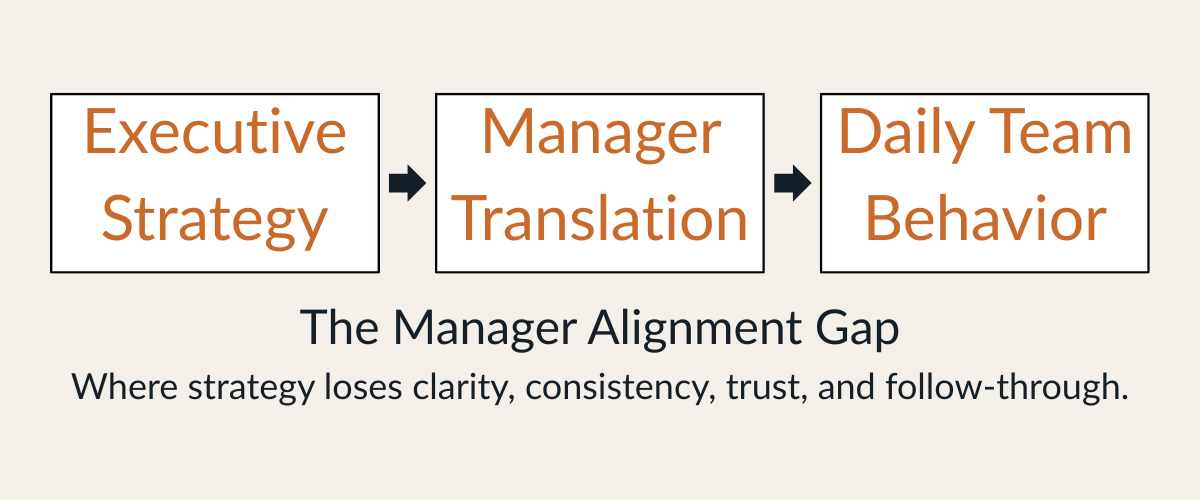
Many organizations talk about the strategy execution gap as if it is only a planning problem. Sometimes it is. But often, the gap opens because strategy is not translated into consistent leadership behavior..
The executive team may know what matters. The board may understand the urgency. The CEO may have made the case. But employees experience strategy through managers, meetings, priorities, pressure, feedback, and follow-through.
That means the manager layer matters enormously.
So CEOs should not only ask:
Are our leaders experienced?
Are they high performers?
Are they loyal?
Are they good communicators?
Are they aligned with the strategy?
Those questions matter, but they are incomplete.
The more important question is:
Can our leaders turn strategy into trust, clarity, accountability, feedback, and coordinated action people can actually practice?
That is where the trust, clarity, accountability, feedback, and coordinated action of a healthy workplace culture become visible.
Trust. Interdependence. Genuineness. Empathy. Risk Resolution. Success.
These are not values for a wall. They are behavioral conditions for execution.
Questions CEOs Should Ask Leadership During Organizational Change About Trust
Change fails quietly before it fails visibly.
People often know where the problems are forming. They know which priorities are competing. They know where customers are confused, where employees are overextended, where systems are not ready, and where the announcement sounds better than the operating reality.
But they may not say it.
Not because they do not care.
Because they have learned what is safe.
If truth-telling has been punished, ignored, minimized, or reframed as negativity, employees protect themselves. They nod in meetings and talk privately afterward. They comply on the surface while withholding the information leaders most need.
That is dangerous for a CEO.
A CEO cannot make good decisions from filtered information. A senior team cannot correct what no one is willing to name. A strategy cannot improve if the people closest to the friction are afraid to speak.
So one of the most important questions CEOs should ask during organizational change is this:
Do our leaders create enough trust for people to tell the truth before the damage is expensive?
A leader who builds trust does not require people to pretend. They make it safe to surface reality while there is still time to respond.
The emotional truth is this:
If people are afraid to tell leaders what is really happening, the CEO is not leading an organization. The CEO is leading a performance.
Questions CEOs Should Ask Leadership During Organizational Change About Interdependence
A strategy can be brilliant in the boardroom and still die in the handoffs.
That is the power of interdependence.
Organizations do not execute through isolated departments. They execute through relationships, timing, dependencies, promises, shared information, and coordinated decisions. When leaders only optimize their own function, they can damage the system they are trying to improve.
Sales makes a promise operations cannot support.
Executives announce a priority without removing older priorities.
Managers ask for speed while approval processes stay slow.
One department celebrates progress while another absorbs the cost.
This is how organizational change creates frustration. Not because people are unwilling, but because the system is misaligned.
The CEO question is:
Do our leaders understand how their decisions affect other people’s ability to succeed?
Interdependence asks leaders to see beyond their own goals. It asks them to understand the chain of work, the flow of trust, and the consequences of their decisions across the organization.
This is especially important during change because employees do not experience change as a concept. They experience it as more meetings, new expectations, shifting priorities, unclear ownership, and pressure to deliver results through systems that may not yet support them.
Leaders who understand interdependence do not simply ask, “Did my team hit the goal?”
They ask, “Did the way we pursued the goal strengthen or weaken the system around us?”
When leaders do not execute through isolated departments, they create stronger team accountability, cleaner handoffs, and better follow-through.
Questions CEOs Should Ask Leadership During Organizational Change About Genuineness
Genuineness is not casual transparency. It is credible leadership.
During change, employees listen differently. They are not just hearing the message. They are measuring the gap between words and behavior.
When leaders overstate certainty, people notice.
When leaders avoid hard questions, people notice.
When leaders say, “We value people,” but make decisions that treat people as disposable, people notice.
When leaders promise collaboration but reward political behavior, people notice.
Genuineness matters because trust erodes when employees feel managed rather than respected.
The CEO question is:
Do our leaders say what is true, or only what sounds confident?
People do not need leaders to pretend that every change will be easy. They need leaders who are grounded enough to tell the truth, steady enough to listen, and disciplined enough to align their behavior with their message.
There is a difference between confidence and credibility.
Confidence says, “I have this under control.”
Credibility says, “Here is what we know, here is what we do not know yet, here is what we are asking of you, and here is how we will work through this together.”
During organizational change, credibility wins.
Questions CEOs Should Ask About Empathy During Organizational Change
Empathy is often misunderstood in business.
Some leaders hear the word empathy and think it means lowering standards, avoiding hard decisions, or letting feelings override performance. That is not empathy. That is confusion.
Empathy means leaders are willing to understand the human reality of the change they are leading.
What are people being asked to let go of?
What uncertainty are they carrying?
What pressure are managers absorbing?
What fears are employees not saying out loud?
What skills are missing?
What relationships are strained?
What does this change require emotionally, not just operationally?
The CEO question is:
Do our leaders understand the human cost of the change they are asking people to carry?
This question is not sentimental. It is strategic.
People do not resist change only because they dislike change. They often resist being asked to absorb uncertainty without trust, voice, support, or clear agreements.
Empathy gives leaders better information. It helps them notice where people are confused, where morale is dropping, where fear is distorting behavior, and where the organization needs more support to keep moving.
For CEOs, especially those leading organizations through growth, restructuring, AI adoption, or culture change, empathy is not a soft extra. It is a leadership intelligence system.
It helps leaders see what pressure is doing to people before that pressure becomes disengagement, turnover, conflict, or quiet resistance.
The strongest leaders do not choose between empathy and accountability.
They use empathy to make accountability more humane, more precise, and more sustainable.
Questions CEOs Should Ask Leadership During Organizational Change About Risk Resolution
One of the most dangerous moments in change is when a room gets quiet.
Quiet can look like agreement.
It can also mean people have stopped believing it is worth speaking.
Risk Resolution is the TIGERS principle that asks leaders to surface and resolve the issues that threaten trust, progress, safety, and success. It includes conflict, confusion, competing priorities, unspoken concerns, and behavior that damages the team.
The CEO question is:
Do our leaders resolve risk and conflict early, or do they allow problems to move underground?
Many leaders avoid conflict because they want to preserve harmony. But unresolved conflict does not disappear. It changes form.
It becomes side conversations.
It becomes delays.
It becomes blame.
It becomes passive compliance.
It becomes turnover.
It becomes cynicism.
During change, employees need leaders who can address tension without making people feel punished for raising it. They need leaders who can distinguish between destructive resistance and useful warning signals.
A leader who can resolve risk well says, “Let’s name what is getting in the way before it damages the work or the relationship.”
That kind of leadership protects speed because it prevents the organization from dragging hidden conflict behind every decision.
The absence of conflict is not proof of alignment.
Sometimes it is proof that people no longer trust the process.
Questions CEOs Should Ask Leadership During Organizational Change About Success
Success is not just the outcome.
Success is also the behavior that makes the outcome possible.
This is where many change efforts weaken. Leaders define the destination but not the daily practices required to get there. They use words like alignment, agility, accountability, collaboration, ownership, and excellence without defining what those words require in behavior.
Then employees are left to interpret.
One team thinks accountability means faster reporting.
Another thinks it means stricter consequences.
Another thinks it means clearer ownership.
Another thinks it means less micromanagement.
Everyone uses the same word, but they are not practicing the same behavior.
The CEO question is:
Have our leaders made success behaviorally clear?
Can people see what success looks like in meetings, decisions, handoffs, feedback, customer commitments, conflict resolution, and follow-through?
If not, the strategy will fragment.
People cannot execute what leaders have not made behaviorally clear.
This is one of the most important differences between traditional leadership language and TIGERS 6 Principles Leadership Architecture. TIGERS does not stop at ideals. It asks leaders and teams to translate trust, interdependence, genuineness, empathy, risk resolution, and success into observable behavior.
That matters because vague expectations create inconsistent execution.
Clear behavior creates repeatable performance.
What CEOs Need to Know Before Change Breaks Trust
The next competitive advantage may not belong to the organization with the boldest strategy.
It may belong to the organization whose leaders can execute change without destroying trust.
That is why CEOs cannot stop at executive alignment, strategic clarity, or leadership confidence during organizational change.
CEOs need to know whether leaders can carry strategy in a way people can trust.
Can they tell the truth?
Can they listen before the organization goes silent?
Can they coordinate across functions?
Can they protect dignity while strengthening accountability?
Can they resolve risk before it becomes resistance?
Can they turn success into behavior people can practice every day?
These questions matter because employees do not experience leadership development as a program. They experience it as the person leading the meeting, making the decision, giving the feedback, handling the conflict, explaining the change, and following through when pressure rises.
That is where leadership becomes real.
And that is where change either becomes something people can build together, or something they must protect themselves from.
Final Thought About Leadership During Organizational Change
For CEOs leading through change, the leadership question is not only whether people are capable. It is whether they are behaviorally trustworthy under pressure.
The TIGERS 6 Principles help leaders turn trust, interdependence, genuineness, empathy, risk resolution, and success into daily team behavior. For organizations navigating change, the goal is not just to announce a better future. It is to build the leadership capacity required for people to trust the path forward.
Because before change breaks trust, CEOs need to know whether their leaders can carry it.