
The TIGERS 6 Principles Framework

The TIGERS 6 Principles framework helps teams turn trust, interdependence, genuineness, empathy, risk resolution, and success into daily workplace behavior. It gives leaders, managers, HR professionals, consultants, and facilitators a shared way to strengthen how people communicate, collaborate, resolve problems, keep agreements, and achieve results together.

The framework is grounded in interdisciplinary research on group process and group dynamics across business, education, and psychology.

That is what makes the framework practical. It helps teams identify what builds trust, what damages performance, and what agreements are needed so people can move from good intentions to consistent behavior.

What Are the TIGERS 6 Principles?

The TIGERS 6 Principles are Trust, Interdependence, Genuineness, Empathy, Risk Resolution, and Success.

Together, these six principles describe the conditions working people need to build ethical, quality-focused, productive, engaged, and successful collaboration. They are not abstract values or personality labels. They are behavior principles that help teams define how they communicate, cooperate, solve problems, keep agreements, and achieve results together.

Trust gives people confidence that commitments will be kept, communication will be honest, and people can rely on one another.

Interdependence helps people understand that their work affects others and that strong performance depends on shared responsibility, clear handoffs, and cooperation.

Genuineness supports honest communication, direct feedback, and the willingness to address what is real rather than working around tension or pretending problems do not exist.

Empathy helps people understand impact, listen with respect, and respond to others as stakeholders in shared success.

Risk Resolution gives teams a way to surface concerns, address conflict, solve problems early, and prevent avoidable breakdowns.

Success clarifies the shared outcomes, standards, and agreements that help people work together toward meaningful results.

When these six principles are practiced together, they create a behavior-based framework for improving how people work, communicate, decide, solve, and follow through.

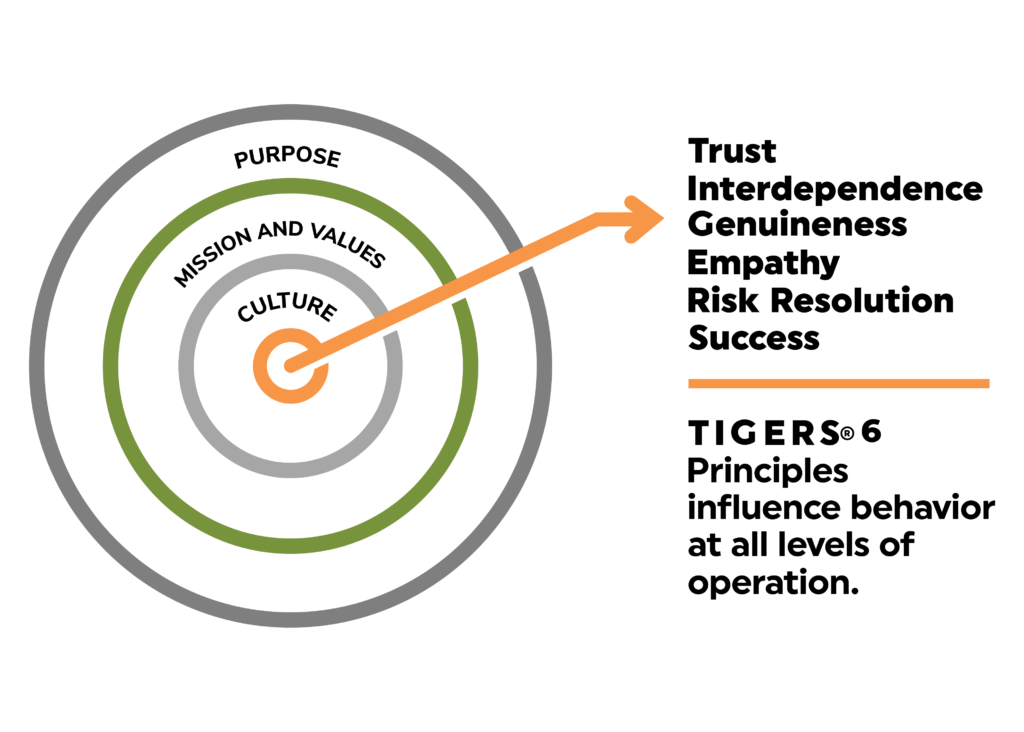
TIGERS 6 Principles framework showing trust interdependence genuineness empathy risk resolution and success influencing workplace behavior

The TIGERS 6 Principles sit beneath culture formation. When they are practiced, they help make purpose, mission, and values real through daily behavior. When they are ignored or omitted, culture still forms — but it often forms around inconsistent communication, weak accountability, conflict avoidance, disengagement, or uneven trust.

This is why values on a wall are not enough. Vision and mission statements only become credible when people experience the behaviors that support them. Trust, interdependence, genuineness, empathy, risk resolution, and success are the behavioral conditions that help turn stated purpose into lived culture.

The framework helps teams ask a practical question: are our daily behaviors making our purpose real, or are they quietly working against it?

Where the TIGERS 6 Principles Came From

The TIGERS 6 Principles did not begin as a values exercise, personality model, or traditional team-building program. They began with one practical research question:

What is required to build an ethical, quality-focused, productive, engaged, and highly successful group of working people?

That question matters because group process alone does not guarantee a healthy workplace. Groups can have process and still fail. Teams can meet often and still avoid the truth, protect silos, reward poor behavior, or treat employees as costs rather than stakeholders.

To answer that question, Dianne Crampton studied group process and group dynamics research across three disciplines: business, education, and psychology. This interdisciplinary foundation is important because many workplace models come primarily from one lens. Some focus on business performance. Some focus on education. Others focus on psychology or individual development.

TIGERS 6 Principles draws from all three disciplines because successful workplace groups require more than one perspective. They require ethical behavior, quality standards, productive cooperation, psychological safety, engagement, shared success, and a practical understanding of how adults learn, practice, and transfer new behaviors into daily work.

The result is a behavior-focused framework. TIGERS 6 Principles helps leaders and teams define the conditions required to build trust, strengthen interdependence, communicate genuinely, practice empathy, resolve risk, and achieve success together.

This is what makes the framework practical. It does not stop at understanding people. It helps working groups define the behaviors required to work together ethically, productively, and successfully.

Why These Six Principles Matter Together

The TIGERS 6 Principles matter because they operate in every group of two or more people who come together to achieve something. They influence group behavior whether they are intentionally included or not.

When the principles are weak or missing, groups tend to experience predictable problems. Trust breaks down. Cooperation becomes uneven. Communication becomes guarded. People avoid difficult truths. Risk is handled too late. Success becomes fragmented because people are working from different assumptions. People also disengage when they are not included, respected, or given a meaningful way to contribute to shared success.

When the principles are intentionally understood, practiced, and reinforced, the group has a stronger foundation for ethical behavior, quality-focused work, productive cooperation, psychological safety, engagement, and shared success.

Trust gives people the confidence to communicate honestly and rely on one another. Interdependence helps people understand that their work affects others and that shared success requires cooperation. Genuineness makes conversations more truthful. Empathy strengthens respect, learning, and psychological safety. Risk Resolution gives teams a way to surface problems before they become larger breakdowns. Success clarifies the shared outcomes people are working toward.

The six principles are not separate values to admire. They are connected behavior conditions. When they are practiced together, teams are better able to strengthen trust, improve communication, resolve risk, support learning, and turn improved attitudes into improved workplace behavior.

This is why teams that intentionally build these principles into daily work can outpace competitors. They are not relying on talent alone. They are building the conditions that help people work together with more clarity, quality, accountability, inclusion, and shared commitment.

Research, Validation, and Independent Evaluation

The TIGERS 6 Principles framework was developed from interdisciplinary research and then tested in practice.

After the initial research identified the six principles required for ethical, quality-focused, productive, engaged, and successful working groups, the framework went through a four-year validation process. The purpose was to answer an important question: 

Could each of the six principles be independently measured in group performance, or were they simply good ideas people liked?

That distinction mattered.

Leadership development is often dismissed as “soft skill” training. But trust, interdependence, genuineness, empathy, risk resolution, and success are not soft when they affect communication, quality, accountability, conflict, engagement, and follow-through. The goal was to determine whether team interventions could be measured by how they improved the way people actually worked together.

Being able to measure each principle independently made the framework more useful. It helped leaders and facilitators see which behaviors were supporting performance and which behaviors were damaging it. It also made it possible to target training and development where the team needed it most, rather than treating every team problem as a generic communication or morale issue.

Two independent evaluations later confirmed the importance of the TIGERS 6 Principles in group performance and team development. This matters because many leadership and team models are introduced as useful ideas, but they are not always tested against workplace behavior, group process, and measurable team outcomes.

The TIGERS 6 Principles framework is different because it connects research, behavior, learning transfer, and implementation. It helps teams move from understanding concepts to practicing the behaviors that improve trust, interdependence, genuineness, empathy, risk resolution, and success.

This is why the framework remains practical across industries and settings. The principles apply wherever two or more people come together to accomplish something together.

How the Framework Becomes Observable Behavior

The TIGERS 6 Principles framework becomes practical when the principles are translated into behaviors people can see, discuss, practice, and improve.

This is important because no two teams are exactly the same. A team of emergency responders, a team of hair stylists, a team of insurance professionals, and a team of software coders may all need trust, interdependence, genuineness, empathy, risk resolution, and success — but the way those conditions show up in daily work will look different.

That is why TIGERS is not a cookie-cutter team development process. The framework gives teams a researched structure, but the team itself must identify the conditions, practices, and behaviors that support higher performance, fewer conflicts, stronger understanding, and better follow-through in their own working environment.

This matters because most teams do not fail because people dislike trust, collaboration, feedback, empathy, or success. They struggle because those ideas are not clearly defined in daily work. One person’s idea of trust may be independence. Another person’s idea of trust may be frequent updates. One manager may define accountability as consequences, while another defines it as clear agreements and follow-through.

The framework gives teams a shared way to make those expectations visible.

Trust becomes observable when people keep agreements, communicate honestly, and follow through.

Interdependence becomes observable when people understand how their work affects others and coordinate handoffs clearly.

Genuineness becomes observable when people speak truthfully, give useful feedback, and address what is real.

Empathy becomes observable when people listen to understand impact and treat one another as stakeholders in shared success.

Risk Resolution becomes observable when people surface concerns early, work through disagreement, and solve problems before they damage performance.

Success becomes observable when the team defines outcomes, standards, and shared commitments clearly enough for people to act on them.

In post-merger work, this becomes especially important. One team should not simply dissolve into another. The stronger opportunity is to identify the conditions and behaviors that elevate both groups so the combined team can build a better way of working together.

This is how the framework moves from concept to practice. It helps teams name the behaviors that build performance, identify the behaviors that damage trust, and create agreements that guide how people work together every day.

How TIGERS Differs From Values Statements and Personality Tools

The TIGERS 6 Principles framework is different from values statements, personality tools, and one-time team-building programs because it focuses on the behaviors that shape how people actually work together.

Values statements often describe what an organization hopes to stand for. Personality tools can help people understand preferences, communication styles, or individual differences. Those resources can be useful, but they do not always show a team how to change the daily behaviors that build or damage trust, accountability, collaboration, and follow-through.

TIGERS 6 Principles works at the group behavior level.

It helps teams define the conditions required for ethical, quality-focused, productive, engaged, and successful work. It also helps leaders and facilitators identify where behavior is strengthening the group and where behavior is creating friction, disengagement, conflict, or performance drag.

This matters because teams do not improve by admiring good words. They improve when people can name what is happening, agree on better behaviors, practice those behaviors, and hold one another accountable for how they work together.

The framework gives teams a practical way to move from broad intention to daily practice. It helps people define trust in their own work environment, clarify interdependence, communicate with genuineness, practice empathy, resolve risk, and align around shared success.

That is why TIGERS is not a cookie-cutter model. It gives teams a researched structure, while allowing each group to define the behaviors and agreements that fit their work, responsibilities, risks, and desired outcomes.

Where the Framework Has Been Applied

The TIGERS 6 Principles framework has been applied in workplace culture development, leadership training, team alignment, onboarding, feedback, conflict resolution, and organizational development work.

Because the framework applies to any group of two or more people who come together to accomplish something, it can be used across many different types of teams. The behaviors that build trust in a team of emergency responders may look different from the behaviors that build trust in a team of stylists, insurance professionals, software coders, educators, executives, or post-merger employees. But the underlying conditions still matter.

Each group must define what trust, interdependence, genuineness, empathy, risk resolution, and success look like in its own work environment.

This is one reason TIGERS is useful in complex team situations. In post-merger work, for example, the goal is not for one team to disappear into another. The stronger opportunity is to help both groups name the conditions and behaviors that elevate how they work together. That means identifying what should be preserved, what should change, and what new agreements are needed for shared success.

The framework has also supported teams that needed to improve communication, strengthen accountability, reduce conflict, build psychological safety, improve follow-through, and turn leadership development into measurable workplace behavior.

This is where the TIGERS 6 Principles become practical. They give leaders and teams a way to move beyond generic team-building and into the real behavior patterns that shape performance, trust, quality, engagement, and culture.

Why the Framework Is Being Shared With Other Experts

The need for behavior-based team development is larger than one founder, one consultant, or one organization can carry alone.

That is why TIGERS 6 Principles is being released as an organizational development system for trained leaders, consultants, HR professionals, facilitators, educators, and internal change partners who want a practical way to help teams improve how they work together.

The framework gives these professionals more than content to deliver. It gives them a structured way to help teams identify the conditions and behaviors that strengthen trust, reduce conflict, improve communication, support learning, and increase shared success.

This matters because no two teams are the same. A team of emergency responders, stylists, insurance professionals, coders, executives, educators, or post-merger employees will each define trust, risk, accountability, and success through the realities of their own work.

The TIGERS 6 Principles framework gives trained experts a way to guide that discovery without forcing teams into a cookie-cutter model. The goal is not to impose one team’s culture on another. The goal is to help each group name the behaviors that elevate performance, protect dignity, improve quality, and help people contribute fully.

That is what makes the possibility larger. When more skilled professionals can use the TIGERS 6 Principles responsibly, more workplaces can move beyond generic training and begin building the conditions people need to work ethically, productively, and successfully together.

How the Framework Supports Leadership Architecture

The TIGERS 6 Principles framework supports leadership architecture by giving leaders and teams a behavior-based foundation for how work gets done.

Leadership architecture becomes practical when people can see the behaviors that support trust, accountability, feedback, collaboration, risk resolution, and follow-through. Without that structure, leadership expectations often remain too broad. Managers may agree with the vision, but still interpret trust, accountability, communication, and success differently from one another.

The TIGERS 6 Principles help close that gap.

They give leaders a shared language for defining the behaviors teams need in order to work ethically, productively, and successfully together. They also help managers move beyond general encouragement and into clearer agreements, better feedback, safer problem-solving, and more consistent follow-through.

This is why the framework connects directly to behavior-based leadership architecture. The framework names the conditions working groups need. Leadership architecture turns those conditions into practices, routines, development tools, and measurable team agreements.

When the framework and architecture work together, organizations gain a more practical way to align purpose, culture, leadership behavior, and daily execution.

Related TIGERS Resources

The TIGERS 6 Principles Framework connects to several TIGERS resources that show how the six principles become practical in leadership, culture, team accountability, and organizational development.

Behavior-Based Leadership Architecture
Use this when you want to understand how the TIGERS 6 Principles become a leadership system for turning trust, accountability, feedback, collaboration, and follow-through into daily workplace behavior.

The Manager Alignment Gap
Use this when executive strategy is not becoming consistent manager behavior, team clarity, trust, accountability, or execution.

High-Trust Leadership Training for Teams
Use this when leaders and teams need a practical way to strengthen trust, feedback, accountability, and follow-through.

Team Accountability Training for Collaborative Teams
Use this when teams need clearer agreements, stronger ownership, and more consistent follow-through.

Workplace Culture Training to Strengthen Trust
Use this when culture gaps are showing up as low trust, inconsistent behavior, conflict avoidance, disengagement, or poor collaboration.

Leadership Facilitation Certification
Use this when consultants, HR leaders, facilitators, and internal change partners want a structured way to guide behavior-based team development.

Build Stronger Teams With the TIGERS 6 Principles Framework

The TIGERS 6 Principles Framework gives leaders and teams a practical way to move from good intentions to daily behavior people can see, practice, and improve.

When trust, interdependence, genuineness, empathy, risk resolution, and success are intentionally included in how people work together, teams gain more than better communication. They gain clearer agreements, stronger follow-through, fewer avoidable conflicts, more useful feedback, and a shared path for achieving results together.

This is why the framework matters now. Organizations do not need more values on a wall or another disconnected training event. They need a behavior-based way to help people work ethically, productively, and successfully together.

TIGERS 6 Principles helps leaders, managers, HR professionals, consultants, facilitators, and internal change partners guide that work with more clarity and consistency. It helps teams name what builds trust, identify what damages performance, and create agreements that make collaboration more reliable.

When the framework is practiced well, people are not left guessing what good teamwork means. They can define it, practice it, measure it, and improve it together.